Representative Melton D. Hancock
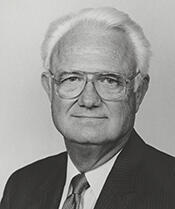
Here you will find contact information for Representative Melton D. Hancock, including email address, phone number, and mailing address.
| Name | Melton D. Hancock |
| Position | Representative |
| State | Missouri |
| District | 7 |
| Party | Republican |
| Status | Former Representative |
| Term Start | January 3, 1989 |
| Term End | January 3, 1997 |
| Terms Served | 4 |
| Born | September 14, 1929 |
| Gender | Male |
| Bioguide ID | H000151 |
About Representative Melton D. Hancock
Melton D. “Mel” Hancock (September 14, 1929 – November 6, 2011) was a Republican member of the United States House of Representatives from Missouri’s 7th congressional district, serving four terms in Congress from January 3, 1989, to January 3, 1997. Over the course of his public life, he became particularly known for his advocacy of constitutional limits on taxation and government spending, both in Missouri and at the national level.
Hancock was born in Cape Fair, Stone County, Missouri, on September 14, 1929. His family moved frequently during his childhood, and his early education reflected this mobility. He began school in Carthage, Missouri, in 1936, then attended school in Springfield, Missouri, from 1936 to 1941. During World War II, between 1941 and 1945, he continued his schooling in several locations—Amarillo, Texas; Topeka, Kansas; and Sioux City, Iowa—before returning to Springfield. From 1945 to 1947 he attended high school in Springfield, graduating in 1947. He went on to attend Southwest Missouri State University (now Missouri State University) in Springfield, where he earned a Bachelor of Science degree in 1951.
In August 1951, Hancock enlisted in the United States Air Force. During basic training he was awarded the American Spirit Honor Medal, recognizing leadership, character, and dedication. He attended the United States Air Force Officer Candidate School and was commissioned a second lieutenant in March 1953. Relieved from active duty later in 1953, he continued his military association in the United States Air Force Inactive Reserve until 1965, at which time he was discharged with the rank of first lieutenant. His military service coincided with the early years of his marriage; on November 17, 1951, he married Alma “Sug” McDaniel, with whom he would later have three children—two sons, born in 1955 and 1958, and a daughter, born in 1969.
Hancock’s business career began while he was still a student. From 1947 to 1951 he worked full- and part-time for the International Harvester Company during his college years. After leaving active military service, he returned to International Harvester from 1953 to 1959. In 1959 he resigned from the company and returned to Springfield, Missouri, where he entered the insurance business. He worked in insurance from 1959 to 1969, gaining experience in finance and risk management. In 1969 he co-founded Federal Protection, Inc., a bank security equipment leasing company, which reflected his entrepreneurial interests and provided security products and services to financial institutions.
Hancock emerged as a prominent figure in Missouri politics through his advocacy of tax limitation measures. In 1977 he founded The Taxpayer Survival Association, a not-for-profit organization dedicated to educating the public on the principle of constitutional tax limitation. He was the originator, catalyst, primary organizer, and principal author of an omnibus state and local tax limitation amendment to the Missouri Constitution that was approved by Missouri voters in 1980. Placed on the ballot through an initiative petition process led by Hancock, this measure—commonly known as “The Hancock Amendment”—added sections 16 to 24 of Article 10 of the Missouri Constitution. Subject to definitions, exceptions, and enforcement provisions set forth in the amendment, it limited total state revenues and expenditures to a fixed percentage of the personal income of Missouri residents, required the state to continue funding expenditures of local political subdivisions mandated by state law, and required that new local taxes, licenses, or fees be approved by the voters of the affected political subdivisions. One of the first state tax limitation amendments in the United States, the Hancock Amendment remains in effect and has continued to influence Missouri fiscal policy; in the mid-1990s, after a Missouri Supreme Court ruling that the state had exceeded the amendment’s limits, the state refunded nearly a billion dollars to taxpayers. The amendment has since served as a continuing constraint on significant tax increases considered by the Missouri General Assembly, whose members are aware that major revenue increases must secure voter approval.
Building on his state-level work, Hancock sought to advance constitutional tax and spending limitations at the national level. He was a candidate for the Republican nomination for the United States Senate in 1982, challenging incumbent Republican Senator John Danforth, and later ran for the Republican nomination for Lieutenant Governor of Missouri in 1984, a race ultimately won in the general election by Democrat Harriett Woods. Although unsuccessful in these early bids for elective office, these campaigns increased his visibility as a fiscal conservative and tax reform advocate within Missouri and the Republican Party.
In 1988, Hancock was elected as a Republican to represent Missouri’s 7th congressional district in the U.S. House of Representatives. He served in the 101st, 102nd, 103rd, and 104th Congresses, from January 3, 1989, to January 3, 1997. His tenure in Congress coincided with a period of significant national and international change, including the end of the Cold War, the Gulf War, and major domestic debates over taxation, spending, and the size of the federal government. As a member of the House of Representatives, Hancock participated in the legislative process and represented the interests of his southwest Missouri constituents, bringing to his work the same emphasis on limited government and taxpayer protections that had characterized his earlier political activism. He chose not to be a candidate for re-election to the 105th Congress in 1996, concluding his congressional service after four terms.
Following his retirement from Congress, Hancock remained a respected figure in Missouri public life, particularly among advocates of limited government and tax restraint. He continued to reside in Springfield, Missouri, with his wife, Alma “Sug” McDaniel Hancock, until his death on November 6, 2011. His legacy in Missouri politics was further recognized posthumously when, in December 2014, it was announced that he would be inducted into the Hall of Famous Missourians. His bronze bust, created by Kansas City sculptor E. Spencer Schubert, became one of forty-four on permanent display in the Missouri State Capitol in Jefferson City, commemorating his role in shaping Missouri’s constitutional and fiscal landscape.