Representative Mervyn Malcolm Dymally
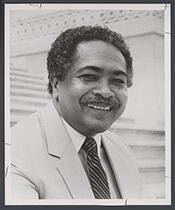
Here you will find contact information for Representative Mervyn Malcolm Dymally, including email address, phone number, and mailing address.
| Name | Mervyn Malcolm Dymally |
| Position | Representative |
| State | California |
| District | 31 |
| Party | Democratic |
| Status | Former Representative |
| Term Start | January 5, 1981 |
| Term End | January 3, 1993 |
| Terms Served | 6 |
| Born | May 12, 1926 |
| Gender | Male |
| Bioguide ID | D000592 |
About Representative Mervyn Malcolm Dymally
Mervyn Malcolm Dymally (May 12, 1926 – October 7, 2012) was an American politician from California who served as a Representative from California in the United States Congress from 1981 to 1993. A member of the Democratic Party, he served six terms in the U.S. House of Representatives and contributed to the legislative process during a significant period in American history. Over the course of a long public career, he also served in the California State Assembly, the California State Senate, and as the 41st lieutenant governor of California, becoming a pioneering figure in both state and national politics and one of the first persons of Dougla (mixed African and Indian) origin to serve in Congress.
Dymally was born in Cedros, Trinidad and Tobago, and was of Dougla descent, reflecting a heritage of mixed African and Indian ancestry. He received his early education in Trinidad, first attending Naparima College and then transferring to Saint Benedict’s College, both in San Fernando. He immigrated to the United States as a young man and initially studied journalism at Lincoln University in Jefferson City, Missouri. After a semester there, he moved to the greater Los Angeles area, where he continued his education and began to lay the foundations for his future in public service.
In California, Dymally attended Chapman University and went on to complete a Bachelor of Arts degree in education at California State University, Los Angeles, in 1954. He became a member of the Kappa Alpha Psi fraternity in 1949, reflecting his early engagement in civic and social organizations. Dymally became a naturalized citizen of the United States in 1957. While already serving in elected office, he continued his education, earning a master’s degree in government from California State University, Sacramento, in 1969. He later completed a doctorate in human behavior from United States International University in San Diego (later merged into Alliant International University), underscoring his commitment to academic as well as political pursuits.
Dymally entered elective office in the early 1960s. He was first elected to the California State Assembly, the lower house of the state legislature, in 1962 from the 53rd District and was re-elected in 1964, serving there from 1963 to 1966. In 1966 he won election to the California State Senate, the legislature’s upper house, initially for a two-year term because of court-ordered reapportionment. Following the U.S. Supreme Court’s requirement that state legislatures reapportion their upper houses on the basis of population, California restructured its Senate districts, and in 1966 even-numbered districts elected senators to full four-year terms. Representing the 29th District, Dymally was required to run again in 1968; he was re-elected that year and again in 1972, serving in the State Senate from 1967 to 1975. He was the first Trinidadian to serve California as a state senator and emerged as an influential figure in state politics.
In 1974, Dymally was elected lieutenant governor of California, defeating Republican incumbent John L. Harmer, who had been appointed to the office only a month earlier and had previously served with Dymally in the State Senate. Dymally won the race by a margin of 49.2 percent to 46.3 percent and served as the 41st lieutenant governor from 1975 to 1979. He was the second African American to hold statewide office in California, following Wilson Riles, who became California Superintendent of Public Instruction in 1971, and he and George L. Brown of Colorado became the first two African Americans elected to the office of lieutenant governor in any state since Oscar Dunn held that position in Louisiana during Reconstruction. In 1978, Dymally sought re-election in a tightly contested race, but his campaign was damaged in its final days when Michael Franchetti, an aide to State Senator George Deukmejian, circulated a false rumor that Dymally was about to be indicted. Although the allegation could not be substantiated, it was reported as fact on Los Angeles radio station KNX (AM) and its CBS affiliates, and Dymally lost to Republican Mike Curb. Then–Attorney General Evelle J. Younger later filed a letter of reprimand in Franchetti’s personnel records, citing a breach of responsibility. During this period, Dymally was also known to have been an old friend of Peoples Temple founder Jim Jones; when Jones moved his congregation to Jonestown, Guyana, Dymally wrote to Guyanese Prime Minister Forbes Burnham to reassure him that Jones was an upstanding citizen, years before the mass suicide at Jonestown on November 18, 1978.
After leaving statewide office, Dymally turned to national politics. In 1980, two years after losing the lieutenant governorship, he ran for Congress from California’s 31st District. In the Democratic primary he faced former U.S. Representative Mark W. Hannaford and 18-year incumbent Charles H. Wilson, who had been reprimanded by the House of Representatives for financial misconduct in the Koreagate scandal. Dymally won the primary decisively with 49 percent of the vote, compared with 24 percent for Hannaford and 15 percent for Wilson, and went on to defeat Republican Don Grimshaw in the general election by a margin of 64 percent to 36 percent. He took his seat in the U.S. House of Representatives in January 1981 and served six consecutive terms, remaining in office until January 1993. As a member of the House of Representatives during a significant period in American history, Dymally participated actively in the democratic process and represented the interests of his California constituents, particularly in matters affecting minority communities and international affairs. In 1983 he joined with seven other U.S. representatives to sponsor a resolution to impeach President Ronald Reagan over the administration’s sudden and unexpected invasion of Grenada, reflecting his concern with U.S. foreign policy in the Caribbean. He retired from Congress in 1992, choosing not to seek re-election after six terms.
Following his departure from the House, Dymally remained engaged in public affairs. In the 1990s he served as a paid lobbyist for the country of Mauritania, working to present the nation as engaged in abolishing every remnant of slavery. After roughly a decade away from elective office, he returned to politics at the state level. When Assemblyman Carl Washington was term-limited, Dymally came out of retirement and successfully ran for the California State Assembly in 2002. He again represented a Los Angeles–area district and served in the Assembly from 2003 to 2008. Term-limited after six years, he sought to return to the State Senate in 2008. At age 82, he ran in the Democratic primary but was defeated by Rod Wright, bringing his long electoral career to a close.
Mervyn Malcolm Dymally died in Los Angeles, California, on October 7, 2012. He was interred at Holy Cross Cemetery in Culver City. His legacy as a trailblazing African American and Trinidadian-born officeholder in California and national politics is reflected in various commemorations, including the naming of Mervyn M. Dymally High School, located at 88th and San Pedro Streets in South Central Los Angeles and part of the Los Angeles Unified School District, in his honor.