Representative Merwin Coad
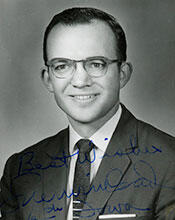
Here you will find contact information for Representative Merwin Coad, including email address, phone number, and mailing address.
| Name | Merwin Coad |
| Position | Representative |
| State | Iowa |
| District | 6 |
| Party | Democratic |
| Status | Former Representative |
| Term Start | January 3, 1957 |
| Term End | January 3, 1963 |
| Terms Served | 3 |
| Born | September 28, 1924 |
| Gender | Male |
| Bioguide ID | C000540 |
About Representative Merwin Coad
Doyle Merwin Coad (September 28, 1924 – September 5, 2025) was an American minister and politician from Iowa who became a prominent Democratic member of the United States House of Representatives in the mid-twentieth century. Born in the rural Midwest, he came of age during the Great Depression and the Second World War, experiences that shaped his later interest in public service, social welfare, and the role of government in supporting working families and agricultural communities. His early years in Iowa exposed him to the concerns of small-town residents and farmers, laying the groundwork for his later political identity as a representative closely attuned to the needs of his constituents.
Coad pursued his formal education in Iowa, where he prepared for both the ministry and public life. He undertook religious and academic studies that led to his ordination as a minister, a vocation that placed him in close contact with parishioners and community organizations. His work in the ministry deepened his engagement with issues of social justice, economic opportunity, and moral responsibility in public affairs. This background as a clergyman gave him a distinctive perspective among his contemporaries in politics, combining pastoral experience with an emerging interest in legislative solutions to the problems he encountered in his congregational and community work.
Before entering Congress, Coad built a career that blended religious leadership with civic involvement. As a minister, he was active in local and regional church affairs and became known for his advocacy on behalf of families, workers, and rural communities. His pastoral responsibilities often intersected with public policy questions, particularly in areas such as poverty, education, and support for veterans and the elderly. This combination of spiritual leadership and community activism gradually drew him toward elective office, as he sought a broader platform from which to address the challenges facing his state and the nation.
Merwin Coad’s congressional career began with his election as a Democrat to the United States House of Representatives in 1956, taking office on January 3, 1957. His victory was historically significant: his election snapped the Republican Party’s fourteen-year hold on every U.S. House seat from Iowa, signaling a shift in the state’s political landscape during the postwar era. Serving three consecutive terms, he represented his Iowa district in the Eighty-fifth, Eighty-sixth, and Eighty-seventh Congresses, from 1957 to 1963. During this period, he contributed to the legislative process at a time of major national developments, including the early stages of the civil rights movement, the expansion of federal programs in education and infrastructure, and the evolving Cold War foreign policy of the United States.
As a member of the House of Representatives, Coad participated fully in the democratic process and worked to represent the interests of his Iowa constituents in Washington, D.C. A member of the Democratic Party, he aligned himself with policies aimed at strengthening the agricultural economy, improving conditions for working families, and expanding access to essential public services. He engaged in committee work, floor debates, and constituent advocacy, reflecting both his ministerial concern for individual well-being and his commitment to broader structural reforms. His tenure coincided with the administrations of Presidents Dwight D. Eisenhower and John F. Kennedy, and he took part in the legislative deliberations that defined that transitional period in American political history.
Coad’s service in Congress concluded on January 3, 1963, after three terms in office. Leaving the House at a relatively young age, he returned to private life with the experience of having helped guide Iowa through a period of economic and social change. In the years following his congressional service, he remained identified with public affairs and the values that had informed his earlier work as both minister and legislator. His combined careers in the pulpit and in the House of Representatives left a record of engagement with the moral and practical dimensions of public policy.
Doyle Merwin Coad died on September 5, 2025, closing a long life that spanned from the interwar years through the early twenty-first century. Remembered as both an American minister and a Democratic politician from Iowa, he occupied a distinctive place in his state’s political history as the man whose election ended a fourteen-year period of exclusive Republican control of Iowa’s U.S. House delegation. His years in Congress from 1957 to 1963, set against a significant period in American history, reflected his enduring commitment to democratic governance and the representation of his constituents’ interests at the national level.