Representative Meyer Jacobstein
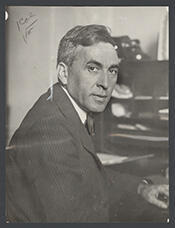
Here you will find contact information for Representative Meyer Jacobstein, including email address, phone number, and mailing address.
| Name | Meyer Jacobstein |
| Position | Representative |
| State | New York |
| District | 38 |
| Party | Democratic |
| Status | Former Representative |
| Term Start | December 3, 1923 |
| Term End | March 3, 1929 |
| Terms Served | 3 |
| Born | January 25, 1880 |
| Gender | Male |
| Bioguide ID | J000040 |
About Representative Meyer Jacobstein
Meyer Jacobstein (January 25, 1880 – April 18, 1963) was an American educator, economist, and Democratic politician who served three terms as a member of the United States House of Representatives from New York from 1923 to 1929. Over the course of his career he combined academic work in economics with public service at the federal and local levels, and he became known in Congress for his opposition to racially discriminatory immigration legislation.
Jacobstein was born on Henry Street on the Lower East Side of Manhattan, New York City, to Polish Jewish parents who had immigrated to the United States via Stockholm, Sweden, only weeks before his birth. In 1881 his family moved to Syracuse, New York, and then, a year later, relocated to Rochester, New York, where he was raised. Coming from a family of tailors, he briefly worked in a Rochester tailor shop, but left after less than a week, choosing instead to pursue formal education. He attended the public schools of Rochester, laying the foundation for his later academic and professional achievements.
After completing his early schooling, Jacobstein attended the University of Rochester and subsequently enrolled at Columbia University, from which he graduated in 1904. He pursued postgraduate studies at Columbia in economics and political science, fields that would shape his later academic and political work. In 1907 he entered federal service as a special agent in the Bureau of Corporations in the Department of Commerce in Washington, D.C., gaining experience in economic regulation and corporate oversight at a time when the federal government was expanding its role in economic affairs.
Jacobstein began his formal academic career in 1909 as an assistant professor of economics at the University of North Dakota at Grand Forks, a position he held until 1913. During this period he wrote on contemporary financial and banking issues, including the Aldrich plan for a National Reserve Association. Addressing North Dakota bankers in 1912, he urged them to set aside what he described as “rural prejudices” against eastern financial interests and to consider the broader needs of the national banking system, arguing that “it will be well for the rural banker, however, to dispossess himself of this native prejudice and withhold judgment until he has made a careful and conscientious examination of the bill.” In 1914 he returned to Rochester as a professor of economics at the University of Rochester. During World War I, from 1916 to 1918, he served as director in emergency employment management at the University of Rochester under the auspices of the War Industries Board, helping to coordinate labor and economic resources for the war effort.
Building on his academic and public-service experience, Jacobstein entered electoral politics as a Democrat. He was elected as a Representative from New York to the Sixty-eighth, Sixty-ninth, and Seventieth Congresses, serving from March 4, 1923, to March 3, 1929. During these three terms in the United States House of Representatives, he participated in the legislative process at a time of significant social and economic change in the United States, representing the interests of his New York constituents and contributing to national debates on economic and social policy. A member of the Democratic Party, he also took part in party affairs as a delegate to the Democratic National Conventions in 1924 and 1932. In 1925 he declined the party’s nomination for mayor of Rochester, New York, choosing instead to continue his work in Congress and in other professional pursuits. He was not a candidate for renomination to the House in 1928.
Jacobstein’s congressional career is particularly noted for his staunch opposition to the Immigration Act of 1924, which imposed national-origin quotas that heavily favored northern and western European immigrants and sharply restricted immigration from other regions. He denounced the measure in moral and constitutional terms, declaring that “nothing is more un-American. Nothing could be more dangerous, in a land the Constitution of which says that all men are created equal, than to write into our law a theory which puts one race above another, which stamps one group of people as superior and another as inferior. The fact that it is camouflaged in a maze of statistics will not protect this Nation from the evil consequences of such an unscientific, un-American, wicked philosophy.” His stance reflected both his training as an economist, skeptical of the bill’s purported scientific basis, and his background as the son of recent immigrants.
After leaving Congress in 1929, Jacobstein turned to private enterprise and institutional leadership. From 1929 to 1936 he engaged in banking in Rochester, New York, applying his economic expertise in the financial sector during the tumultuous years of the Great Depression. In 1936 he became chairman of the board of the Rochester Business Institute, contributing to business education and vocational training in his home city. His reputation as an economist and policy specialist led to further national service when he joined the staff of the Brookings Institution in Washington, D.C., where he worked from 1939 to 1946 on research and analysis related to public policy and economic issues.
In 1947 Jacobstein returned to direct government service as an economic counsel in the Legislative Reference Service of the Library of Congress, an office that provided nonpartisan research and drafting assistance to members of Congress. He held this position until his retirement on May 31, 1952, continuing to influence federal policymaking through his analytical work even after his own tenure as a legislator had ended. Following his retirement, he resided in Rochester, New York, maintaining his long-standing ties to the community where he had grown up, taught, and conducted much of his professional life.
Meyer Jacobstein died in Rochester on April 18, 1963. He was interred at Mount Hope Cemetery in that city. His life and career, spanning academia, federal service, elective office, and policy research, reflected the trajectory of a first-generation American who rose from immigrant origins on Manhattan’s Lower East Side to become a prominent voice in national economic and legislative debates.