Representative Michael Allen Collins
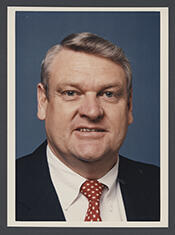
Here you will find contact information for Representative Michael Allen Collins, including email address, phone number, and mailing address.
| Name | Michael Allen Collins |
| Position | Representative |
| State | Georgia |
| District | 8 |
| Party | Republican |
| Status | Former Representative |
| Term Start | January 5, 1993 |
| Term End | January 3, 2005 |
| Terms Served | 6 |
| Born | October 15, 1944 |
| Gender | Male |
| Bioguide ID | C000640 |
About Representative Michael Allen Collins
Michael Allen “Mac” Collins (October 15, 1944 – November 20, 2018) was an American businessman and Republican politician who represented Georgia in the United States House of Representatives from 1993 to 2005. Over six terms in Congress, he represented first Georgia’s 3rd congressional district from 1993 to 2003 and then Georgia’s 8th congressional district from 2003 to 2005. His service in the House occurred during a significant period in American political history, and he participated actively in the legislative process and in Republican Party leadership.
Collins was born in Jackson, Butts County, Georgia, on October 15, 1944, and attended public schools throughout his youth. After graduating from high school, he joined a concrete products business operated by his father and eventually expanded it into a ready-mix concrete company, establishing himself as a businessman before entering elective office. His mother was notable in local public life as the first woman to serve on the city council in Flovilla, Georgia. Collins served in the Georgia Army National Guard from 1964 to 1970, combining military service with his growing involvement in the family business.
Collins began his political career at the local level in 1977, when he was elected to the Butts County Commission. His colleagues on the commission immediately chose him as chairman, a position in which he served for two terms. Originally a Democrat, he gave up his county commission seat in 1980 when he switched his party affiliation to Republican, reflecting the broader partisan realignment underway in Georgia and the South. He twice sought election to the Georgia State Senate before winning a seat in 1988 from a district based in Henry County, south of Atlanta. Collins served two terms in the Georgia State Senate, gaining experience in state-level legislative affairs and building a political base that would support his later bid for Congress.
The 1990s round of congressional redistricting in Georgia provided the opening for Collins’s entry into national politics. In an effort to weaken House Republican Whip Newt Gingrich, Democrats in the state legislature dismantled Gingrich’s old 6th District and shifted much of its territory south of Atlanta, including Collins’s home area, into the 3rd District. That district, then based in Columbus, was represented by five-term Democrat Richard Ray. Collins immediately entered the 1992 race for the redrawn 3rd District, first winning the Republican primary over Paul Broun, who would later serve in Congress from Georgia’s 10th District, and then defeating Ray in the general election by almost 10 percentage points. He took office in the 103rd Congress on January 3, 1993, beginning a twelve-year tenure in the House of Representatives.
During his congressional service, Collins steadily consolidated his political position. In 1994 he was reelected by defeating Democrat Fred Overby with 66 percent of the vote to Overby’s 34 percent. In 1996 he won another term by defeating Democrat Jim Chafin, 61 percent to 39 percent. He ran unopposed for reelection in 1998, reflecting his growing strength in the district. In 2000 he defeated Democrat Gail Notti by a margin of 63 percent to 37 percent. Following the 2000 redistricting cycle, Collins’s home base was placed in Georgia’s 8th congressional district. Running in the new district in 2002, he secured reelection by the widest margin of his congressional career, defeating Democrat Angelos Petrakopoulos 78 percent to 22 percent. Throughout his six terms, he represented the interests of his constituents in central and south-central Georgia and was an active participant in the legislative and political work of the House.
In the House of Representatives, Collins served on the influential Committee on Ways and Means, which has jurisdiction over tax, trade, and many revenue-related matters. He was also appointed Deputy Whip for the Republican Party, participating in party leadership efforts to marshal votes on key legislation, and was selected by the Speaker of the House to serve on the highly classified United States House Permanent Select Committee on Intelligence. His legislative focus included commerce, tax reform, foreign trade and international finance, and technology-related legislation. Collins sponsored, among other measures, H.R. 1121, which designated the federal building and United States courthouse at 18 Greenville Street in Newnan, Georgia, as the “Lewis R. Morgan Federal Building and United States Courthouse,” and H.R. 1316, which amended chapter 87 of title 5 of the United States Code regarding the order of precedence for payment of federal life insurance benefits. After the September 11, 2001, terrorist attacks, Collins lost his position as Deputy Whip when he informed President George W. Bush that he would not support the creation of the Transportation Security Administration (TSA), underscoring his willingness to break with his party’s leadership on matters of principle.
In 2004, Collins declined to seek reelection to the House and instead entered the race for the Republican nomination for the United States Senate seat being vacated by Senator Zell Miller. In a three-way primary, he faced U.S. Representative Johnny Isakson and businessman Herman Cain. With 98 percent of precincts reporting, Isakson won the nomination with 53 percent of the vote, followed by Cain with 26 percent and Collins with 21 percent. Isakson went on to win the general election against Democratic Representative Denise Majette. Collins’s decision to pursue the Senate seat ended his continuous service in the House, and he was succeeded in representing Georgia’s 8th congressional district by Republican Lynn Westmoreland, who took office in January 2005.
After leaving Congress, Collins remained active in Georgia politics. In 2006, having moved back to Butts County, he attempted to return to the U.S. House of Representatives by challenging Democratic Representative Jim Marshall. The district in which he ran included none of the territory Collins had represented during his first five terms in Congress, but it did contain three counties he had represented in his final term following mid-decade Republican redistricting. The contest quickly became one of the most competitive House races in the nation, drawing heavy spending by both campaigns and by independent political groups. President George W. Bush traveled to Georgia to attend a rally on Collins’s behalf during the campaign. In a closely fought election, Marshall narrowly won reelection by approximately 1,700 votes, 50.5 percent to 49.5 percent, effectively ending Collins’s efforts to return to Congress.
Collins was a Christian and was married to his wife for 54 years; together they had four children. One of their children, Mike Collins, followed his father into national politics and was later elected as a U.S. representative for Georgia’s 10th congressional district. Mac Collins died on November 20, 2018, in Flovilla, Georgia, at the age of 74, closing a career that spanned local, state, and national public service and more than a decade in the United States Congress.