Representative Michael Crawford Kerr
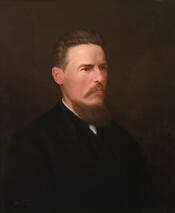
Here you will find contact information for Representative Michael Crawford Kerr, including email address, phone number, and mailing address.
| Name | Michael Crawford Kerr |
| Position | Representative |
| State | Indiana |
| District | 3 |
| Party | Democratic |
| Status | Former Representative |
| Term Start | December 4, 1865 |
| Term End | March 3, 1877 |
| Terms Served | 5 |
| Born | March 15, 1827 |
| Gender | Male |
| Bioguide ID | K000143 |
About Representative Michael Crawford Kerr
Michael Crawford Kerr (March 15, 1827 – August 19, 1876) was an American lawyer and legislator who served as a Representative from Indiana in the United States Congress from 1865 to 1877 and became the first Democratic Speaker of the United States House of Representatives after the Civil War. He was born in Titusville, Crawford County, Pennsylvania, where he spent his early years. Kerr received his preparatory education at the Erie Academy in Erie, Pennsylvania, an institution that prepared many young men for professional careers in law and public life.
After completing his early schooling, Kerr pursued legal studies and enrolled at the University of Louisville School of Law in Louisville, Kentucky. He graduated from the University of Louisville School of Law in 1851. The following year, in 1852, he moved west to New Albany, Indiana, a growing Ohio River community that would remain his home and political base. There he was admitted to the bar and commenced the practice of law, building a reputation that soon led him into public service.
Kerr entered politics in Indiana as a member of the Democratic Party. He was elected to the Indiana State Legislature and served in the state House of Representatives from 1856 to 1857. During this period he became known as a capable lawyer-legislator and an articulate spokesman for Democratic positions in a state that was sharply divided in the years leading up to the Civil War. His legislative experience in Indianapolis helped establish his credentials for national office and introduced him to the broader currents of state and national politics.
With the outbreak of the Civil War, Kerr aligned himself with the War Democrat faction of his party, supporting the Union war effort while remaining a Democrat. In the tense political climate of Indiana, he vigorously opposed the Copperhead, or Peace Democrat, element in his district, which sought to undermine the war effort and resist federal policies. His efforts to combat clandestine anti-war activities won him the praise of Republican Governor Oliver P. Morton, who credited Kerr with helping to suppress illegal conspiracies by Copperheads in Indiana. This stance distinguished him from many in his party and positioned him as a loyal Unionist during the conflict.
Kerr was elected to Congress in 1864 as a War Democrat and took his seat in the United States House of Representatives on March 4, 1865. A member of the Democratic Party, he served as a Representative from Indiana from 1865 to 1873, contributing to the legislative process during five terms in office. During these years, which encompassed the closing months of the Civil War and the early phases of Reconstruction, he was regarded as one of the leaders of the Democratic minority in the House. He strongly opposed the Republican policy of Reconstruction in the Southern states, reflecting the views of many Northern Democrats who criticized what they saw as excessive federal intervention in Southern affairs. Despite his prominence, he was not re-elected in 1872, in part because his positions on financial policy placed him at odds with many of his constituents.
Kerr’s views on economic and monetary questions were firmly in the “hard money” tradition. He openly antagonized the inflationists and the Greenback element within his largely agrarian constituency, where many favored an expanded paper currency to ease debt burdens and stimulate economic activity. Kerr instead advocated the resumption of specie payments and a return to a sound, gold-based currency, positions that were unpopular with many farmers and small borrowers in Indiana. His adherence to these principles contributed to his defeat in 1872, but he remained an influential voice within the Democratic Party on fiscal issues.
In the Democratic resurgence of the mid-1870s, Kerr returned to national prominence. In 1874, after a sharp and closely contested campaign, he won back his congressional seat from Indiana. Upon his re-entry into Congress at the opening of the Forty-fourth Congress on March 4, 1875, he was chosen by his party colleagues as Speaker of the House of Representatives, becoming the first Democrat to hold that office after the Civil War. As Speaker, he presided over the House during a period marked by economic distress following the Panic of 1873 and by continuing disputes over Reconstruction, civil service reform, and federal fiscal policy. He presided as Speaker at only the first session of the Forty-fourth Congress, guiding the Democratic majority in organizing the House and shaping its legislative agenda.
Kerr’s tenure as Speaker was cut short by serious illness. He suffered from consumption (tuberculosis), which progressively weakened him even as he attempted to fulfill the demanding responsibilities of the speakership. After the adjournment of the first session of the Forty-fourth Congress in 1876, his health rapidly declined. Michael Crawford Kerr died of consumption on August 19, 1876, while still in office, becoming one of the members of the United States Congress who died during their term of service in the nineteenth century. His death ended a career that had spanned state and national legislatures, wartime party realignment, and the turbulent politics of Reconstruction and postwar economic adjustment.