Representative Michael Lynn Synar
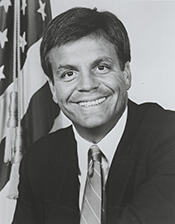
Here you will find contact information for Representative Michael Lynn Synar, including email address, phone number, and mailing address.
| Name | Michael Lynn Synar |
| Position | Representative |
| State | Oklahoma |
| District | 2 |
| Party | Democratic |
| Status | Former Representative |
| Term Start | January 15, 1979 |
| Term End | January 3, 1995 |
| Terms Served | 8 |
| Born | October 17, 1950 |
| Gender | Male |
| Bioguide ID | S001139 |
About Representative Michael Lynn Synar
Michael Lynn Synar (October 17, 1950 – January 9, 1996) was an American Democratic politician and attorney who represented Oklahoma’s 2nd congressional district in the United States House of Representatives for eight consecutive terms from 1979 to 1995. A member of the Democratic Party, he served during a significant period in late twentieth-century American history and became known nationally for his liberal political views, his challenges to powerful economic interests, and his role in a landmark constitutional case before the Supreme Court.
Synar was born in Vinita, Oklahoma, and grew up in eastern Oklahoma. His father, Ed Synar, was a World War II B-24 tail gunner who served in Europe; the Synar family line on his father’s side was of Polish Catholic heritage. Michael Synar was raised in Muskogee, Oklahoma, and graduated from Muskogee High School in 1968. His early years in a region shaped by agriculture, small business, and military service helped form the populist and reform-minded outlook that later characterized his public career.
Synar attended the University of Oklahoma (OU), where he was active in student government and public affairs, including participation in the Oklahoma Intercollegiate Legislature. He received a Bachelor of Science degree from the University of Oklahoma in 1972. Pursuing advanced study abroad, he was selected as a Rotary International Scholar and attended the Graduate School of Economics at the University of Edinburgh in Scotland in 1973. He went on to earn a Master of Arts degree from Northwestern University in 1974. Returning to Oklahoma, Synar enrolled at the University of Oklahoma College of Law, where he completed his Juris Doctor degree in 1977, preparing for a career that combined law, politics, and public policy.
Before entering Congress, Synar’s primary profession was the practice of law. He established himself as an attorney in the Muskogee area, while also working as a rancher and a real estate broker and agent. This combination of legal practice, agricultural involvement, and business activity rooted him firmly in the economic life of eastern Oklahoma and provided him with direct experience of the issues facing his future constituents. His engagement in local affairs and his reputation as an energetic young lawyer and civic participant set the stage for his rapid ascent in electoral politics.
Synar was first elected to Congress in 1978 at the age of 28, defeating incumbent Democrat Ted Risenhoover in a notable upset in the Democratic primary. His campaign gained attention for circulating copies of a Washington, D.C., media report noting that Risenhoover slept on a “heart-shaped waterbed,” a detail that played poorly with many conservative voters in Oklahoma and helped underscore Synar’s message of change. He went on to win the general election and took office on January 3, 1979, as the representative of Oklahoma’s 2nd congressional district. He was subsequently reelected seven times, serving until January 3, 1995. During his eight terms in the House of Representatives, Synar participated actively in the legislative process and represented the interests of his largely rural and small-town constituency while often taking positions that were more liberal than those of most Oklahoma Democrats.
In Congress, Synar became best known nationally for his role in challenging the constitutionality of the Gramm–Rudman–Hollings Balanced Budget and Emergency Deficit Control Act. As a named party in the Supreme Court case Bowsher v. Synar (1986), he successfully argued that the law’s delegation of executive power to the Comptroller General, a legislative branch officer, violated the separation of powers. The Court agreed, holding that the provision “violate[d] the Constitution’s command that Congress play no direct role in the execution of the laws,” and struck down the enforcement mechanism of the act. Synar also emerged as an ardent and persistent foe of the tobacco industry, pressing for stronger public health protections and restrictions on tobacco use and marketing. His liberal voting record and willingness to confront powerful interests, including tobacco companies, the National Rifle Association, and large ranching and corporate interests, distinguished him from many of his colleagues in the Oklahoma delegation.
Synar’s committee work and oversight activities further enhanced his national profile. He served as chairman of the Environment, Energy, and Natural Resources Subcommittee of the House Committee on Government Operations. In that capacity, he led investigations into federal land and resource policy, including a major effort to raise the low fees charged to ranchers for grazing cattle on public lands. At the time, the “animal unit month” (AUM) fee was set at $1.35, far below the 1983 market value, which Synar argued amounted to a federal subsidy benefiting a relatively small number of ranchers and large corporations controlling millions of acres of grazing land. Working closely with Secretary of the Interior Bruce Babbitt, he attempted to rally environmentalists and reformers to increase these fees, though senators from Western states successfully blocked the proposed changes. In 1992, under his subcommittee’s leadership, the House Committee on Government Operations issued its 17th report, formally titled “Misplaced Trust: The Bureau of Indian Affairs Mismanagement of the Indian Trust Fund,” but widely known as “the Synar Report.” Directed by the 102nd Congress and chaired by John Conyers Jr., the committee documented longstanding mismanagement of Native American trust funds. The Synar Report led directly to the Indian Trust Fund Management Reform Act of 1994 and helped pave the way for the landmark class action lawsuit Cobell v. Babbitt, initiated in 1996, which sought redress for decades of federal mismanagement of Indian trust assets.
Synar also played a prominent role in one of the most significant judicial impeachment proceedings of the late twentieth century. In 1989, despite having no prior criminal prosecution experience, he was selected as the lead House manager in the impeachment trial of U.S. District Judge Alcee Hastings. Hastings had previously been acquitted by a jury on bribery charges, but the House of Representatives later impeached him on related allegations of corruption. Synar led the House managers in presenting the case before the Senate, which ultimately voted to remove Hastings from the federal bench. In a notable historical irony, Hastings was later elected to the U.S. House of Representatives from Florida, where he served for three decades and became the dean of the Florida congressional delegation, though he was later passed over for the chairmanship of the House Permanent Select Committee on Intelligence.
Despite his national prominence, Synar’s independent positions and reform efforts generated strong opposition from several powerful interest groups. In 1994, he faced a serious challenge in the Democratic primary from Virgil Cooper, a retired high school principal. Cooper’s campaign itself spent less than $20,000, but it benefited from spending by outside organizations opposed to Synar, including the National Rifle Association, tobacco companies, and cattlemen’s groups angered by his stands on gun control, tobacco regulation, and grazing fees. Cooper capitalized on local unease with Synar’s national profile and international business contacts, using the slogan “Sayonara Synar” to highlight Synar’s perceived closeness to Japanese business interests. In a closely contested runoff, Cooper defeated Synar by 2,609 votes out of 92,987 cast, a 51–49 percent margin. Cooper then lost the general election to Republican Tom Coburn, who won the seat by a 52–48 margin, ending Democratic control of the district.
After leaving Congress in January 1995, Synar remained active in public policy and national reform efforts. He served as chairman of the Campaign for America Project, an organization focused on political and governmental reform, and as chairman of the National Bankruptcy Review Commission, which was tasked with examining and recommending changes to the nation’s bankruptcy laws. His continued advocacy for principled, and often politically difficult, positions earned him the 1995 John F. Kennedy Profile in Courage Award, recognizing his willingness to take stands that were often unpopular with powerful constituencies but that he believed were in the public interest.
Michael Lynn Synar died of a brain tumor on January 9, 1996, at the age of 45. His legacy has been honored by a number of institutions and awards that bear his name. The American College of Physicians established a national public service award in his honor, recognizing outstanding efforts in the fight against tobacco use and in promoting public health, reflecting his long-standing opposition to the tobacco industry. In Muskogee, Oklahoma, Northeastern State University named a 40,000-square-foot (3,700 m²) facility the Mike Synar Center, commemorating his service to the region and the state. The Institute of Governmental Studies at the University of California, Berkeley, annually awards up to five Mike Synar Graduate Research Fellowships to distinguished graduate students writing dissertations on aspects of American politics, further extending his influence on the study of government and public policy. Through these memorials and the continuing impact of his legislative and oversight work, Synar’s career remains a notable chapter in the political history of Oklahoma and the United States Congress.