Representative Miles Crowley
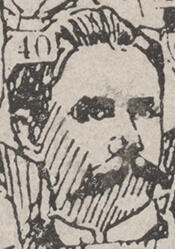
Here you will find contact information for Representative Miles Crowley, including email address, phone number, and mailing address.
| Name | Miles Crowley |
| Position | Representative |
| State | Texas |
| District | 10 |
| Party | Democratic |
| Status | Former Representative |
| Term Start | December 2, 1895 |
| Term End | March 3, 1897 |
| Terms Served | 1 |
| Born | February 22, 1859 |
| Gender | Male |
| Bioguide ID | C000944 |
About Representative Miles Crowley
Miles Crowley (February 22, 1859 – September 22, 1921) was a Democratic member of the United States House of Representatives from Texas who served one term in Congress from 1895 to 1897. Born in Boston, Massachusetts, he attended the common schools there and entered the workforce at an early age. As a young man he was employed as a longshoreman, work that exposed him to the concerns of laborers and the commercial life of a major port city. In the 1870s he moved to Galveston, Texas, then one of the most important ports on the Gulf of Mexico, where he established himself in his adopted state.
In Galveston, Crowley became active in public service and local affairs. He joined the city’s fire department and rose to the position of assistant chief of the Galveston Fire Department, a role that placed him in a position of responsibility in a growing and often vulnerable coastal city. While engaged in these duties, he pursued legal studies, reading law in the traditional manner of the period. His efforts culminated in his admission to the bar in 1892, after which he commenced the practice of law in Galveston. His legal training and growing prominence in the community provided a foundation for his entry into elective office.
Crowley’s political career began in the Texas state legislature. In 1892 he was elected as a member of the Texas House of Representatives, where he served during a period marked by debates over railroad regulation, agricultural interests, and the evolving economic structure of the state. The following year he advanced to the upper chamber of the legislature, serving in the Texas Senate in 1893 and 1894. His rapid progression from the House to the Senate reflected his standing within the Democratic Party and his ability to represent the concerns of his coastal constituency.
Building on his state legislative experience, Crowley was elected as a Democrat to the Fifty-fourth Congress, serving in the U.S. House of Representatives from March 4, 1895, to March 3, 1897. Representing Texas during a significant period in American history marked by economic adjustment after the Panic of 1893 and intense national debate over monetary policy and tariffs, he participated in the legislative process and represented the interests of his Galveston-area constituents. His single term in Congress coincided with the administration of President Grover Cleveland and the broader realignments within the Democratic Party of the 1890s. Crowley did not seek renomination in 1896 and thus concluded his federal legislative service after one term.
After leaving Congress, Crowley returned to Galveston and resumed the practice of law. He continued to play a role in public life through legal and prosecutorial work. From 1904 to 1912 he served as prosecuting attorney of Galveston County, a position that placed him at the center of local law enforcement and judicial proceedings during a period of growth and modernization in the region. His tenure as prosecuting attorney further solidified his reputation as a capable lawyer and public official.
In the later phase of his career, Crowley moved from prosecutorial work to the bench. In 1920 he was elected judge of the Galveston County Court, assuming judicial responsibilities in a jurisdiction that encompassed the busy port city and its surrounding communities. He was serving in this judicial capacity at the time of his death in Galveston on September 22, 1921. Miles Crowley was interred in Calvary Cemetery, leaving a record of service that spanned municipal, state, and federal office and reflected the political and civic life of Texas in the late nineteenth and early twentieth centuries.