Representative Milledge Luke Bonham
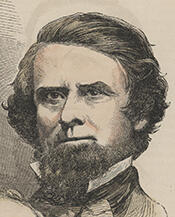
Here you will find contact information for Representative Milledge Luke Bonham, including email address, phone number, and mailing address.
| Name | Milledge Luke Bonham |
| Position | Representative |
| State | South Carolina |
| District | 4 |
| Party | Democratic |
| Status | Former Representative |
| Term Start | December 7, 1857 |
| Term End | March 3, 1861 |
| Terms Served | 2 |
| Born | December 25, 1813 |
| Gender | Male |
| Bioguide ID | B000616 |
About Representative Milledge Luke Bonham
Milledge Luke Bonham (December 25, 1813 – August 27, 1890) was an American politician, lawyer, soldier, and Congressman who represented South Carolina in the United States House of Representatives from 1857 to 1861. A member of the Democratic Party, he later served as the 70th Governor of South Carolina from 1862 until 1864 and was a Confederate general during the American Civil War. His congressional service occurred during a significant period in American history, immediately preceding secession and the outbreak of war, and he participated in the legislative process and represented the interests of his South Carolina constituents during two terms in office.
Bonham was born near Redbank (now Saluda), in Edgefield District, South Carolina, the son of Capt. James Bonham, a Maryland native, and Sophie Smith Bonham. Through his mother he was connected to an influential South Carolina family: she was the niece of Capt. James Butler, head of a prominent Butler family line, and Bonham was a first cousin once removed of U.S. Senator Andrew Pickens Butler. He was also a descendant of an Englishman, Thomas Butler, who had emigrated to the American colonies in the seventeenth century. Bonham attended private schools in the Edgefield District and at Abbeville before enrolling at South Carolina College in Columbia, from which he graduated with honors in 1834. His family was deeply affected by the Texas Revolution; in 1836 his older brother, James Butler Bonham, was killed at the Battle of the Alamo.
Soon after college, Bonham embarked on a dual path of military and legal training. In 1836 he served as captain and adjutant general of the South Carolina Brigade in the Seminole War in Florida. He then studied law, was admitted to the bar in 1837, and commenced practice in Edgefield, South Carolina. Bonham entered public life early, serving as a member of the South Carolina House of Representatives from 1840 to 1843. On November 13, 1845, he married Ann Patience Griffin. During the Mexican–American War he returned to military service, being commissioned lieutenant colonel of the 12th U.S. Infantry Regiment in March 1847 and promoted to colonel in August 1847. Among his fellow officers in that regiment were Maxcy Gregg and Abner Monroe Perrin, both of whom would later become Confederate generals. After the war he rose to the rank of major general in the South Carolina Militia. From 1848 to 1857 he served as solicitor of the southern circuit of South Carolina, consolidating his reputation as a lawyer and public official.
Bonham’s national political career began with his election as a Democrat to the Thirty-fifth Congress, where he succeeded his cousin, Representative Preston Smith Brooks, and continued with his reelection to the Thirty-sixth Congress. He served in the U.S. House of Representatives from March 4, 1857, until his retirement on December 21, 1860. During these two terms he took part in debates and votes on the sectional issues that dominated the late 1850s, representing the pro-slavery and states’ rights views of much of his South Carolina constituency. His service in Congress thus coincided with the final years of the Union before the secession crisis, and he left his seat shortly after South Carolina adopted its ordinance of secession.
With the secession movement underway, Bonham quickly assumed new responsibilities for his state. A slaveowner, he was appointed Commissioner from South Carolina to the Mississippi Secession Convention in early 1861, where he worked to persuade Mississippi’s leaders to follow South Carolina out of the Union. On February 10, 1861, Governor Francis W. Pickens appointed him major general and commander of the Army of South Carolina. When the Confederate States of America organized its forces, Bonham was appointed brigadier general in the Confederate Army on April 19, 1861 (his Confederate brigadier general’s commission is also recorded as dating from April 23, 1861). He commanded the First Brigade of the Confederate “Army of the Potomac” under General P. G. T. Beauregard and took part in the First Battle of Manassas (First Bull Run), where he directed his brigade, two artillery batteries, and six companies of cavalry in the defense of Mitchell’s Ford on Bull Run. He resigned his Confederate commission on January 27, 1862, in order to take a seat in the Confederate Congress.
On December 17, 1862, the South Carolina General Assembly elected Bonham governor by secret ballot. He served as Governor of South Carolina from 1862 until December 1864, a period marked by the strains of total war on the Confederate home front. During his administration, the General Assembly enacted a prohibition against distilling in 1863 to conserve grain and other resources for the war effort. That same year, the legislature, with his support, required that more land be devoted to food crops rather than cotton in an attempt to alleviate shortages and increase the food supply within the state. After leaving the governorship, Bonham again entered Confederate military service; on February 20, 1865, he was commissioned brigadier general of cavalry and was actively engaged in recruiting troops in the closing months of the war. Near Greenville, South Carolina, a group of troops stationed to guard against a possible federal invasion from North Carolina named their position “Camp Bonham” in his honor.
Following the collapse of the Confederacy, Bonham turned to business and the law during the Reconstruction era. From 1865 to 1878 he owned and operated an insurance business in Edgefield, South Carolina, and in Atlanta, Georgia. He also resumed his political activities in the immediate postwar period, serving once more in the South Carolina House of Representatives from 1865 to 1866. He was a delegate to the Democratic National Convention in 1868 and participated in the South Carolina taxpayers’ conventions of 1871 and 1874, gatherings that protested high taxes and Republican rule during Reconstruction. Afterward he returned to the practice of law in Edgefield and engaged in planting, maintaining his position as a leading figure in South Carolina’s conservative Democratic establishment.
In 1878 Bonham was appointed state railroad commissioner of South Carolina, a position he held until his death. In that capacity he oversaw aspects of railroad regulation and development during a period when rail transportation was central to the state’s economic recovery. On August 27, 1890, while staying at the resort community of White Sulphur Springs, North Carolina—then a late-nineteenth-century resort in Surry County near Mount Airy—Bonham was found dead in his bed in his room at Hawood. Contemporary newspaper accounts, including obituaries in the Fisherman and Farmer of Edenton, North Carolina (September 12, 1890) and the Swain County Herald of Bryson City, North Carolina (September 11, 1890), reported that he died during the night from a hemorrhage. He was buried in Elmwood Cemetery in Columbia, South Carolina. Bonham’s legacy includes his service as a U.S. Representative, Confederate general, and wartime governor, and he was later commemorated in sites such as the Bonham House. His family’s public role continued through descendants, including his son Milledge Lipscomb Bonham.