Senator Milton Ruben Young
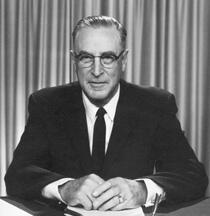
Here you will find contact information for Senator Milton Ruben Young, including email address, phone number, and mailing address.
| Name | Milton Ruben Young |
| Position | Senator |
| State | North Dakota |
| Party | Republican |
| Status | Former Representative |
| Term Start | March 12, 1945 |
| Term End | January 3, 1981 |
| Terms Served | 6 |
| Born | December 6, 1897 |
| Gender | Male |
| Bioguide ID | Y000047 |
About Senator Milton Ruben Young
Milton Ruben Young (December 6, 1897 – May 31, 1983) was an American politician, most notable for representing North Dakota in the United States Senate from 1945 until 1981. A member of the Republican Party, he served six full terms in the Senate, and at the time of his retirement he was the most senior Republican in that body and the last member of the so‑called Lost Generation to serve in the Senate. His long tenure coincided with a significant period in American history, during which he participated in the democratic process and represented the interests of his North Dakota constituents on issues ranging from agriculture to civil rights.
Young was born in Berlin, LaMoure County, North Dakota, to John and Rachel Zimmerman Young. All four of his grandparents were immigrants from Germany, and he grew up in a rural, agrarian environment that would shape his political priorities throughout his life. He attended local schools and graduated from LaMoure High School. He then pursued higher education at North Dakota State University in Fargo and at Graceland College, gaining exposure to agricultural and liberal arts studies before returning to his home community.
After college, Young returned to Berlin to operate his parents’ farm, taking over management of the family agricultural operation. In 1919 he married Malinda Benson, and the couple had three sons: Wendell, Duane, and John. During the late 1920s and 1930s, amid the Great Depression and severe drought on the Northern Plains, Young became increasingly interested in public affairs. He was active in community service, holding positions on the local school board, the township board, and the county Agricultural Adjustment Act (AAA) board. These roles deepened his engagement with farm policy and rural economic issues and laid the groundwork for his entry into elective office.
Young’s formal political career began in the North Dakota Legislature. Running as a Republican, he was elected to the North Dakota House of Representatives in 1932, at the height of the Depression. Just two years later, in 1934, he was elected to the North Dakota Senate. During the 1940s he emerged as one of the key figures in organizing and strengthening the state Republican Party, helping to develop the Republican Organizing Committee in North Dakota. His reputation as a practical, agriculture‑focused legislator and party organizer brought him to statewide prominence.
With the death of U.S. Senator John Moses in 1945, Governor Fred G. Aandahl appointed Milton Ruben Young to fill the vacant United States Senate seat from North Dakota. Young relinquished day‑to‑day management of the family farm to assume his duties in Washington, D.C. He subsequently won election in his own right and was repeatedly returned to the Senate by North Dakota voters, ultimately serving from 1945 to 1981. Over these six terms, he became one of the longest‑serving senators in American history. In the 1952 presidential election cycle, Young initially indicated his support for Senator Robert A. Taft of Ohio for the Republican nomination. In March of that year, he startled many in his party by publicly endorsing Democratic Senator Richard Russell Jr. for the presidency, calling Russell “superbly qualified” and expressing his willingness to support him if nominated. The endorsement caused a sensation and provoked calls from some North Dakota Republicans for Young’s withdrawal from the party, though he remained a Republican and continued his Senate career.
During his long congressional service, Young focused heavily on agricultural and appropriations matters. His major committee assignments were on the Senate Committee on Agriculture, Nutrition, and Forestry and the Senate Appropriations Committee, on which he eventually became the ranking Republican member. His deep involvement in farm legislation earned him the nickname “Mr. Wheat.” He was instrumental in the passage of the Agricultural Act of 1956 and the Agriculture and Consumer Protection Act of 1973, measures that shaped federal farm price supports and commodity programs. Although he generally supported President Dwight D. Eisenhower, Young was openly critical of the farm policies of Eisenhower’s Secretary of Agriculture, Ezra Taft Benson, and he also criticized the far‑right John Birch Society, which had praised Benson. Despite his Republican affiliation, Young was frequently commended by the Farmers Union and other agricultural organizations for his consistent support of farm‑friendly policies. He once summarized his approach by saying, “I have always tried to stay close to the people. In North Dakota to be elected and to stay on, you have to know the farmers and stay close to them. They are loyal to a fault.”
Young’s Senate record extended beyond agriculture to major national issues, including civil rights, social policy, and constitutional amendments. He was a close friend of Senate Majority Leader, and later President, Lyndon B. Johnson, whom he described as the president most closely attuned to “agriculture and rural America.” Young voted in favor of the Civil Rights Acts of 1957, 1960, 1964, and 1968, as well as the Voting Rights Act of 1965 and the confirmation of Thurgood Marshall to the United States Supreme Court. He did not vote on the proposed Twenty‑Fourth Amendment to the Constitution, which abolished the poll tax in federal elections. Although he opposed the creation of Medicare and Medicaid in 1965, he later co‑sponsored health care legislation that sought to provide benefits and services similar to Medicare for people under age 65 and their families through the Social Security Act, and he supported a federally run health care program that would have replaced Medicaid. Young also voted in favor of the Comprehensive Child Development Act of 1971, which was ultimately vetoed by President Richard Nixon, and he supported the Equal Rights Amendment in 1972. Known for his plainspoken style, he responded to speculation about challengers to his seat in 1968 by quipping, when asked about a potential candidacy from journalist Eric Sevareid, “What does Sevareid know about wheat?”
Young’s electoral strength endured well into his later years. He won reelection in multiple Senate contests, including the 1956, 1962, 1968, and 1974 United States Senate elections in North Dakota. During his final campaign in 1974, his age became an issue in the general election. To counter perceptions that he was too old for the job, Young aired campaign commercials showing himself breaking a board with a karate chop, a memorable image that helped underscore his vigor and contributed to his successful reelection. As a result of the 1980 elections, Republicans gained control of the Senate, and as the longest‑serving Republican senator, Young would have been in line to become President pro tempore in the new Congress. Having already decided not to seek a seventh term, he chose instead to retire at the end of his sixth full term in 1981. In recognition of his long service, the outgoing Democratic‑controlled Senate elected him President pro tempore on December 5, 1980; he held the office ceremonially for one day.
In his personal life, Young experienced both long companionship and later remarriage. His first wife, Malinda Benson Young, died shortly before their fiftieth wedding anniversary in 1969. Some years later, he married Patricia Byrne of Bowman, North Dakota, who had been his secretary in the Senate. After leaving public office, Young retired to Sun City, Arizona. He died there at his retirement home on May 31, 1983, and was buried in his hometown of Berlin, North Dakota. His legacy in his home state is commemorated by the Milton R. Young Power Plant in Oliver County and by a public housing facility in Minot, the city’s tallest building, which bears his name.