Representative Morris Michael Edelstein
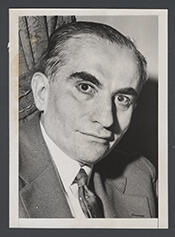
Here you will find contact information for Representative Morris Michael Edelstein, including email address, phone number, and mailing address.
| Name | Morris Michael Edelstein |
| Position | Representative |
| State | New York |
| District | 14 |
| Party | Democratic |
| Status | Former Representative |
| Term Start | January 3, 1939 |
| Term End | January 3, 1943 |
| Terms Served | 2 |
| Born | February 5, 1888 |
| Gender | Male |
| Bioguide ID | E000041 |
About Representative Morris Michael Edelstein
Morris Michael Edelstein (February 5, 1888 – June 4, 1941) was a Polish-born American lawyer and Democratic Representative from New York who served in the United States House of Representatives from 1940 until his death in 1941. His congressional service, which occurred during a significant period in American history on the eve of the United States’ entry into World War II, was marked by his advocacy for democratic principles and opposition to antisemitism.
Edelstein was born on February 5, 1888, in Meseritz (Międzyrzec Podlaski), in Congress Poland, then a part of the Russian Empire. When he was three years old, he immigrated to the United States with his parents, who settled in New York City. Growing up in New York, he attended the city’s public schools and later enrolled at Cooper Union College. He subsequently studied law at the Brooklyn Law School of St. Lawrence University, from which he graduated in 1909.
After completing his legal education, Edelstein was admitted to the bar in 1910 and commenced the practice of law in New York. He established himself as a practicing attorney in the city, building a career that preceded and underpinned his later entry into public office. Throughout his adult life he lived with his mother, never marrying; she was 85 years old at the time of his death, underscoring the close family bond that characterized his private life.
Edelstein entered national politics as a member of the Democratic Party. He was elected as a Democrat to the Seventy-sixth Congress to fill the vacancy caused by the death of Representative William I. Sirovich, representing a New York district in the U.S. House of Representatives. He took his seat on February 6, 1940. He was subsequently reelected to the Seventy-seventh Congress, continuing to represent the interests of his New York constituents and to participate in the legislative process during a critical era marked by global conflict and domestic debate over the nation’s role in world affairs. Across what are described as two terms in office, he contributed to the work of the House as the United States moved closer to direct involvement in World War II.
Edelstein’s most noted moment on the House floor came on June 4, 1941, the day of his death. On that day, he rose to respond to a speech by Representative John Elliott Rankin of Mississippi, who was widely described as an anti-Semite and who had just accused “international Jewish brethren” of seeking to drag America into World War II. Edelstein, who was Jewish, denounced such rhetoric as demagoguery and scapegoating. In his remarks, he declared: “Hitler started out by speaking about ‘Jewish brethren.’ It is becoming the play and the work of those people who want to demagogue to speak about their ‘Jewish brethren’ and ‘international bankers.’ … I deplore the idea that … men in this House … attempt to use the Jews as their scapegoat. I say it is unfair and I say it is un-American. … All men are created equal, regardless of race, creed or color, and whether a man be Jew or Gentile, he may think what he deems fit.” He then left the House floor, walked into the cloakroom, collapsed, and died shortly thereafter in the House cloakroom in Washington, D.C., on June 4, 1941, while still serving in office.
Edelstein’s death brought an abrupt end to a congressional career that had unfolded during a pivotal historical moment. He was buried in Mount Zion Cemetery in Maspeth, New York. His funeral was attended by an estimated 15,000 mourners, reflecting the esteem in which he was held by his community and colleagues. In recognition of his service and sacrifice, a World War II Liberty ship, the SS M. Michael Edelstein, was named in his honor, commemorating his contributions as a Polish-born American legislator and his defense of democratic and egalitarian ideals in the United States Congress.