Senator Morris Sheppard
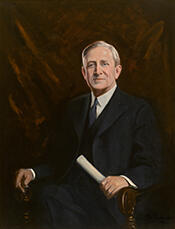
Here you will find contact information for Senator Morris Sheppard, including email address, phone number, and mailing address.
| Name | Morris Sheppard |
| Position | Senator |
| State | Texas |
| Party | Democratic |
| Status | Former Representative |
| Term Start | November 9, 1903 |
| Term End | December 31, 1941 |
| Terms Served | 10 |
| Born | May 28, 1875 |
| Gender | Male |
| Bioguide ID | S000337 |
About Senator Morris Sheppard
John Morris Sheppard (May 28, 1875 – April 9, 1941) was a Democratic United States Representative and United States Senator from Texas who served in Congress from 1903 until his death in 1941. Over the course of ten terms in office, he became one of the most influential Southern progressives of his era and was best known as the principal author of the Eighteenth Amendment establishing national Prohibition, for which he was widely referred to as “the father of national Prohibition.” His long tenure in the Senate spanned the Progressive Era, World War I, the interwar period, and the New Deal, during which he consistently represented the interests of his Texas constituents while advancing a national reform agenda.
Sheppard was born in Morris County, Texas, on May 28, 1875, into a politically active family; his father, John Levi Sheppard, served as a Democratic member of the U.S. House of Representatives from Texas. Raised in East Texas, he was exposed early to public affairs and the legal profession, experiences that helped shape his interest in law and politics. After attending local schools, he pursued higher education with the intention of entering public life, reflecting the family tradition of political service that would later continue through his descendants.
Sheppard studied at the University of Texas at Austin and subsequently attended the University of Virginia School of Law, where he received legal training that prepared him for a career at the bar and in public office. After completing his legal studies, he was admitted to the bar and began practicing law in Texas. His legal career, combined with his family’s political connections and his own growing reputation as a capable advocate, positioned him for election to Congress at a relatively young age.
Sheppard entered national politics in 1902, when he was elected as a Democrat to the United States House of Representatives to fill the vacancy caused by the death of his father. He took his seat in the Fifty-seventh Congress and was subsequently reelected, serving in the House from November 4, 1902, until his election to the Senate. In the House, he aligned with the progressive wing of the Democratic Party, supporting reforms in areas such as banking, agriculture, and social policy. His legislative work and party loyalty quickly made him a prominent figure in the Texas delegation and a natural candidate for higher office.
In 1913, Sheppard was elected by the Texas Legislature to the United States Senate, where he would serve continuously until his death on April 9, 1941. His Senate service, which began before the direct election of senators under the Seventeenth Amendment and extended through the administrations of multiple presidents, coincided with a significant period in American history. As a senator, Morris Sheppard participated actively in the democratic process, contributing to the legislative work of the Progressive Era, World War I mobilization, and the New Deal. He was a strong advocate of agrarian interests, rural credit, and military preparedness, and he supported many of President Franklin D. Roosevelt’s New Deal measures, reflecting his commitment to federal action in times of economic crisis.
Sheppard’s most enduring national legacy came through his leadership in the temperance movement. A committed prohibitionist, he authored the Eighteenth Amendment to the United States Constitution, which established national Prohibition, and introduced it in the Senate. His central role in drafting and advancing the amendment, as well as in supporting the subsequent Volstead Act that provided for its enforcement, earned him the sobriquet “the father of national Prohibition.” Even after Prohibition’s repeal by the Twenty-first Amendment in 1933, he remained identified with the cause and continued to support temperance measures, underscoring his reputation as a moral reformer as well as a political leader.
On December 1, 1909, Sheppard married Lucile Sanderson. The couple had three daughters: Susan, Lucile, and Janet. Their family would go on to produce several notable public officials and jurists, extending Sheppard’s influence well beyond his own lifetime. Through their daughter Susan, Sheppard and his wife were the grandparents of Connie Mack III, a Republican U.S. Representative and later U.S. Senator from Florida, and the great-grandparents of Connie Mack IV, a Republican U.S. Representative from Florida. Through their daughter Janet, they were also the grandparents of Richard Sheppard Arnold (1936–2004) and Morris Sheppard “Buzz” Arnold (born 1941), who served at different times as judges on the United States District Court for the Western District of Arkansas and later concurrently on the United States Court of Appeals for the Eighth Circuit—the only brothers to serve concurrently on a U.S. federal court of appeals. The federal courthouse in Little Rock, Arkansas, is named in honor of Judge Richard Arnold, while Judge Morris Arnold continues to serve on the Eighth Circuit under senior status.
Morris Sheppard died in office on April 9, 1941, in Washington, D.C., bringing to a close nearly four decades of continuous congressional service. His career in the House and Senate, his authorship of the Eighteenth Amendment, and the prominent public roles later assumed by his descendants secured his place in American political history as a central figure in early twentieth-century reform and as a leading representative of Texas in the United States Congress.