Representative Myron Virgil George
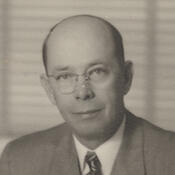
Here you will find contact information for Representative Myron Virgil George, including email address, phone number, and mailing address.
| Name | Myron Virgil George |
| Position | Representative |
| State | Kansas |
| District | 3 |
| Party | Republican |
| Status | Former Representative |
| Term Start | January 3, 1949 |
| Term End | January 3, 1959 |
| Terms Served | 5 |
| Born | January 6, 1900 |
| Gender | Male |
| Bioguide ID | G000129 |
About Representative Myron Virgil George
Myron Virgil George (January 6, 1900 – April 11, 1972) was a Republican member of the United States House of Representatives from Kansas who served five terms in Congress between 1949 and 1959. He was born in Erie, Neosho County, Kansas, the son of Frank E. George and Elizabeth (née Kyle) George. Raised in southeastern Kansas, he attended local grade schools and completed his secondary education at Labette County High School in Altamont, Kansas. Growing up in a family involved in the newspaper business, he learned the printing trade at the Altamont Journal, a paper published by his father, acquiring skills that would shape his early professional life.
In April 1917, shortly after the United States entered World War I, George enlisted in the United States Army. He served as a corporal, performing stateside duty during the conflict, and remained in uniform until his discharge in May 1919. Returning to Kansas after the war, he resumed work in the printing and newspaper field, consolidating his experience in publishing and local affairs. On April 2, 1923, he married Hazel Eplee in Parsons, Kansas. The couple made their home in southeastern Kansas and had three children: Elaine, Don, and Richard, establishing deep personal and civic ties to the region he would later represent in Congress.
George’s early career was rooted in journalism and small-town publishing. From 1924 to 1941 he was the owner and publisher of the Edna Sun in Edna, Kansas. In that role he managed all aspects of a community newspaper, from reporting and editing to printing and business operations, which brought him into close contact with local issues, business leaders, and public officials. His work as a publisher helped build his reputation as a civic-minded citizen and provided a platform for engagement in public affairs at the county and state levels.
Transitioning from journalism to public administration, George became an officer with the Kansas State Highway Commission, serving from 1939 to 1950. His tenure coincided with a period of expansion and modernization of transportation infrastructure in Kansas, and his responsibilities placed him at the intersection of state government, local communities, and the growing demands of automobile travel and commerce. This experience in transportation policy and administration broadened his understanding of public works, economic development, and the practical implications of government programs, preparing him for national legislative service.
Myron Virgil George entered Congress as a Republican from Kansas during a significant period in American history, marked by the early Cold War, the Korean War, and the beginnings of the modern civil rights movement. He was elected to the Eighty-first Congress on November 7, 1950, in a special election to fill the vacancy caused by the death of Representative Herbert Alton Meyer, and at the same time was elected to a full term in the Eighty-second Congress. He was subsequently reelected to the three succeeding Congresses, serving continuously from November 7, 1950, to January 3, 1959. Over the course of these five terms, he participated in the legislative process and represented the interests of his Kansas constituents in the U.S. House of Representatives, contributing to debates and votes on domestic policy, infrastructure, agriculture, and national security.
During his congressional service, George aligned with the Republican Party on most major issues of the era while also supporting key bipartisan measures. Notably, he voted in favor of the Civil Rights Act of 1957, the first federal civil rights legislation enacted since Reconstruction, which aimed to protect voting rights for African Americans. His support for this legislation placed him among those members of Congress willing to endorse incremental federal action on civil rights at a time of growing national attention to racial inequality. His background in transportation and public works also informed his attention to infrastructure and economic development matters affecting Kansas and the broader region.
In 1958, George was an unsuccessful candidate for reelection to the Eighty-sixth Congress, bringing his formal congressional career to a close at the start of 1959. After leaving office, he remained active in professional life, engaging in public relations work in the transportation and construction fields. Drawing on his experience with the Kansas State Highway Commission and his legislative background, he advised and represented interests connected to infrastructure development and related industries, maintaining his longstanding association with public works and economic growth.
George continued to reside in Parsons, Kansas, in the years following his congressional service, remaining part of the community in which he had lived for much of his adult life. He died in Parsons on April 11, 1972. He was interred in Memorial Lawn Cemetery, leaving a legacy as a World War I veteran, newspaperman, state official, and five-term U.S. Representative who served Kansas during a transformative period in mid-twentieth-century American history.