Representative Nathan Ball Bradley
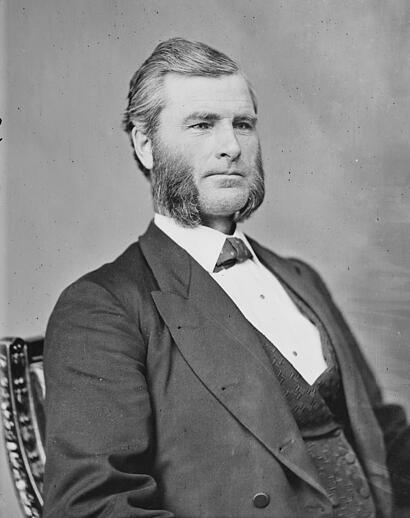
Here you will find contact information for Representative Nathan Ball Bradley, including email address, phone number, and mailing address.
| Name | Nathan Ball Bradley |
| Position | Representative |
| State | Michigan |
| District | 8 |
| Party | Republican |
| Status | Former Representative |
| Term Start | December 1, 1873 |
| Term End | March 3, 1877 |
| Terms Served | 2 |
| Born | May 28, 1831 |
| Gender | Male |
| Bioguide ID | B000744 |
About Representative Nathan Ball Bradley
Nathan Ball Bradley (May 28, 1831 – November 8, 1906) was an American politician and businessman from the state of Michigan who served as a Republican Representative in the United States House of Representatives from 1873 to 1877. He was the first person to represent Michigan’s newly created 8th congressional district and served two consecutive terms in Congress during a significant period in American history, participating in the legislative process and representing the interests of his constituents.
Bradley was born on May 28, 1831, in Lee, Berkshire County, Massachusetts. In 1835 he moved with his parents to Lorain County, Ohio, where he attended the common schools. As a young man he entered the lumber trade, moving in 1849 to Wisconsin, where he was employed in a sawmill in the pine region. In 1850 he returned to Ohio and built and operated a sawmill there until 1852, gaining early experience in both the technical and commercial aspects of the lumber industry.
In 1852 Bradley moved to Lexington, Michigan, and engaged in the manufacture of lumber, marking the beginning of his long association with Michigan’s forest and industrial economy. He relocated in 1855 to St. Charles in the Saginaw Valley, where he continued in the lumber business. Expanding his operations, he purchased a mill in Bay City, Michigan, which he operated from 1858 to 1864. During this period he also entered the salt industry in Bay City, contributing to the development of that important regional enterprise.
Bradley’s growing prominence in Bay City’s business community led naturally to public service at the local level. He served as justice of the peace for three terms, as a supervisor for one term, and as an alderman for three terms. When Bay City obtained its charter in 1865, he was elected its first mayor, underscoring his leadership role in the city’s early municipal development. He further broadened his interests by engaging in banking, and in 1867 he became vice president of the First National Bank of Bay City, reflecting his standing in local financial circles.
At the state level, Bradley served as a member of the Michigan State Senate from 1866 to 1868. His legislative experience in Lansing, combined with his business background and local offices, positioned him for higher national office. A member of the Republican Party, he was elected as a Republican to the United States House of Representatives as the first representative of Michigan’s 8th congressional district. He served in the 43rd and 44th Congresses from March 4, 1873, to March 3, 1877. During his two terms in office, Bradley contributed to the legislative process in the House of Representatives at a time of post–Civil War reconstruction and industrial expansion, participating in the democratic process and advocating for the interests of his district. He was not a candidate for renomination in 1876.
After leaving Congress in 1877, Bradley returned to Bay City and resumed his involvement in the lumber business. He continued to play a role in the economic development of Michigan and was instrumental in establishing the first beet-sugar factory in the state, helping to diversify Michigan’s industrial and agricultural base. His post-congressional career thus combined continued business leadership with efforts to foster new industries.
Nathan Ball Bradley died in Bay City, Michigan, on November 8, 1906. He was interred in Elm Lawn Cemetery in Bay City. His life reflected the trajectory of a nineteenth-century American entrepreneur who rose from the lumber and salt industries to local and state office, and ultimately to the United States Congress, where he served two terms as a Republican representative from Michigan during a formative era in the nation’s history.