Representative Nathan David Perlman
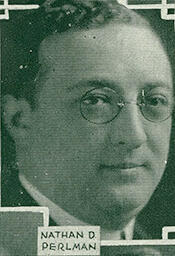
Here you will find contact information for Representative Nathan David Perlman, including email address, phone number, and mailing address.
| Name | Nathan David Perlman |
| Position | Representative |
| State | New York |
| District | 14 |
| Party | Republican |
| Status | Former Representative |
| Term Start | May 19, 1919 |
| Term End | March 4, 1927 |
| Terms Served | 4 |
| Born | August 2, 1887 |
| Gender | Male |
| Bioguide ID | P000239 |
About Representative Nathan David Perlman
Nathan David Perlman (August 2, 1887 – June 29, 1952) was an American lawyer, jurist, and Republican politician from New York who served as a member of the U.S. House of Representatives from 1919 to 1927. Over the course of four terms in Congress, he contributed to the legislative process during a significant period in American history, participating in the democratic process and representing the interests of his New York constituents.
Perlman was born in Prusice, Congress Poland (then part of the Russian Empire), on August 2, 1887. In 1891 he immigrated to the United States with his mother, and the family settled in New York City. He attended the public schools of New York City and went on to pursue higher education at the College of the City of New York. He subsequently studied law at New York University Law School, from which he graduated in 1907. Perlman was admitted to the New York bar in 1909 and began practicing law in New York City, establishing himself professionally in the city’s legal community.
Perlman entered public service early in his legal career. From 1912 to 1914 he served as a Special Deputy New York Attorney General, gaining experience in state-level legal and governmental affairs. He then won election to the New York State Assembly, representing New York County’s 6th District, and served as an assemblyman in 1915, 1916, and 1917. In the Assembly he participated in state legislative deliberations at a time of rapid social and political change in New York, further building his reputation as a Republican lawmaker.
Perlman’s congressional career began when he was elected as a Republican to the 66th United States Congress to fill the vacancy caused by the resignation of Fiorello H. La Guardia. He took his seat on November 2, 1920, and was subsequently re-elected to the 67th, 68th, and 69th Congresses. He held office from November 2, 1920, to March 3, 1927, serving a total of four terms as a Representative from New York. During these years, which encompassed the early 1920s and the beginning of the Prohibition era, Perlman participated in the legislative work of the House of Representatives and represented the concerns of his urban constituency in New York City, contributing to debates and policymaking during a formative period in modern American political and economic life.
After leaving Congress in 1927, Perlman resumed the practice of law in New York City. He remained active in public affairs and in Republican politics. He served as a delegate to the New York State convention called to consider and enact the Twenty-first Amendment to the United States Constitution, which repealed national Prohibition. His legal and political experience led to judicial responsibilities in New York City: he was appointed a New York City Magistrate and served in that capacity from May 1, 1935, to September 1, 1936.
Perlman continued to seek higher office and broader influence in state government. At the New York state election of 1936, he ran on the Republican ticket for New York Attorney General but was defeated by the incumbent, John J. Bennett Jr. Later that year, on November 26, 1936, Perlman was appointed a justice of the Court of Special Sessions of the City of New York, a court handling criminal matters in the city. He was reappointed to that court on July 1, 1945, reflecting sustained confidence in his judicial service. During the 1930s, amid the rise of Nazism abroad and the activities of the German American Bund in the United States, Perlman sought to disrupt Bund rallies in New York but found no legal basis to do so. Setting the law aside, he entered into a clandestine arrangement with organized crime figure Meyer Lansky, enlisting Jewish mobsters to violently attack and break up these rallies, a campaign of disruption that continued for months.
In addition to his judicial career, Perlman was a prominent figure in American Jewish communal life. He served as a senior official of the American Jewish Congress, an organization that advocated for Jewish rights and interests in the United States and abroad. In 1945, in the aftermath of World War II, he consulted with and provided assistance to U.S. Supreme Court Justice Robert H. Jackson, President Harry S. Truman’s appointee as chief United States prosecutor of Nazi war criminals. In this role, Perlman contributed to the legal and evidentiary groundwork surrounding the prosecution of Nazi leaders, aligning his legal expertise with his longstanding concern for Jewish welfare and justice.
Nathan David Perlman died on June 29, 1952, at Beth Israel Hospital in New York City. He was buried at Mount Hebron Cemetery in Queens, New York. His career encompassed service as a legislator at both the state and federal levels, as a judge in New York City’s courts, and as a leader in American Jewish organizations during a period marked by profound domestic and international upheaval.