Representative Nathaniel Barratt Smithers
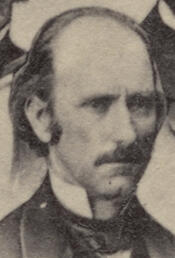
Here you will find contact information for Representative Nathaniel Barratt Smithers, including email address, phone number, and mailing address.
| Name | Nathaniel Barratt Smithers |
| Position | Representative |
| State | Delaware |
| District | At-Large |
| Party | Unconditional Unionist |
| Status | Former Representative |
| Term Start | December 7, 1863 |
| Term End | March 3, 1865 |
| Terms Served | 1 |
| Born | October 8, 1818 |
| Gender | Male |
| Bioguide ID | S000642 |
About Representative Nathaniel Barratt Smithers
Nathaniel Barratt Smithers (October 8, 1818 – January 16, 1896) was an American lawyer and politician from Dover, in Kent County, Delaware, who served as a Representative from Delaware in the United States Congress from 1863 to 1865. A member of the Republican Party and identified in Congress with the Unconditional Unionist Party during the Civil War, he represented Delaware for one term in the U.S. House of Representatives and contributed to the legislative process at a critical moment in American history.
Smithers was born in Dover, Delaware, the son of Nathaniel Smithers, the county prothonotary, and Susan Fisher Barratt Smithers. He received his early education at Ezra Scovell’s school in Dover and later attended the West Nottingham Academy in Maryland, where he studied under the Rev. James Magraw. He continued his education at Lafayette College in Easton, Pennsylvania, earning his undergraduate degree in 1836. He then entered the law department of Dickinson College in Carlisle, Pennsylvania, with the class of 1840, preparing for a legal career that would underpin his later political activities.
After completing his legal studies, Smithers was admitted to the Delaware bar in 1841 and commenced the practice of law in Dover. His professional work quickly established him as a prominent member of the local bar. In his personal life, he married his half-cousin, Mary Smithers, with whom he had four children, only one of whom survived into adulthood. Mary was the sister of diplomat Enoch Joyce Smithers, linking Nathaniel Smithers to a wider network of public service. Following Mary’s death, he married Mary Barratt Townsend of Frederica, Delaware, further consolidating his ties within the state’s leading families.
Smithers began his political career as a member of the Whig Party. Although he declined a Whig nomination to run for Congress in 1844, he served as clerk of the Delaware General Assembly in 1845 and again in 1847, gaining experience in legislative procedure and state politics. He was a delegate to the Whig National Convention in Philadelphia in 1848 that nominated Millard Fillmore. Over time, however, he became estranged from the mainstream Whigs in Delaware, particularly after the party rejected proposals for the gradual abolition of slavery and supported local option on alcohol in 1847. In the 1850s he cooperated with the American Party, though he never formally joined it. As the political landscape realigned on the eve of the Civil War, he emerged as a leading Republican in Delaware and chaired the state delegation to the 1860 Republican National Convention in Chicago, which nominated Abraham Lincoln for the presidency.
With the outbreak of the Civil War, Smithers’s Unionist and antislavery views placed him at the forefront of Delaware’s loyalist politics. He was appointed Secretary of State of Delaware under Governor William Cannon and served from January 20, 1863, until November 23, 1863. That year he was elected to the U.S. House of Representatives to fill the vacancy caused by the death of Democratic Representative William Temple. Taking his seat in the Thirty-eighth Congress, he served from 1863 to 1865 as Delaware’s at-large Representative. During his term, he was identified with the Unconditional Unionist Party in Congress, reflecting his firm support for the Union war effort. Smithers served on the important Special Committee on Reconstruction, where he participated in early congressional debates over the conditions under which former Confederate states would be readmitted to the Union. In that capacity, he helped block efforts by representatives from Arkansas and Louisiana to secure early readmission. He also played a role in shepherding through Congress an amendment that abolished the practice of purchasing relief from the military draft, thereby closing a controversial loophole in the Union’s conscription system. In 1864 he attended the Baltimore Republican National Convention as a member of the executive committee; while he supported the party’s war aims, he did not support the nomination of Andrew Johnson for vice president.
As the candidate of the Union Party in Delaware, Smithers sought reelection in 1864 but was defeated by Democrat John A. Nicholson. His single term in Congress thus coincided entirely with the latter half of the Civil War, a period in which he participated in the democratic process and represented the interests of his Delaware constituents while supporting national policies aimed at preserving the Union and shaping Reconstruction. After leaving Congress in March 1865, he returned to private legal practice in Dover. In his law office he mentored younger attorneys, including James Pennewill, who would later become a long-serving Chief Justice of Delaware, thereby extending Smithers’s influence on the state’s legal and judicial life.
In the decades following his congressional service, Smithers remained active in Republican politics and in civic affairs. He continued to lead the Delaware Republican delegation to national conventions, supporting Ulysses S. Grant for president in 1868 and voting for James G. Blaine at the Republican National Convention in 1880. In Dover he broadened his public service beyond law and politics, serving as president of the First National Bank and as a member of the local school board, where he contributed to the community’s financial and educational development. In recognition of his professional achievements and public service, Dickinson College awarded him an honorary doctorate in 1890, honoring both his early association with the institution and his long career in law and politics.
Nathaniel Barratt Smithers died in Dover on January 16, 1896. He was buried in the Old Methodist, also known as Whatcoat, Cemetery in Dover. His life and career spanned the antebellum, Civil War, and Reconstruction eras, and his work as a lawyer, state official, and member of Congress reflected Delaware’s complex position as a border state committed to the Union during one of the most consequential periods in American history.