Representative Nelson Ira Norton
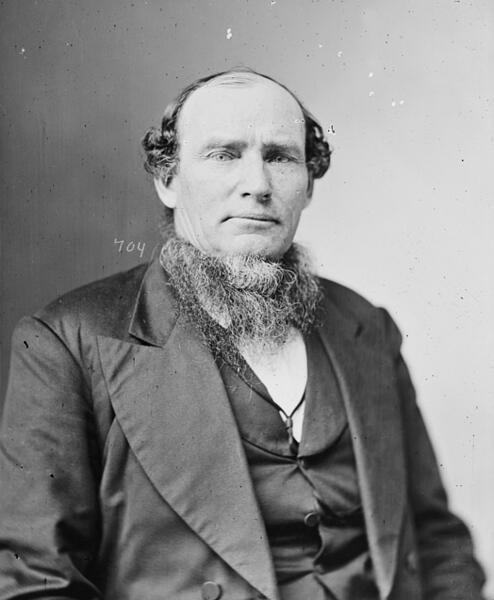
Here you will find contact information for Representative Nelson Ira Norton, including email address, phone number, and mailing address.
| Name | Nelson Ira Norton |
| Position | Representative |
| State | New York |
| District | 33 |
| Party | Republican |
| Status | Former Representative |
| Term Start | December 6, 1875 |
| Term End | March 3, 1877 |
| Terms Served | 1 |
| Born | March 30, 1820 |
| Gender | Male |
| Bioguide ID | N000155 |
About Representative Nelson Ira Norton
Nelson Ira Norton (March 30, 1820 – October 28, 1887) was an American politician and a United States Representative from New York. He was born near Salamanca, in the town of Great Valley, Cattaraugus County, New York, the son of Ira Norton and Lucy Perkins Norton. Norton received a limited formal education in the local schools and, like many in his rural community, engaged in agricultural pursuits from an early age. His early life in western New York, then a developing region of the state, shaped his familiarity with farming, local trade, and the practical concerns of small-town residents that would later inform his public service.
On February 15, 1847, Norton married Mary Ermina Parker, a teacher in Great Valley, New York, whom he had met while she was teaching there; some accounts note that they married on June 23, 1847, seven years after they first became acquainted. After their marriage, Norton formed a partnership with Alonzo Hawley in a general merchandise business, reflecting his growing involvement in local commerce as well as agriculture. During this period he also became one of the first postmasters of the Town of Hinsdale, New York, serving under Presidents James K. Polk and Zachary Taylor. His combined roles as farmer, merchant, and postmaster placed him at the center of community life and laid the groundwork for his entry into elective office.
Norton’s public career began at the town and county level, where he quickly emerged as a prominent local official. He served as a Justice of the Peace for twenty consecutive years, from 1852 to 1870, and was still serving in this capacity at the time of his death. He was supervisor of the town of Hinsdale in the years 1860, 1861, 1865, 1866, and 1869, and is also recorded as a supervisor of Cattaraugus County in 1860 and again from 1865 to 1867. These positions gave him responsibility for local governance, finance, and administration during a period that encompassed the Civil War and its immediate aftermath, when questions of loyalty, infrastructure, and economic recovery were pressing concerns in New York’s rural communities.
Norton advanced to state-level politics as a member of the New York State Assembly, representing the 1st District of Cattaraugus County. He served in the Assembly in 1861 and 1862, participating in state legislative deliberations during the opening years of the Civil War. Later accounts also note that he served in the legislature from 1872 to 1874, reflecting his continued influence in state affairs. In 1872 he was chosen as one of the presidential electors from New York, taking part in the Electoral College in the presidential election of that year. Throughout these years he was aligned with the Republican Party, which had become the dominant political force in much of upstate New York following the 1850s.
Norton’s congressional service came during a significant period in American history, as the nation grappled with the end of Reconstruction and the political realignments of the 1870s. A member of the Republican Party, he was elected to the Forty-fourth United States Congress to fill the vacancy caused by the death of Representative-elect Augustus F. Allen. He took his seat in the U.S. House of Representatives on December 6, 1875, and served until March 3, 1877, completing one full term. During this time he represented the interests of his New York constituents, contributed to the legislative process, and participated in the democratic governance of the post–Civil War United States. His tenure coincided with debates over federal spending, civil service reform, and the lingering issues of Reconstruction, although detailed records of his specific committee assignments and sponsored legislation are limited.
After leaving Congress in 1877, Norton resumed his agricultural pursuits and returned to his longstanding role as a community leader in Hinsdale and Cattaraugus County. He continued to be identified with farming and local business, maintaining the pattern of alternating between public service and private enterprise that had characterized much of his adult life. His reputation as a steady local official—particularly through his long service as Justice of the Peace and multiple terms as town supervisor—remained an important part of his legacy in the region.
Nelson Ira Norton died on October 28, 1887, at the age of 67 years, 7 months, and 28 days. He was interred at Hinsdale Cemetery in Hinsdale, New York. At the time of his death he was still serving as Justice of the Peace, underscoring his lifelong engagement in local governance. His career, spanning town, county, state, and national office, reflected the trajectory of a nineteenth-century rural politician who rose from modest beginnings in Great Valley to represent New York in the United States Congress while remaining closely tied to the agricultural and civic life of his home community.