Representative Nelson Platt Wheeler
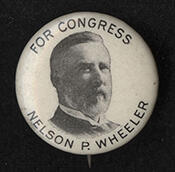
Here you will find contact information for Representative Nelson Platt Wheeler, including email address, phone number, and mailing address.
| Name | Nelson Platt Wheeler |
| Position | Representative |
| State | Pennsylvania |
| District | 28 |
| Party | Republican |
| Status | Former Representative |
| Term Start | December 2, 1907 |
| Term End | March 3, 1911 |
| Terms Served | 2 |
| Born | November 4, 1841 |
| Gender | Male |
| Bioguide ID | W000340 |
About Representative Nelson Platt Wheeler
Nelson Platt Wheeler (November 4, 1841 – March 3, 1920) was a U.S. Representative from the state of Pennsylvania who served in the United States Congress from 1907 to 1911. A member of the Republican Party, he represented his constituents during a significant period in American history, contributing to the legislative process over two terms in office. His career in public service reflected the political and economic currents of the early twentieth century, as the nation grappled with industrial growth, regulatory reform, and evolving party politics.
Born on November 4, 1841, Wheeler came of age in the decades leading up to and following the Civil War, a formative era that shaped the political and social environment in which he would later serve. Although detailed records of his early life and family background are limited, his subsequent professional and political activities suggest that he was influenced by the economic development and civic life of Pennsylvania during the latter half of the nineteenth century. Growing up in this context likely exposed him to the issues of infrastructure, commerce, and governance that would later inform his public career.
Information about Wheeler’s formal education is sparse, but like many public figures of his generation, he appears to have combined practical experience with whatever schooling was available to him locally. In an era when higher education was not a prerequisite for public office, it was common for future legislators to build their reputations through business, local government, or community leadership. Wheeler’s later election to Congress indicates that he achieved a level of standing and respect within his community that enabled him to enter national politics.
Before his election to Congress, Wheeler developed the professional and civic profile that would support his political ambitions. While specific details of his early career are not extensively documented, his eventual rise to the U.S. House of Representatives suggests prior involvement in local or regional affairs, likely including participation in Republican Party activities and engagement with the economic interests of his district. Through these roles he would have become familiar with the concerns of Pennsylvania voters, particularly those related to industry, transportation, and agriculture, which were central to the state’s economy at the turn of the century.
Wheeler’s congressional service began in 1907, when he took his seat in the U.S. House of Representatives as a Republican from Pennsylvania. Serving two terms, from 1907 to 1911, he participated in the democratic process during a period marked by the Progressive Era’s early reforms, debates over regulation of business, and questions of federal authority. As a member of the House of Representatives, Nelson Platt Wheeler represented the interests of his constituents, contributing to deliberations on legislation that affected both Pennsylvania and the nation. His tenure coincided with the administrations of Presidents Theodore Roosevelt and William Howard Taft, when Congress addressed issues such as tariff policy, corporate oversight, and improvements in infrastructure.
During his time in Congress, Wheeler’s work reflected the responsibilities of a representative from an industrial and resource-rich state. He took part in the legislative process that shaped federal policy in these years, aligning with the Republican Party’s positions while responding to the specific needs of his district. Although the detailed record of his committee assignments and sponsored measures is limited in surviving summaries, his service from 1907 to 1911 placed him within the broader Republican majority that influenced national economic and regulatory policy in the pre–World War I era.
After leaving Congress in 1911, Wheeler returned to private life, concluding his direct role in national legislative affairs. In the years following his congressional service, he lived through a period that included the continued expansion of American industry and the approach of World War I, observing from outside the Capitol the further evolution of many issues he had encountered during his tenure. Nelson Platt Wheeler died on March 3, 1920, closing a life that spanned from the antebellum United States through the Progressive Era. His career as a Republican representative from Pennsylvania remains part of the historical record of early twentieth-century congressional service.