Senator Newton Booth
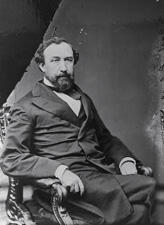
Here you will find contact information for Senator Newton Booth, including email address, phone number, and mailing address.
| Name | Newton Booth |
| Position | Senator |
| State | California |
| Party | Republican |
| Status | Former Representative |
| Term Start | December 6, 1875 |
| Term End | March 3, 1881 |
| Terms Served | 1 |
| Born | December 30, 1825 |
| Gender | Male |
| Bioguide ID | B000630 |
About Senator Newton Booth
Newton Booth (December 30, 1825 – July 14, 1892) was an American entrepreneur, lawyer, and politician who served as the eleventh governor of California from 1871 to 1875 and as a United States Senator from California from 1875 to 1881. A member of the Republican Party in state politics and later the only member of the Anti-Monopoly Party ever elected to the U.S. Senate, he played a notable role in California’s political and commercial life in the decades following the Gold Rush.
Booth was born in Salem, Washington County, Indiana, to Beebe Booth of Connecticut and Hannah (née Pitts) of North Carolina, both Quakers. He attended the common schools of Salem, and in 1841 his parents moved the family to Terre Haute, Indiana. Seeking higher education, Booth enrolled at Asbury College in Greencastle, Indiana (later renamed DePauw University), from which he graduated in 1846. After college he worked in his father’s store in Terre Haute and then read law in the office of attorney William Dickson Griswold. He was admitted to the bar in 1849 and became Griswold’s law partner, beginning a legal career that would intersect closely with his later business and political pursuits.
In 1850, drawn by the opportunities of the Pacific Coast, Booth traveled to Panama and continued by ship to San Francisco, California. He soon made his way to Sacramento, where a severe cholera epidemic was underway, prompting him to spend a period in Amador County, where he himself fell ill before recovering. Booth entered the burgeoning mercantile trade associated with the Gold Rush economy. Members of his extended family, including his cousin Lucius Anson Booth, had already helped organize the firm of Lindley & Booth in 1849. In May 1850, John Forshee, Lucius Anson Booth, and John Dye established Forshee, Booth & Co., and in early 1851 Booth joined Charles Smith in the firm of Smith & Booth on J Street in Sacramento. These and related enterprises, including Kleinhaus & Co. founded in 1852, were part of a complex and evolving wholesale and retail trade in groceries and provisions that served the mining camps and growing towns of northern California. The Sacramento Fire of November 2, 1852, damaged these businesses, but the firm was reorganized as Booth & Co., which continued until 1856, when Booth retired from the partnership and returned to Indiana. Although later accounts sometimes noted that Booth made his fortune as a saloon keeper, his principal and sustained success came in the wholesale mercantile and grocery trade.
Returning to Terre Haute in 1856, Booth resumed the practice of law, forming a partnership with Harvey D. Scott, who would later serve as a U.S. Representative from Indiana. In the summer of 1857 he traveled through Europe, broadening his experience before ultimately deciding to reestablish himself on the Pacific Coast. By 1860 he had returned to Sacramento and reentered the wholesale mercantile business. Over the next decade the firm that bore his name went through several reorganizations: Booth again entered the firm after 1860; Lucius Anson Booth and T. L. Barker retired in 1862, and Joseph Terry Glover of San Francisco became a partner; and by December 1871 the business had expanded with an associated operation in San Francisco in connection with W. W. Dodge. By 1878 the firm was composed of Newton Booth, C. T. Wheeler, Joseph Terry Glover, and W. W. Dodge. Booth’s commercial success provided both the financial base and the public prominence that underpinned his political career.
Booth’s formal political life began in California during the Civil War era. A committed supporter of the Union, he campaigned for Abraham Lincoln’s presidential candidacy in 1860. In 1862 he was elected to the California State Senate as a Republican, serving from 1863 to 1865. During this period he emerged as a critic of entrenched economic interests and an advocate of broader participation in the political process, including openly seeking Black support in a state where African Americans still faced significant legal and social discrimination. His reputation as an independent-minded reformer and successful businessman made him a viable candidate for higher office in the postwar years.
In 1871 Booth was elected the eleventh governor of California as a Republican, assuming office on December 8, 1871. His governorship coincided with a period of rapid economic expansion, intense railroad development, and growing public concern over monopolistic practices. Booth became associated with the anti-monopoly movement that criticized the political influence of the large railroad corporations, particularly the Central Pacific Railroad. In 1873 he helped organize an independent, anti-monopoly political organization in California known as the “Dolly Vardens,” an eclectic coalition described as a party of “sore heads from any party or by any name,” its title drawn from a multicolored calico pattern suggesting a mixture of diverse elements. While still serving as governor, Booth was elected by the California legislature in December 1873 to the United States Senate as a member of the Anti-Monopoly Party, reflecting both his Republican roots and his alignment with insurgent economic reformers. He resigned the governorship on February 27, 1875, in anticipation of his Senate term, which began on March 4, 1875.
Booth served one term in the U.S. Senate, representing California from March 4, 1875, to March 3, 1881, during a significant period in American history marked by the end of Reconstruction and the consolidation of industrial capitalism. Although his state-level affiliation had been Republican, his election as an Anti-Monopoly Party candidate made him the only member of that party ever to sit in the Senate, and, as of 2021, the only California senator to have served as a member of a third party. In the Senate he participated fully in the legislative process and represented the interests of his California constituents, focusing particularly on economic and industrial issues. During the 45th Congress he served as chairman of the Senate Committee on Manufacturers and the Senate Committee on Patents, positions that placed him at the center of debates over industrial regulation, intellectual property, and the broader relationship between government and business. In 1876 the Greenback Party nominated him for Vice President of the United States on a national ticket with Peter Cooper, but Booth declined the nomination, and Samuel F. Cary was chosen in his place. He did not seek reelection to the Senate in 1880 and concluded his congressional service at the end of his term in 1881.
After leaving the Senate, Booth returned to private life and to the wholesale mercantile business in Sacramento that had long been the foundation of his wealth. He remained a respected figure in California’s commercial and civic circles. On February 9, 1892, he married Octavine C. Glover (1833–1907), the widow of his former business partner Joseph Terry Glover. Later that year, on July 14, 1892, Booth died in Sacramento. He was interred in the Sacramento Historic City Cemetery, in a family plot that also includes his wife Octavine, her mother Eliza Payne (1810–1873), her sister Julia E. Dunn (1839–1923), and her brother William Henry Payne (1848–1919). Booth was also the uncle of the novelist Booth Tarkington, the son of his sister Elizabeth Booth, who was raised in Terre Haute, Indiana. His name endures in Sacramento’s Newton Booth neighborhood and in historical markers such as the Native Sons of the Golden West plaque placed before the Booth Company wholesale grocery building on Front Street in Old Sacramento, commemorating his dual legacy as a businessman and public servant.