Senator Nicholas Brady
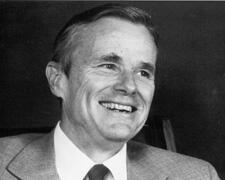
Here you will find contact information for Senator Nicholas Brady, including email address, phone number, and mailing address.
| Name | Nicholas Brady |
| Position | Senator |
| State | New Jersey |
| Party | Republican |
| Status | Former Representative |
| Term Start | January 3, 1981 |
| Term End | January 3, 1983 |
| Terms Served | 1 |
| Born | April 11, 1930 |
| Gender | Male |
| Bioguide ID | B000756 |
About Senator Nicholas Brady
Nicholas Frederick Brady (born April 11, 1930) is an American banker and politician from New Jersey who briefly served in the United States Senate for eight months in 1982 and later served as the 68th United States Secretary of the Treasury under Presidents Ronald Reagan and George H. W. Bush from 1988 to 1993. A member of the Republican Party, he emerged as an influential figure in both state and national politics and in international finance, and, as of 2025, is the last Republican to have held New Jersey’s Class 1 United States Senate seat. In September 2024, following the death of Daniel J. Evans, he became the oldest living former United States senator.
Brady built his early career in finance and public affairs in New Jersey, where he became active in Republican Party politics. He served as the Republican committeeman of Somerset County, New Jersey, a role that placed him among the key organizers and strategists for the party at the county level. His reputation as a capable administrator and advisor led to his selection in 1981 as head of the transition team for Thomas Kean following Kean’s election as Governor of New Jersey. In that capacity, Brady helped organize the incoming administration and contributed to shaping its early policy and personnel decisions, further solidifying his standing within state Republican circles and introducing him more prominently into public life.
Brady’s brief but notable congressional service came in the context of a major political scandal and a closely watched Senate succession. In 1982, Governor Kean faced the duty of filling the vacant United States Senate seat caused by the resignation of Senator Harrison A. Williams, who stepped down following his conviction for bribery in the Abscam investigation and an impending expulsion vote. Williams had delayed his resignation for ten months after his conviction, thereby preventing Democratic Governor Brendan Byrne from appointing a successor, and ultimately resigned only after New Jersey’s junior senator, Bill Bradley, announced on March 10, 1982, that he would vote for expulsion. By the time of Williams’s resignation, two Republican candidates—Representative Millicent Fenwick and conservative activist Jeff Bell—were already competing for the next full Senate term, and Representative Jim Courter had considered but ultimately declined a Senate run. After a month of deliberation and consultation with more than one hundred state and local Republicans, Governor Kean chose to remain neutral in the primary contest and appointed Brady as a non-candidate caretaker to complete the unexpired term.
Appointed in April 1982, Nicholas Frederick Brady served as a senator from New Jersey in the United States Congress from April 12, 1982, to December 27, 1982, a period of approximately eight months. During this single term in office, he contributed to the legislative process and represented the interests of his New Jersey constituents during a significant period in American history. While in the Senate, Brady served on the United States Senate Committee on Armed Services and the United States Senate Committee on Banking, Housing, and Urban Affairs, assignments that reflected both his interest in national security and his professional background in finance. He did not seek election to a full term and resigned from office before the expiration of the term so that Democrat Frank Lautenberg, the winner of the 1982 election, could enter the Senate early and gain seniority. As of 2025, Brady remains the last Republican to have held New Jersey’s Class 1 Senate seat.
Brady’s most prominent national service came later as Secretary of the Treasury. He became the 68th United States Secretary of the Treasury on September 15, 1988, initially serving during the final four months of President Ronald Reagan’s administration and then throughout the presidency of George H. W. Bush until 1993. As Treasury Secretary, he confronted pressing issues in domestic finance and international debt. In 1989, after several years in which a number of developing countries, including Mexico, had defaulted on their external debt, Brady proposed and implemented a novel debt-reduction framework that enabled these countries to restructure obligations through the issuance of United States dollar‑denominated instruments known as Brady Bonds. This “Brady Plan” became a landmark in sovereign debt restructuring and significantly influenced international financial policy.
Brady’s tenure at the Treasury was closely scrutinized by the press and by members of Congress. Early in his service, The New York Times characterized his start as “rocky” and described him as “bland on television and awkward as a public speaker.” Nonetheless, he emerged as a close friend and advisor to President George H. W. Bush and wielded considerable influence within the administration. Contemporary observers, including Democrats, acknowledged his substantive engagement with complex policy issues. Representative Chuck Schumer of New York, then a Democratic member of the House of Representatives, reflected a prevailing bipartisan view when he remarked that while Brady was not considered “the smartest guy in the world” and had made “some major screwups,” he was “one of the few people in the Government trying to do real substance.” Schumer credited Brady for taking on difficult problems such as the savings and loan crisis and Third World debt, noting that “at least he tried to do something” and that, in an administration often perceived as focused on “image and hype,” Brady “does deserve a lot of credit.”
Beyond his governmental roles, Brady has been active in educational, civic, and policy institutions. He has served as a trustee of Rockefeller University and as a member of the Board of the Economic Club of New York, reflecting his continued engagement with economic and academic affairs. He is a member of the Council on Foreign Relations and a former member of the Steering Committee of the Bilderberg Meeting, positions that underscore his ongoing involvement in international and strategic policy discussions. He has also been a trustee of the Boys & Girls Clubs of America of Newark, New Jersey, demonstrating a commitment to youth and community development in his home state. In recognition of his professional achievements and public service, Brady received the Golden Plate Award of the American Academy of Achievement in 1977.