Representative Nick Lampson
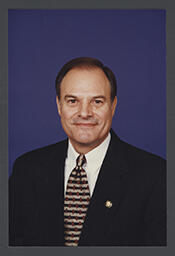
Here you will find contact information for Representative Nick Lampson, including email address, phone number, and mailing address.
| Name | Nick Lampson |
| Position | Representative |
| State | Texas |
| District | 22 |
| Party | Democratic |
| Status | Former Representative |
| Term Start | January 7, 1997 |
| Term End | January 3, 2009 |
| Terms Served | 5 |
| Born | February 14, 1945 |
| Gender | Male |
| Bioguide ID | L000043 |
About Representative Nick Lampson
Nicholas Valentino Lampson (born February 14, 1945) is an American politician and former Democratic member of the United States House of Representatives from Texas, who represented the 9th and 22nd Congressional Districts over five terms between January 3, 1997, and January 3, 2009. A lifelong resident of Southeast Texas and a second-generation Italian American, he served in Congress during a significant period in modern American political history, participating in the legislative process and representing the interests of his constituents in a region undergoing substantial demographic and political change.
Lampson was born in Beaumont, Texas, after his grandparents had immigrated from Italy roughly a century earlier and settled in Stafford, Texas, where they farmed and were founding members of their local church. His parents grew up, met, and married in Fort Bend County before moving to Beaumont, where they raised their family. One of six children born to a welder and a homemaker, Lampson experienced hardship early in life when his father died when he was 12 years old. To help support his family, he took his first job sweeping floors at that young age. His mother received $19 per month from Social Security as long as he remained in school, a modest benefit that helped keep the family together and later shaped Lampson’s strong commitment to protecting and strengthening Social Security. Although his mother had only a fifth-grade education, she emphasized the importance of schooling; all six of her children graduated from college with at least one degree, and she herself earned a GED on her 80th birthday.
Lampson attended Lamar University in Beaumont, where he became a member of the Pi Kappa Alpha fraternity. He earned a Bachelor of Science degree in biology and subsequently a master’s degree in education. After completing his studies, he taught high school science at Hebert High School in Beaumont. His early professional life in education, combined with an internship in 1969 with longtime Democratic Congressman Jack Brooks, fostered an inner calling to public service and introduced him to the workings of the federal government and constituent service, experiences that would later influence his decision to seek elected office.
In 1976, Lampson was elected tax assessor-collector for Jefferson County, Texas, a position he would hold for nearly twenty years. In that role he emphasized customer service, pushed for major upgrades in computer technology, and implemented administrative reforms that reportedly reduced the cost of collecting taxes by approximately $3 million per year. His tenure as tax assessor-collector established his reputation as an efficient, service-oriented public official. He resigned from this post in the mid-1990s in order to run for Congress, transitioning from county-level administration to the national legislative arena.
Lampson first sought a seat in the U.S. House of Representatives in 1996, running as a Democrat in Texas’s 9th Congressional District. The district, historically Democratic and long represented by Jack Brooks for 42 years, had flipped to the Republicans in the 1994 “Republican Revolution” when freshman Republican Steve Stockman defeated Brooks. In the 1996 Democratic primary, Lampson secured the nomination with 69 percent of the vote, and in the general election he defeated Stockman by a margin of 53 percent to 47 percent. He took office on January 3, 1997. He was reelected in 1998 to a second term, defeating Republican Tom Cottar 64 percent to 36 percent; in 2000 he won a third term over Republican Paul Williams by 59 percent to 40 percent; and in 2002 he again prevailed over Williams by the same 59 percent to 40 percent margin, securing a fourth consecutive term. During these years he represented Texas’s 9th District, which included Beaumont and Galveston and portions of the Houston area, and he contributed to the legislative process as a Democratic member of the House of Representatives, with particular interest in issues affecting Social Security, seniors, and his Southeast Texas constituents.
Lampson’s congressional career was significantly affected by the controversial mid-decade redistricting of Texas in 2003, engineered under the leadership of Republican House Majority Leader Tom DeLay. Under the new map, Lampson’s district was renumbered as the 2nd District. Galveston, which along with Beaumont had anchored the district and its predecessors for more than a century, was moved into the neighboring 14th District. Much of Galveston County and the portion of Houston that included NASA’s Johnson Space Center—areas that had been part of the 9th District since 1967—were drawn into DeLay’s 22nd District. In their place, the reconfigured 2nd District took in heavily Republican areas north and east of Houston. Lampson chose to run for reelection in the new 2nd District in 2004. His Republican opponent was Ted Poe, a longtime district court judge in Harris County. Although Lampson carried Beaumont and Jefferson County, he was overwhelmed in the Harris County portion of the district, where Poe received about 70 percent of the vote. Poe defeated Lampson 56 percent to 43 percent, making Lampson one of several Democratic incumbents unseated as a direct result of the mid-decade redistricting.
Undeterred, Lampson announced on May 4, 2005, that he would run in Texas’s 22nd Congressional District, which had been represented by Tom DeLay for 20 years. The 2003 redistricting had drawn much of Lampson’s former territory into the 22nd District, including part of Galveston County (though not Galveston city) and the Johnson Space Center area. Lampson moved to Stafford, Texas—a city roughly halfway between Houston and Sugar Land and the place where his grandparents had originally settled after immigrating from Italy—in order to run from within the district. Some conservative commentators, including Fred Barnes of Fox News Channel, criticized him as a “carpetbagger” who had “moved into” DeLay’s district, but Lampson pointed to his prior representation of parts of the area and his longstanding family ties to Stafford. The 22nd District was considered a strongly Republican seat, with a Cook Partisan Voting Index of R+15; a Democratic presidential candidate had not carried it since Lyndon B. Johnson in 1964, and Democrats had not held the congressional seat since after the 1978 election. Nonetheless, DeLay, then House Majority Leader, was politically weakened by ethics investigations and an indictment on conspiracy and money laundering charges, which, despite his denials and the later dismissal of one charge by a Texas judge in 2006, eroded his standing.
On April 4, 2006, DeLay withdrew from the race for the November midterm elections, citing unfavorable polling. The complicated succession that followed shaped Lampson’s return to Congress. On August 17, 2006, he announced endorsements from three major police organizations: the National Association of Police Organizations, the International Union of Police Associations, and the Texas State Police Coalition. On August 29, 2006, Texas Governor Rick Perry called a special election to fill the remainder of DeLay’s 11th term, to be held concurrently with the November 7, 2006, general election. Voters in the 22nd District thus cast one ballot in a special election to fill the seat for the closing weeks of the 109th Congress and another ballot in the general election for the full term in the 110th Congress. Lampson chose to run only for the full term. The Republican Party, blocked by litigation from replacing DeLay’s name on the ballot, supported Houston City Councilwoman Shelley Sekula-Gibbs as a write-in candidate. Sekula-Gibbs ran unopposed in the special election, while Lampson faced her and Libertarian Bob Smither in the general election.
The race in the 22nd District quickly became one of the most closely watched House contests in the nation. On September 22, 2006, The Hotline ranked it third among the top 30 House races. Several traditionally conservative organizations, including the National Rifle Association and the Veterans of Foreign Wars, endorsed Lampson. Three national political handicappers—the Cook Political Report, Larry Sabato’s Crystal Ball, and Congressional Quarterly—rated the race as “Leans Democratic.” A Zogby poll released on October 30, 2006, and commissioned by the Houston Chronicle and KHOU-TV, showed Lampson leading with 36 percent to Sekula-Gibbs’s 27.9 percent, with nearly a quarter of voters undecided. In the November 7 general election, Lampson defeated Sekula-Gibbs with 52 percent of the vote to her 42 percent, with 6 percent going to Smither. Because DeLay’s name remained on the ballot as the official Republican nominee, many straight-party Republican votes and direct votes for DeLay were discarded, and the unusual ballot situation created confusion among voters who had been urged to “write in Sekula-Gibbs” but then saw DeLay’s printed name. This led to a number of disqualified ballots and some resentment among Sekula-Gibbs’s supporters, who felt their votes had been effectively nullified. Sekula-Gibbs nonetheless won the special election to serve the final two months of DeLay’s term, while Lampson secured the full term beginning January 3, 2007, officially returning to Congress on January 4, 2007.
Lampson sought reelection in 2008 in the 22nd District against Republican Pete Olson, an attorney and former aide to U.S. Senators Phil Gramm and John Cornyn. Despite the perception after DeLay’s departure that the district might be more competitive, it remained heavily Republican and had given President George W. Bush 64 percent of the vote in 2004. Many analysts regarded the race as one of the few realistic opportunities for Republicans to unseat a Democratic incumbent in what was otherwise expected to be a difficult election cycle for the GOP. Lampson and Olson debated on October 20, 2008, in Rosenberg, Texas. A Zogby poll published on October 22, 2008, by the Houston Chronicle showed Olson leading Lampson by 17 points, and on October 30, 2008, Larry Sabato’s Crystal Ball predicted the contest as a “Republican Pick Up.” In the general election on November 4, 2008, Olson defeated Lampson with 52 percent of the vote to Lampson’s 45 percent. Lampson carried the Galveston County portion of the district but was unable to overcome a deficit of approximately 15,900 votes in Harris County. His term concluded on January 3, 2009, marking the end of his five terms in the U.S. House of Representatives, during which he had been an active participant in the democratic process and a prominent Democratic voice for Southeast Texas.