Representative Nicholas Longworth
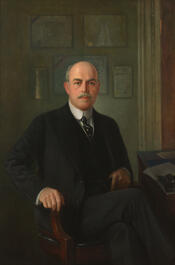
Here you will find contact information for Representative Nicholas Longworth, including email address, phone number, and mailing address.
| Name | Nicholas Longworth |
| Position | Representative |
| State | Ohio |
| District | 1 |
| Party | Republican |
| Status | Former Representative |
| Term Start | November 9, 1903 |
| Term End | March 3, 1933 |
| Terms Served | 14 |
| Born | November 5, 1869 |
| Gender | Male |
| Bioguide ID | L000433 |
About Representative Nicholas Longworth
Nicholas Longworth III (November 5, 1869 – April 9, 1931) was an American lawyer and Republican politician from Ohio who served as a Representative in the United States Congress from 1903 to 1933 and became Speaker of the United States House of Representatives. He was born in Cincinnati, Ohio, the son of Nicholas Longworth II and Susan Walker. The Longworth family was an old, prominent, and wealthy Cincinnati family that played a dominant role in the city’s civic and economic life. His father, Nicholas Longworth II, was the son of Joseph Longworth and the grandson of winemaker Nicholas Longworth I, both distinguished citizens of Cincinnati. Nicholas had two younger sisters, Anna and Clara, and grew up in an environment of social position and public responsibility that helped shape his later career.
Longworth attended the Franklin School, a boys’ school in Cincinnati, before entering Harvard College, from which he graduated in the Class of 1891. At Harvard he was a member of Delta Kappa Epsilon (Alpha chapter) and the Porcellian Club. He was regarded as a talented but not especially industrious student; one friend observed that “his good head made it easy for him to get perfectly respectable marks without doing much of any work.” After receiving his bachelor’s degree, he attended Harvard Law School for one year, then transferred to Cincinnati Law School, where he completed his legal studies and received his law degree in 1894. Admitted to the Ohio bar that same year, he began practicing law in Cincinnati. Outside his professional pursuits, Longworth was an accomplished violinist who cared deeply for music. His wife later recalled that he “was really a musician,” and in Cincinnati he drew on the city’s orchestra, College of Music, and Conservatory to host frequent musical evenings. Conductor Leopold Stokowski, writing to Longworth’s sister Clara, remarked that Longworth had “a rare understanding of music” and that it was his “natural element.”
Longworth’s public career began at the local level. After establishing his law practice, he entered public service as a member of the Cincinnati Board of Education in 1898. Closely associated with Republican political boss George B. Cox, he was elected to the Ohio House of Representatives, serving there in 1899 and 1900, and then to the Ohio State Senate, where he served from 1901 to 1903. In the state senate he sponsored and helped secure passage of the Longworth Act of 1902, a measure regulating the issuance of municipal bonds that was later described as one of the most successful laws in Ohio’s history. His effectiveness in state government and his ties to the Republican organization propelled him to national office.
In 1902 Longworth was elected to the United States House of Representatives from Ohio’s 1st congressional district, which included the city of Cincinnati and surrounding counties, and he took his seat in the 58th Congress on March 4, 1903. A member of the Republican Party, he would ultimately serve 14 terms in the House between 1903 and 1933, contributing to the legislative process during a significant period in American history. A bachelor when he first entered Congress, he soon became a well-known social figure in Washington. On February 17, 1906, he married Alice Lee Roosevelt, the daughter of President Theodore Roosevelt, in a widely publicized White House wedding that attracted national attention. Their marriage, which combined a prominent Midwestern political family with the Roosevelt name, made them one of the capital’s most visible couples. The relationship, however, became strained when Longworth opposed his father-in-law during the Republican Party split of 1912.
Throughout his early congressional career, Longworth championed issues related to foreign affairs and the protective tariff and aligned himself with the conservative wing of the Republican Party. As progressive Republicans began to break with the party’s regular organization in 1910–1912, Longworth sided with the conservatives. When many progressives bolted the party in 1912 to support Theodore Roosevelt’s third-party presidential candidacy, Longworth remained loyal to President William Howard Taft, whose views on an independent judiciary and support for business he shared more closely than those of Roosevelt. The split placed Longworth and his wife on opposite sides of the campaign: Alice Roosevelt Longworth actively supported her father’s Progressive (“Bull Moose”) candidacy, even as her husband ran for reelection as a Republican. In the resulting political upheaval, Longworth narrowly lost his House seat to Democrat Stanley E. Bowdle. He returned to private life briefly but won back the district in a rematch with Bowdle in 1914, resuming his service in the House in 1915. From that point he served continuously until his death in 1931.
Longworth’s influence in the House grew steadily during the 1920s. In 1923 he was chosen House Majority Leader, and in 1925 he became Speaker of the House, succeeding Frederick H. Gillett, who had been elected to the Senate. As Speaker from 1925 to 1931, Longworth set out to restore many of the powers of the speakership that had been curtailed in the revolt against Speaker Joseph G. Cannon in 1910. Without formally revising the House rules, he reasserted leadership by taking control of the Republican Steering Committee and the Committee on Committees and by placing loyalists on the Rules Committee, thereby ensuring his command over the House’s legislative agenda. He also disciplined dissent within his party: after 13 progressive Republicans supported Senator Robert M. La Follette for president instead of Calvin Coolidge in 1924, Longworth expelled them from the Republican caucus and stripped even committee chairmen among them of seniority. His legislative program emphasized balanced budgets and substantial tax reductions, and he resisted new federal initiatives that would expand the role of government. Nonetheless, in 1931 he broke with President Herbert Hoover by supporting a long-stalled veterans’ bonus bill, which passed Congress but was vetoed by Hoover, setting the stage for the Bonus March of 1932.
Despite his firm partisan leadership, Longworth cultivated cordial relations across the aisle, most notably with Democratic House Minority Leader John Nance Garner. The two men developed a close rapport—Garner later said, “I was the heathen and Nick was the aristocrat”—and together they hosted an informal, bipartisan gathering of members in a secluded Capitol room known as the “Bureau of Education.” There, Democratic and Republican representatives met daily to relax, share drinks, and build personal relationships that often facilitated legislative cooperation. Longworth’s personal style contributed to his effectiveness: historian Donald C. Bacon described him as “debonair and aristocratic, given to wearing spats and carrying a gold-headed cane,” perpetually cheerful, witty, and approachable. Journalists and contemporaries noted his quick humor; one oft-repeated anecdote recounts that when a colleague, rubbing Longworth’s bald head, remarked that it felt like his wife’s bottom, Longworth felt his own pate and replied, “Yes, so it does.” Commentator Frank R. Kent of The Baltimore Sun wrote that, though he exercised power with more tact and grace than earlier “czar” speakers such as Thomas B. Reed and Joseph Cannon, Longworth nonetheless recovered “the power of the speakership” and became “the undisputed leader of the House.”
Longworth’s marriage to Alice Roosevelt Longworth remained intact despite political and personal strains. Alice was an outspoken supporter of the progressive movement, while Longworth was firmly aligned with the conservative Republican establishment, and their differing allegiances were most visible during the 1912 party split. Both also engaged in extramarital affairs. In 1925 Alice gave birth to a daughter, Paulina Longworth, who was widely understood by family and friends to have been fathered by Senator William E. Borah of Idaho. A family friend quipped that “everybody called her ‘Aurora Borah Alice.’” Biographers and historians have concluded that Longworth, though almost certainly aware that Borah was Paulina’s biological father, was delighted by her birth and doted on her. Away from politics, he continued to pursue his love of music; at their home in Cincinnati, he and Alice hosted frequent musical gatherings featuring local musicians and visiting artists.
Nicholas Longworth served as Speaker until the end of the 71st Congress on March 4, 1931, and, having been reelected in November 1930, was Speaker-presumptive for the 72nd Congress at the time of his death, as Republicans still held a narrow three-seat majority in the House. While visiting his friend Dwight Filley Davis, the namesake of the Davis Cup, and Daniel J. Duckett in Aiken, South Carolina, he contracted pneumonia and died there on April 9, 1931. His body was returned to Cincinnati and interred at Spring Grove Cemetery. At a memorial service held at the Library of Congress on May 3, 1931, his friends, violinist Efrem Zimbalist and pianist Harold Bauer, performed Brahms’s D minor sonata in tribute to his lifelong devotion to music. In recognition of his long service and leadership, the Longworth House Office Building, one of the three main office buildings for members of the House of Representatives, was named in his honor in 1962.