Representative Nita M. Lowey
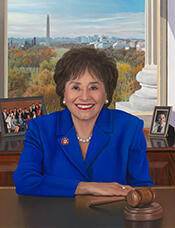
Here you will find contact information for Representative Nita M. Lowey, including email address, phone number, and mailing address.
| Name | Nita M. Lowey |
| Position | Representative |
| State | New York |
| District | 17 |
| Party | Democratic |
| Status | Former Representative |
| Term Start | January 3, 1989 |
| Term End | January 3, 2021 |
| Terms Served | 16 |
| Born | July 5, 1937 |
| Gender | Female |
| Bioguide ID | L000480 |
About Representative Nita M. Lowey
Nita Sue Lowey (née Melnikoff; July 5, 1937 – March 15, 2025) was an American politician who served as a U.S. Representative from New York from 1989 until 2021. A member of the Democratic Party, she represented portions of New York City’s northern suburbs for 16 consecutive terms in Congress and became one of the chamber’s most influential appropriators. Over the course of her tenure, her district was numbered as the 20th from 1989 to 1993, the 18th from 1993 to 2013, and the 17th beginning in 2013. The district included many of New York City’s inner northern suburbs, such as White Plains, Purchase, Tarrytown, Mount Kisco, and Armonk, and for many years encompassed most of Westchester County and all of Rockland County, as well as, earlier in her career, some of the far northern portions of Queens and the Bronx. She also served as co-dean of the New York congressional delegation, along with Representative Eliot Engel, reflecting her seniority and leadership within the state’s Democratic ranks.
Lowey was born in the Bronx, New York City, on July 5, 1937, the daughter of Beatrice (Fleisher) and Jack Melnikoff. Raised in a Jewish family, she attended New York City public schools and graduated from the Bronx High School of Science as valedictorian of the class of 1955. She went on to attend Mount Holyoke College in South Hadley, Massachusetts, where she earned a bachelor’s degree. Her early academic success and exposure to science and liberal arts education helped shape a lifelong interest in public policy, social justice, and international affairs.
Before entering elective office, Lowey built a career in New York state government and Democratic politics. She worked on Mario Cuomo’s 1974 campaign for lieutenant governor of New York, an experience that introduced her to statewide political organizing and policy issues. Following Cuomo’s election, she served as an assistant secretary of state of New York for 13 years. In that role, she was involved in a range of administrative and policy responsibilities, gaining experience in state governance and constituent services that would later inform her work in Congress.
Lowey ran for the United States House of Representatives in the 1988 election from New York’s 20th congressional district, challenging incumbent Republican Representative Joe DioGuardi. She defeated DioGuardi in the general election and took office at the start of the 101st Congress in January 1989. After the 1990 U.S. Census, her district was renumbered as the 18th, and following the 2010 Census it became the 17th district. Throughout these changes, she continued to represent a large portion of New York City’s northern suburbs. Redistricting after the 2000 Census removed the New York City portions of her district, leaving her focused primarily on suburban Westchester and Rockland counties. During her long tenure, she became known as a diligent representative who participated actively in the legislative process and consistently emphasized the interests and needs of her constituents.
Within the House, Lowey developed a reputation as a strong advocate for women’s health, environmental protection, foreign aid to developing nations, and efforts to fight AIDS, as well as a steadfast supporter of Israel. Early in her congressional career, she sponsored an earmark for dredging the Mamaroneck Harbor, a project that local reporting in The Journal News noted was justified in part because the harbor was becoming too shallow “to accommodate the larger yachts.” She was also a vocal supporter of public broadcasting; in the 1990s, she appeared at a congressional hearing accompanied by Sesame Street characters Bert and Ernie to underscore the importance of the Public Broadcasting Service. From 2001 to 2002, she served as the first female chair of the Democratic Congressional Campaign Committee, playing a key role in party strategy and fundraising. Lowey considered running for the United States Senate in 2000, but stepped aside when First Lady Hillary Clinton announced her candidacy. After Clinton was nominated to be Secretary of State in 2008, Lowey was mentioned as a potential appointee to Clinton’s Senate seat, but she stated in a December 1, 2008, interview that she was not interested in giving up her senior position on the House Appropriations Committee.
As a legislator, Lowey was active on a wide range of policy fronts. In early 2009, she introduced the Transportation Security Workforce Enhancement Act, which sought to provide collective bargaining rights for federal workers at the Transportation Security Administration and the Department of Homeland Security. During the debate over health care reform in 2009, she was critical of the Stupak–Pitts Amendment, which placed limits on taxpayer-funded abortions in the context of the Affordable Health Care for America Act. Concerned about the rancor and disruptions that marked many in-person town hall meetings that summer, she chose to present her views on health care reform via a telephone conference call, a decision that drew questions from some constituents about the effectiveness of that approach. In 2015, she publicly expressed disappointment at Congress’s failure to address Puerto Rico’s mounting budget problems. That same year, she announced her opposition to President Barack Obama’s nuclear agreement with Iran, arguing that the deal did not provide sufficient safeguards, that lifting sanctions and releasing funds could fuel a regional arms race and terrorism financing, and that the inspection and accountability provisions were, in her view, inadequate.
Lowey’s influence reached its peak on the House Committee on Appropriations, where she served for many years and ultimately became chairwoman. Following the Democratic Party’s victory in the 2018 midterm elections and its return to the House majority, she was elected in 2018 as the first woman to chair the House Appropriations Committee. She also chaired the Subcommittee on State, Foreign Operations, and Related Programs and, as chair of the full committee, served as an ex officio member of all its subcommittees. In these roles, she was a central figure in shaping federal spending priorities, particularly in the areas of foreign assistance, diplomacy, and development. In 2019, she helped negotiate an end to a 35‑day partial federal government shutdown, one of the longest in U.S. history, underscoring her role as a key negotiator in budgetary and appropriations disputes.
In addition to her committee work, Lowey was active in numerous caucuses that reflected her policy interests and advocacy priorities. She was a member of the Congressional Women’s Caucus, the House Pro-Choice Caucus, the Hudson River Caucus, the United States Congressional International Conservation Caucus, the Israel Allies Caucus, the Congressional Arts Caucus, the National Eating Disorders Awareness Caucus, the Congressional Crohn’s and Colitis Caucus, and the Afterschool Caucuses. She also participated in national party politics as a superdelegate to the 2016 Democratic National Convention. She pledged her support to Hillary Clinton and, when asked whether she might switch to Senator Bernie Sanders if he were to win the New York Democratic presidential primary, her chief of staff responded that she would “absolutely not” do so, emphasizing that Clinton was Lowey’s friend, colleague, and constituent and that she supported her “100%.”
On October 10, 2019, two months after Democrat Mondaire Jones announced his intention to challenge her in a 2020 primary, Lowey announced that she would retire and not run for re-election to Congress in 2020. Her decision brought to a close 32 years of service in the House of Representatives, spanning the end of the Cold War, the post‑9/11 era, and significant domestic policy debates. She left office at the conclusion of the 116th Congress in January 2021, having served 16 terms and played a prominent role in appropriations, foreign aid, and social policy.
Lowey’s personal life was closely tied to the legal and civic community of the New York suburbs she represented. She was married to Stephen Lowey, a named partner in the White Plains law firm of Lowey Dannenberg Cohen & Hart, P.C., whose practice areas included securities law, antitrust law, and consumer protection. The couple had three children and eight grandchildren. A 2010 estimate of her personal assets, based on congressional financial disclosure reports (excluding personal residences and non–interest‑bearing bank accounts), placed her wealth at approximately $41.2 million, largely derived from her husband’s investments, according to a Washington Post investigative series on the assets of members of Congress. Lowey was Jewish and remained active in Jewish and pro‑Israel causes throughout her career. She died from breast cancer at her home in Harrison, New York, on March 15, 2025, at the age of 87.