Representative Norman D. Dicks
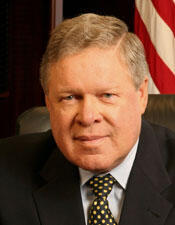
Here you will find contact information for Representative Norman D. Dicks, including email address, phone number, and mailing address.
| Name | Norman D. Dicks |
| Position | Representative |
| State | Washington |
| District | 6 |
| Party | Democratic |
| Status | Former Representative |
| Term Start | January 4, 1977 |
| Term End | January 3, 2013 |
| Terms Served | 18 |
| Born | December 16, 1940 |
| Gender | Male |
| Bioguide ID | D000327 |
About Representative Norman D. Dicks
Norman DeValois Dicks (born December 16, 1940) is an American lawyer and Democratic politician who represented Washington’s 6th congressional district in the United States House of Representatives from January 3, 1977, to January 3, 2013. Over 18 consecutive terms, he became the longest-serving member of the U.S. House of Representatives in Washington State history. His district, located in the northwestern corner of the state, included most of Tacoma as well as the Kitsap Peninsula and the Olympic Peninsula. After retiring at the end of the 112th Congress, he entered private practice and public policy consulting, becoming Senior Policy Advisor at the law and public policy firm Van Ness Feldman LLP.
Dicks was born and raised in Bremerton, Washington, where his family attended Our Saviour’s Lutheran Church; he was confirmed there as a teenager. Growing up in a Navy town, he was exposed early to the importance of military and defense issues, themes that would later figure prominently in his congressional career. He attended local schools in Bremerton before enrolling at the University of Washington in Seattle. At the university he distinguished himself both academically and athletically, playing linebacker on the Washington Huskies football team and joining the Sigma Nu fraternity. He earned a Bachelor of Arts degree and subsequently a Juris Doctor from the University of Washington, preparing for a career in law and public service.
Following completion of his legal education, Dicks began his career in national politics as a legislative and administrative assistant to U.S. Senator Warren G. Magnuson of Washington, one of the most influential senators of his era and a senior member of the Senate Appropriations Committee. In this role, Dicks gained extensive experience in federal budgeting, appropriations, and constituent service, and developed a detailed understanding of defense, transportation, and maritime issues critical to Washington State. His work for Magnuson helped establish his reputation in Democratic Party circles and provided the legislative and policy background that would underpin his own congressional career.
In 1976, when incumbent Democratic Representative Floyd Hicks retired from the House to run for a seat on the Washington State Supreme Court, Dicks sought election to the open 6th district seat. He qualified for the general election via Washington’s blanket primary and won the November 1976 contest decisively, receiving 74 percent of the vote against Republican nominee Rob Reynolds. He took office on January 3, 1977, and would go on to win re-election 17 more times. Over the course of his tenure, he rarely faced serious electoral difficulty; he received less than 58 percent of the vote in a November general election only once, in 1980, when he defeated Republican Jim Beaver by a margin of 54 percent to 46 percent. His second-lowest winning percentage, 58 percent, came in the 1994 and 2010 elections, both years in which Republicans captured the House majority.
Upon entering Congress, Dicks quickly secured a coveted seat on the House Committee on Appropriations, an assignment he held throughout his career and on which he rose to become one of the most senior and influential Democrats. He eventually served as ranking member of the full Appropriations Committee, a position that entitled him to sit ex officio on all of its subcommittees, and he was also ranking member of the Defense Subcommittee. In addition, he served for eight years on the House Permanent Select Committee on Intelligence, where he was involved in oversight of U.S. intelligence activities during the late Cold War and post–Cold War periods. Known as a close friend and ally of Vice President Al Gore, Dicks often aligned with Gore on environmental and defense-related issues. His long-standing interest in the military and naval affairs was reflected in his support for defense appropriations and in public events such as his attendance at the March 28, 1981, christening of the nuclear-powered attack submarine USS Bremerton (SSN-698) alongside Senator Henry M. Jackson.
Throughout his congressional service, Dicks played a prominent role in defense, national security, and environmental policy. Representing a district with major military installations and with Boeing as a leading employer in the state, he consistently supported the acquisition of military aircraft and other defense programs through his work on the Defense Appropriations Subcommittee. On October 10, 2002, he was among the 81 House Democrats who voted in favor of the resolution authorizing the use of military force in Iraq. In later years he publicly expressed regret for that vote, stating that his biggest regret in Congress was supporting the Iraq War and explaining that he believed Congress had not been given accurate information about weapons of mass destruction. He maintained that had lawmakers known Saddam Hussein did not possess such weapons, he doubted Congress would even have been asked to vote on the authorization.
Dicks also took an active interest in civil liberties, intelligence oversight, and intellectual property enforcement. On June 20, 2008, he voted in favor of the FISA Amendments Act of 2008, legislation that, among other provisions, granted immunity to telecommunications companies such as AT&T and Verizon Communications from lawsuits alleging cooperation with the National Security Agency’s warrantless surveillance program after the September 11 attacks. The bill also required Foreign Intelligence Surveillance Court permission to wiretap Americans overseas, prohibited targeting a foreigner as a pretext to eavesdrop on an American without court approval, allowed the FISA court 30 days to review expiring surveillance orders, permitted emergency eavesdropping without prior court approval if the government filed required papers within a week, and barred the government from invoking war powers or other authorities to supersede surveillance rules in the future. Earlier, on May 8, 2008, he had voted in favor of H.R. 4279, the Prioritizing Resources and Organization for Intellectual Property Act of 2007 (the PRO-IP Act), which increased civil and criminal penalties for trademark and copyright infringement, created the Office of the United States Intellectual Property Enforcement Representative, and authorized seizures of unlicensed copies and the devices on which they were stored.
Environmental protection and conservation formed another major theme of Dicks’s legislative work. As co-chair of the International Conservation Caucus and an active member of the Sportsmen’s Caucus and the Congressional Arts Caucus, he supported increased funding for public lands, wildlife, and cultural programs. In June 2007, he backed a House bill to increase funding for environmental protection, national parks, and conservation by approximately $1.2 billion. Criticizing prior budget cuts, he stated that the Bush administration had reduced the Interior Department budget over six to seven years by 16 percent, the Environmental Protection Agency by 29 percent, and the Forest Service by 35 percent, saying these reductions had “devastated these agencies” and that Congress was “trying to turn the corner, to bring these agencies back.” His leadership in conservation policy was recognized with the 2008 Ansel Adams Conservation Award from The Wilderness Society and, in 2010, with the first Lifetime Achievement Award in Salmon Conservation from the Washington nonprofit Long Live the Kings.
Over the course of his career, Dicks received numerous honors and played a visible role in civic life in his home state. On October 22, 2004, he cut the ribbon at the dedication of the Norm Dicks Government Center in Bremerton, Washington, a civic complex named in recognition of his service to the community and the region. On June 9, 2007, he delivered the 132nd commencement address at the University of Washington, returning to his alma mater as a senior statesman. In 2008, the U.S. Navy Memorial Foundation presented him with its Naval Heritage Award in acknowledgment of his longstanding support for the U.S. Navy and the military during his terms in Congress, particularly through his work on the Appropriations Committee.
Dicks announced his decision not to seek re-election in 2012 and retired from Congress at the conclusion of the 112th Congress on January 3, 2013, bringing to a close 36 years of continuous service in the House. After leaving office, he continued to engage in public policy and conservation initiatives. In 2013, he joined the board of the Seattle-based nonprofit Long Live the Kings as an Ambassador to a new U.S.–Canada partnership, the Salish Sea Marine Survival Project, stating that such efforts promised to “fundamentally change our knowledge about salmon and steelhead in saltwater” and to fill “a crucial information-gap that has inhibited the progress of recovery.” In 2014, he was elected to the board of directors of the National Bureau of Asian Research, extending his involvement in foreign policy and Asia-Pacific issues. Alongside these roles, he has served as Senior Policy Advisor at Van Ness Feldman LLP, drawing on his decades of experience in appropriations, defense, environmental, and energy policy.