Senator Norris Cotton
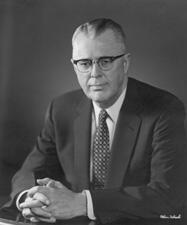
Here you will find contact information for Senator Norris Cotton, including email address, phone number, and mailing address.
| Name | Norris Cotton |
| Position | Senator |
| State | New Hampshire |
| Party | Republican |
| Status | Former Representative |
| Term Start | January 3, 1947 |
| Term End | January 3, 1977 |
| Terms Served | 15 |
| Born | May 11, 1900 |
| Gender | Male |
| Bioguide ID | C000802 |
About Senator Norris Cotton
Norris Henry Cotton (May 11, 1900 – February 24, 1989) was an American politician from the state of New Hampshire. A member of the Republican Party, he served as a U.S. representative and subsequently as a U.S. senator, representing New Hampshire in the United States Congress from 1947 to 1975. His long tenure in Congress, encompassing eight terms in office, coincided with a significant period in American history, during which he participated in the democratic process and represented the interests of his constituents in both the House of Representatives and the Senate.
Cotton was born on a farm in Warren, Grafton County, New Hampshire, the son of Henry Lang Cotton and Elizabeth (née Moses) Cotton. Raised in modest circumstances, he attended local schools before enrolling at Phillips Exeter Academy in Exeter, New Hampshire. He continued his education at Wesleyan University in Middletown, Connecticut. While in college, he gained early exposure to public affairs by serving as a clerk to the New Hampshire State Senate, an experience that helped shape his interest in legislative work and public service.
Cotton entered public life at a young age. In 1923 he was elected to the New Hampshire House of Representatives, becoming one of the youngest legislators in the state’s history. He later pursued legal studies at George Washington University Law School in Washington, D.C., after which he was admitted to the bar and established a law practice in Lebanon, New Hampshire. Alongside his legal career, he remained active in state politics and Republican Party affairs, building a reputation as an effective legislator and party leader. He returned to the New Hampshire House of Representatives in 1943, serving that year as majority leader and then as Speaker of the House from 1945 to 1947.
In 1946, Cotton was elected to the United States House of Representatives from New Hampshire’s 2nd congressional district. He took office in January 1947 and served in the House until 1954. During his tenure in the House, he contributed to the legislative process in the early years of the Cold War and the post–World War II era, representing the interests of his district while aligning with the broader priorities of the Republican Party. In 1954 he ran successfully for the United States Senate in a special election to fill the vacancy caused by the death of Senator Charles W. Tobey. He was elected to a full Senate term in 1956, reelected twice thereafter, and served in the Senate until 1975, becoming one of New Hampshire’s most prominent mid‑twentieth‑century political figures.
As a U.S. senator, Cotton played a significant role in major national debates of the 1950s and 1960s. He voted in favor of the Civil Rights Acts of 1957, 1960, and 1968, supported the 24th Amendment to the U.S. Constitution abolishing the poll tax in federal elections, backed the Voting Rights Act of 1965, and voted to confirm Thurgood Marshall to the United States Supreme Court. At the same time, he opposed the Civil Rights Act of 1964 and the Immigration and Nationality Act of 1965, and he was the only senator from New England to vote against those two measures. Cotton was also one of thirteen Republican senators to vote in favor of the creation of Medicare in 1965. Within the Senate Republican Conference he emerged as a party leader, serving as chair of the Senate Republican Conference from 1973 to 1975. He chose not to run for reelection in 1974, and three days before his final term expired in January 1975, he resigned his seat to allow the governor of New Hampshire to appoint Louis C. Wyman as his successor.
Cotton’s departure from the Senate was followed by one of the most closely contested elections in Senate history. The 1974 election to fill his seat, involving Louis C. Wyman and John A. Durkin, resulted in an extremely narrow margin and was subjected to two recounts at the state level, followed by extended debate in the U.S. Senate. While the dispute was pending, Cotton was appointed to return to the Senate in August 1975 as a temporary senator, serving until a special election could be held. The special election took place in September 1975, and its result was not challenged. After this interim service, Cotton returned to Lebanon, New Hampshire. His brief reappointment made him the last former senator to return to the Senate via appointment for 43 years, until former Arizona Senator Jon Kyl was appointed in 2018 following the death of Senator John McCain.
In his later years, Cotton remained a respected figure in New Hampshire public life. He lived in Lebanon, where he had long practiced law and maintained his political base. His contributions to public service were recognized through several honors, including the naming of the Norris Cotton Cancer Center at Dartmouth–Hitchcock Medical Center in Lebanon and a federal building in Manchester, New Hampshire, that bears his name. In 2012, a New Hampshire historical marker (number 231) was unveiled in his native town of Warren, noting that his rise from humble beginnings “embodied an American way of life.”
Cotton’s personal life included two marriages and one child. He had a daughter, Mary Martha Ballou, born on February 15, 1925. He married Ruth Isaacs on May 11, 1927; the couple had no children together, and Ruth remained his wife until her death in 1978. In 1980 he married his housekeeper, Eleanor Coolidge Brown. Norris Henry Cotton died on February 24, 1989, in Lebanon, New Hampshire, at the age of 88. He was interred at School Street Cemetery in Lebanon, leaving a legacy as a long-serving legislator who played a notable role in mid‑twentieth‑century national and New Hampshire politics.