Representative Bill Emerson
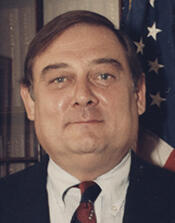
Here you will find contact information for Representative Bill Emerson, including email address, phone number, and mailing address.
| Name | Bill Emerson |
| Position | Representative |
| State | Missouri |
| District | 8 |
| Party | Republican |
| Status | Former Representative |
| Term Start | January 5, 1981 |
| Term End | January 3, 1997 |
| Terms Served | 8 |
| Born | January 1, 1938 |
| Gender | Male |
| Bioguide ID | E000174 |
About Representative Bill Emerson
Norvell William Emerson (January 1, 1938 – June 22, 1996) was an American politician who represented Missouri in the United States House of Representatives from 1981 until his death in 1996. A member of the Republican Party, he served eight consecutive terms in Congress and became known for his work on legislative procedure, food security, and public service reforms. He died of lung cancer in Bethesda, Maryland, while still in office, and was succeeded in the House by his widow, Jo Ann Emerson.
Emerson was raised in Jefferson County, Missouri, and attended public schools in nearby Hillsboro. As a teenager he came to Washington, D.C., as a House page, an experience that introduced him early to the workings of Congress. While serving as a page, he was on the floor of the House during the 1954 United States Capitol shooting incident involving Puerto Rican nationalists, an event that left a lasting impression on him and deepened his interest in public service.
After returning to Missouri, Emerson pursued higher education at Westminster College in Fulton, Missouri, graduating in 1959. He then studied law, first at the University of Missouri and later at the University of Baltimore, where he completed his legal education and received an LL.B. degree in 1964. That same year he began a long association with the United States Air Force Reserve, in which he served until 1992, attaining the rank of captain.
Emerson’s early professional career was closely tied to Capitol Hill. While in law school he worked as a congressional aide to U.S. Representative Robert Ellsworth of Kansas, gaining practical experience in legislative affairs. After earning his law degree, he joined the staff of U.S. Senator Charles Mathias of Maryland, further developing his expertise in federal policy and constituent service. During the 1970s he moved into the private sector, working in governmental affairs for several companies and advising on regulatory and legislative issues. In 1979 he formed his own consulting group, which focused on government relations and public policy, positioning him for a return to elective office.
In 1980 Emerson was elected to the United States House of Representatives from Missouri, beginning his service in January 1981. He was re-elected seven times, serving continuously until his death in 1996. During his eight terms in office, he participated actively in the legislative process and represented the interests of his Missouri constituents during a period of significant political and economic change in the United States. Emerson served on the influential House Committee on Rules, which oversees the flow of legislation to the House floor and plays a central role in shaping debate and procedure. His work in Congress reflected both his early exposure to the institution as a page and his later experience as a staff member and policy consultant.
Emerson’s congressional career also included notable efforts in the areas of health, employee assistance, and food policy. In 1988, after an intervention by family and friends, he publicly acknowledged his struggle with alcoholism and spent a month undergoing treatment at the Betty Ford Center. Drawing on this experience, he helped create the House Employee Assistance Program, which provides legislative and administrative support services for the House of Representatives and assists employees, including those with alcohol dependency, in finding treatment. The program was later expanded to serve the United States Senate as well. Emerson also became associated with legislation encouraging food donations. The Bill Emerson Good Samaritan Food Donation Act of 1996, named in his honor, was enacted after his death and encourages the donation of food and grocery products to nonprofit organizations by protecting donors from liability when they donate in good faith, even if the product later causes harm. In the realm of international food security, the national Food Security Wheat Reserve, established in 1980 and later expanded to the Food Security Commodity Reserve, was renamed the Bill Emerson Humanitarian Trust in 1998 to recognize his contributions to humanitarian food policy.
Norvell William Emerson’s service in Congress occurred during a significant period in American history, and he remained in office until his death from lung cancer in Bethesda, Maryland, on June 22, 1996. His passing made him one of the members of Congress who died in office in the latter half of the twentieth century. Following his death, his widow, Jo Ann Emerson, won election to succeed him and continued to represent their Missouri district in the House of Representatives.
Emerson’s legacy is reflected in several memorials and institutions that bear his name. The Bill Emerson Memorial Bridge, which crosses the Mississippi River at Cape Girardeau, Missouri, commemorates his service and connection to the region. Emerson Hall, the main assembly room in the House Page School located in the Jefferson Building of the Library of Congress, honors his early experience as a page and his long association with the institution. Another Emerson Hall, an upperclass residence hall at Westminster College in Fulton, Missouri, recognizes his achievements as a distinguished alumnus. Through these memorials, as well as the Bill Emerson Good Samaritan Food Donation Act and the Bill Emerson Humanitarian Trust, his contributions to Congress, public service, and humanitarian efforts continue to be remembered.