Representative Oakes Ames
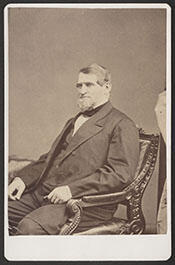
Here you will find contact information for Representative Oakes Ames, including email address, phone number, and mailing address.
| Name | Oakes Ames |
| Position | Representative |
| State | Massachusetts |
| District | 2 |
| Party | Republican |
| Status | Former Representative |
| Term Start | December 7, 1863 |
| Term End | March 3, 1873 |
| Terms Served | 5 |
| Born | January 10, 1804 |
| Gender | Male |
| Bioguide ID | A000175 |
About Representative Oakes Ames
Oakes Ames (January 10, 1804 – May 8, 1873) was an American businessman, investor, and Republican politician who represented Massachusetts in the United States House of Representatives from 1863 to 1873. Serving five consecutive terms as a Representative from Massachusetts during a critical decade in American history, he participated actively in the legislative process and represented the interests of his constituents in the Second Congressional District. As a congressman, he is credited by many historians as being the single most important influence in the building of the Union Pacific portion of the first transcontinental railroad, and he later became widely known for his central role in the Crédit Mobilier scandal involving the alleged improper sale of railroad construction company stock.
Ames was born in Easton, Massachusetts, the son of Susanna (Angier) Ames and Oliver Ames Sr. His father, originally a blacksmith, had built a thriving shovel-making enterprise known as the Ames Shovel Shop and became widely nicknamed the “King of Spades.” Oakes Ames received a public school education in his youth and then entered the family workshops, where he learned each step of the shovel manufacturing process firsthand. This practical training prepared him for a leading role in the family business, which he would later share with his brother Oliver Ames Jr.
By the mid-nineteenth century, Ames had become a partner in his father’s enterprise, and together with his brother he helped organize and expand the firm under the name Oliver Ames & Sons. The company’s fortunes rose dramatically as westward settlement of the Midwest, the discovery of gold in California and Australia, and the rapid expansion of railroad construction generated enormous demand for shovels and related tools. During the Civil War, the firm prospered further through government and private contracts for swords, shovels, and other implements essential to the Union war effort. Through this period of industrial growth, Ames amassed a large personal fortune and emerged as a prominent figure in New England’s manufacturing and business community.
Ames became influential in the establishment and early development of the Republican Party in Massachusetts, aligning himself with the new party’s economic and Unionist policies. His growing political prominence led to his election to the Massachusetts Governor’s Council (executive council) in 1860, where he participated in state-level governance on the eve of the Civil War. Building on this experience, he was elected to the United States House of Representatives as a Republican and served from 1863 to 1873, holding his seat through five terms. In Congress, he served during the Civil War and Reconstruction, a period marked by intense debates over national unity, economic development, and the reorganization of the former Confederate states. As a member of the House of Representatives, Ames took part in the democratic process, contributed to the legislative work of the chamber, and represented the interests of his Massachusetts constituents.
During his congressional service, Ames became a member of the House Committee on Railroads at a time when the federal government was deeply engaged in promoting the construction of a transcontinental railroad. In 1865, President Abraham Lincoln personally appealed to Ames to assume a leading role in the stalled Union Pacific Railroad project, which had been hampered by the Civil War and had completed only about 12 miles (19 kilometers) of track. Responding to this call, Ames used his influence and resources to advance the work of the Union Pacific. He obtained construction contracts for his family’s firm in connection with the railroad, and he staked nearly all of the Ames family’s holdings as capitalization to keep the enterprise moving forward. Under his leadership, the construction contracts were transferred to the Crédit Mobilier of America, a construction and finance company, after he succeeded in ousting its founder, Thomas Durant, from control. His brother Oliver Ames Jr. was appointed president of the Union Pacific in 1866, and the railroad was completed in 1869, marking a milestone in the economic and geographic integration of the United States.
Ames’s close involvement with the Union Pacific and Crédit Mobilier later gave rise to one of the most notorious political scandals of the nineteenth century. In 1872, it was publicly disclosed that Ames had sold shares in Crédit Mobilier to fellow members of Congress at prices significantly below the prevailing market value. The revelations prompted a formal House investigation into whether he had used these discounted stock sales to influence legislative action favorable to the railroad and its construction company. The investigating committee concluded that Ames had improperly sought to secure congressional attention for a corporation in which he had a direct financial interest. On February 28, 1873, the House of Representatives passed a resolution formally censuring him “in seeking to secure congressional attention to the affairs of a corporation in which he was interested, and whose interest directly depended upon the legislation of Congress, by inducing members of Congress to invest in the stocks of said corporation.” The scandal damaged his reputation, and detractors derisively referred to him as “Hoax Ames,” even as some contemporaries and later observers continued to credit him with playing a decisive role in the completion of the Union Pacific.
Ames’s health declined soon after the censure. He died of a stroke in North Easton, Massachusetts, on May 8, 1873. In the years following his death, opinion in his home state gradually shifted toward a more sympathetic view of his contributions. On May 10, 1883, the fourteenth anniversary of the completion of the transcontinental railroad, the Massachusetts legislature adopted a resolution exonerating Oakes Ames, effectively seeking to restore his public standing in light of his central role in one of the nation’s greatest internal improvements. His family continued to play a prominent role in Massachusetts public life; his son Oliver Ames later served as Governor of Massachusetts from 1887 to 1890.
The legacy of Oakes Ames is reflected in both physical monuments and place names across the United States. Together with his brother Oliver, his contributions to the building of the Union Pacific are commemorated in the Oliver and Oakes Ames Monument at Sherman Summit near Laramie, Wyoming, along the original transcontinental route. Designed by architect Henry Hobson Richardson, who undertook several commissions for the Ames family, and featuring sculpted reliefs of the brothers by Augustus Saint-Gaudens, the pyramidal monument originally stood at the highest elevation reached by the Union Pacific line. Subsequent changes in the railroad’s route left the monument off major transportation corridors, but it remains a significant historic landmark. The city of Ames, Iowa, is named in his honor, as is likely the community of Ames, Nebraska, and Ames Avenue in Omaha. In his hometown of Easton, Massachusetts, the family’s influence is also evident in such landmarks as the Oakes Ames Memorial Hall, the Ames Free Library, and the historic Ames Shovel Shop, all of which testify to the intertwined industrial, political, and civic legacy of Oakes Ames and his family.