Representative Ogden Livingston Mills
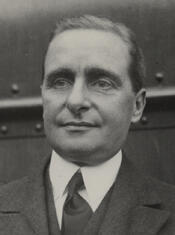
Here you will find contact information for Representative Ogden Livingston Mills, including email address, phone number, and mailing address.
| Name | Ogden Livingston Mills |
| Position | Representative |
| State | New York |
| District | 17 |
| Party | Republican |
| Status | Former Representative |
| Term Start | April 11, 1921 |
| Term End | March 4, 1927 |
| Terms Served | 3 |
| Born | August 23, 1884 |
| Gender | Male |
| Bioguide ID | M000776 |
About Representative Ogden Livingston Mills
Ogden Livingston Mills (August 23, 1884 – October 11, 1937) was an American lawyer, businessman, and Republican politician who served three terms as a Representative from New York in the United States Congress, later becoming Undersecretary of the Treasury under President Calvin Coolidge and Secretary of the Treasury in the cabinet of President Herbert Hoover. He was born on August 23, 1884, in Newport, Rhode Island, the son of financier and racehorse owner Ogden Mills (1856–1929) and Ruth T. Livingston Mills (1855–1920), a granddaughter of Maturin Livingston (1769–1847). He had twin sisters, Beatrice Mills Forbes (1883–1972) and Gladys Mills Phipps (1883–1970), and was a grandson of the prominent banker Darius Ogden Mills. Raised in a wealthy and socially prominent family with deep roots in New York and Rhode Island, Mills grew up in an environment that combined finance, public affairs, and thoroughbred horse racing.
Mills was educated at Harvard University, from which he graduated in 1904. He continued his studies at Harvard Law School, earning his law degree in 1907, and was admitted to the bar in 1908. Trained as a lawyer, he entered private practice and business, drawing on both his legal education and his family’s financial background. His early adult years also reflected the social connections of his family; on September 20, 1911, he married his first wife, Margaret Stuyvesant Rutherfurd (1891–1976), daughter of Anne Harriman Rutherfurd and Lewis Morris Rutherfurd Jr., and stepdaughter of William Kissam Vanderbilt. The marriage ended in divorce in 1919. On September 2, 1924, he married his second wife, Dorothy Randolph Fell (d. 1968), the former wife of banker John R. Fell, becoming stepfather to her three children. Mills had no children of his own.
Before entering national office, Mills built a political career in New York and became active in Republican Party affairs. He served as a delegate to the Republican National Conventions of 1912, 1916, and 1920, participating in the party’s deliberations during a period of significant national political realignment. In state government, he was a member of the New York State Senate from 1915 to 1917, sitting in the 138th, 139th, and 140th New York State Legislatures. During his tenure he served as chairman of the Committee on Affairs of the City of New York in 1917, giving him a prominent role in legislative oversight of the state’s largest city. On July 31, 1917, amid the First World War, he resigned his Senate seat to enlist in the United States Army, where he served with the rank of captain until the close of World War I. After the war, he returned to civilian life and served as president of the New York State Tax Association, reflecting his growing expertise and interest in fiscal and tax policy.
Mills entered national legislative service when he was elected as a Republican to the United States House of Representatives from New York’s 17th Congressional District. He served in the 67th, 68th, and 69th Congresses, holding office from March 4, 1921, until March 3, 1927. His three terms in the House of Representatives coincided with a significant period in American history marked by postwar adjustment, economic expansion, and evolving federal fiscal policy. As a member of the House, Ogden Livingston Mills participated in the democratic process, represented the interests of his New York constituents, and contributed to the legislative work of the Republican majorities of the 1920s. In 1926 he was the Republican nominee for Governor of New York, running against incumbent Democrat Alfred E. Smith; Mills was defeated in that election, but the campaign elevated his profile within the party and the nation.
Following his congressional service, Mills moved into senior positions in the federal executive branch. In 1927, President Calvin Coolidge appointed him Undersecretary of the Treasury, where he served under Secretary Andrew W. Mellon. In this role he was deeply involved in federal fiscal and tax matters during the late 1920s, a period of continued economic growth followed by the onset of the Great Depression. In 1932, President Herbert Hoover appointed Mills as Secretary of the Treasury. As Treasury Secretary, he advocated tax increases, spending cuts, and other austerity measures that, in retrospect, are widely regarded as having deepened the economic crisis. Mills acted as a close adviser to President Hoover and actively campaigned for Hoover’s reelection in 1932, traveling to major cities including Detroit, St. Louis, Los Angeles, San Francisco, Chicago, and Minneapolis on the president’s behalf. Hoover’s opponent in that election was then-Governor of New York Franklin D. Roosevelt, a Democrat who had been Mills’s college friend and lifelong neighbor. Mills remained in office as Secretary of the Treasury until March 3, 1933, when the Hoover administration ended.
After leaving the Treasury Department, Mills remained an influential voice in public affairs and business. He became a prominent critic of President Franklin D. Roosevelt’s New Deal policies, arguing against the expansion of federal intervention in the economy. He articulated his views in two books, “What of Tomorrow” (1935) and “The Seventeen Million” (1937), in which he analyzed contemporary economic conditions and political developments. In the private sector, he served on the boards of several major corporations, including the Lackawanna Steel Company, the Atchison, Topeka and Santa Fe Railway, the Virginia & Truckee Railroad, the Mergenthaler Linotype Company, and the Shredded Wheat Company. While in New York, he was also an active member of the New York Civitan Club, reflecting his engagement in civic as well as corporate life.
In addition to his political and business activities, Mills was deeply involved in thoroughbred horse racing and breeding, continuing a family tradition. Together with his sister Gladys, he owned Wheatley Stable, a prominent racing and breeding operation. Wheatley Stable owned and bred notable racehorses including Seabiscuit and Bold Ruler, the latter becoming one of the most important sires in American racing history and the sire line that produced Secretariat. Mills also owned Kantar, who won the 1928 Prix de l’Arc de Triomphe in France. After the death of his father in 1929, Mills and each of his sisters inherited $12,197,034 from the elder Mills’s estate, further consolidating the family’s financial capacity to support their racing and business interests.
Ogden Livingston Mills died of heart disease in Manhattan, New York, on October 11, 1937. He left no direct descendants but was the stepfather of three children through his second marriage to Dorothy Randolph Fell. He was interred in St. James Churchyard in Hyde Park, New York, a region long associated with his family and with many of the political figures of his era.