Representative Olin E. Teague
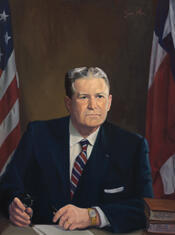
Here you will find contact information for Representative Olin E. Teague, including email address, phone number, and mailing address.
| Name | Olin E. Teague |
| Position | Representative |
| State | Texas |
| District | 6 |
| Party | Democratic |
| Status | Former Representative |
| Term Start | January 3, 1945 |
| Term End | January 3, 1979 |
| Terms Served | 17 |
| Born | April 6, 1910 |
| Gender | Male |
| Bioguide ID | T000110 |
About Representative Olin E. Teague
Olin Earl “Tiger” Teague (April 6, 1910 – January 23, 1981) was an American politician, decorated World War II veteran, and long-serving Democratic member of the United States House of Representatives from Texas. He represented Texas’s 6th congressional district for 32 years, serving 17 terms in Congress from his first election in 1946 until his retirement in 1978. Over the course of his congressional career, he became one of the most influential advocates for veterans’ affairs and a key figure in the development of the nation’s space program. He is buried in Arlington National Cemetery.
Teague was born on April 6, 1910, in Oklahoma and grew up in Mena, Arkansas. His lifelong nickname, “Tiger,” originated from his vigorous play on the football field while he was in high school. Seeking higher education in Texas, he enrolled at the Agricultural and Mechanical College of Texas, now Texas A&M University, and graduated in 1932. His early years in Texas and his education at what would become one of the state’s leading public universities helped establish the regional and institutional ties that later shaped his political base and legislative interests.
In 1940, Teague entered active military service, joining the United States Army as a lieutenant. During World War II he rose to the rank of colonel and served with distinction in the European Theater. He participated in the D-Day invasion of Normandy and saw extensive combat. For his wartime service he received the Silver Star with two oak leaf clusters, the Bronze Star, and two Purple Hearts, reflecting both his bravery and the wounds he sustained in action. He was discharged from the Army in 1946, the same year he would begin his long tenure in Congress.
Teague’s congressional career began with his election in 1946 as a Democrat to represent Texas’s 6th congressional district in the U.S. House of Representatives. He took office at the start of the 80th Congress and went on to serve continuously until 1979, encompassing 17 terms and more than three decades in Washington. His service in Congress occurred during a significant period in American history, spanning the early Cold War, the civil rights era, the Vietnam War, and the height of the space race. As a member of the House of Representatives, he participated in the democratic process and represented the interests of his Texas constituents while also emerging as a national figure on veterans’ issues and science policy.
A decorated veteran himself, Teague became one of the foremost champions of veterans in Congress, authoring more veterans’ legislation than any member before him. He was instrumental in improving benefits for servicemembers’ survivors and played a central role in the 1956 overhaul of survivors’ benefits that created Dependency and Indemnity Compensation, a landmark program providing financial support to the families of deceased veterans. From 1955 to 1972 he served as chairman of the House Committee on Veterans’ Affairs, where he used his leadership position to shape policy on compensation, medical care, and rehabilitation for veterans, including those disabled in service. His work earned him a lasting reputation as a dedicated advocate for those who had served in the armed forces.
Teague also held important leadership roles within the House Democratic Party and in the development of national science and technology policy. He served as chairman of the House Democratic Caucus, helping to guide party strategy and internal organization. In the realm of science and space exploration, he chaired the Manned Space Flight Subcommittee before 1973, overseeing NASA’s efforts during the critical years that led to the successful Apollo missions and the landing of American astronauts on the Moon. From 1973 to 1978 he was chairman of the House Committee on Science and Astronautics, where he influenced legislation and oversight related to space exploration, research, and technology. In 1976, he was pivotal in the establishment of the White House Office of Science and Technology Policy, which institutionalized high-level scientific and technical advice within the executive branch.
Throughout his congressional career, Teague proposed approximately 50 constitutional amendments and legislative initiatives on a wide range of subjects. Among these were measures to provide for the direct election of the President and Vice President and to abolish the Electoral College (1953), as well as repeated proposals in 1950, 1951, and 1953 to empower Congress to grant representation in Congress and among presidential electors to the people of the District of Columbia. He introduced proposals in 1957 concerning representation for the residents of the District of Columbia, and measures in 1959 and 1961 related to the appointment of postmasters. In 1967 he supported an amendment to guarantee equal rights regardless of sex, reflecting his engagement with evolving questions of representation and equality even as his record on civil rights legislation was complex.
On civil rights, Teague’s positions reflected both independence and resistance to certain landmark measures. In 1956 he was one of the majority of the Texas congressional delegation who declined to sign the Southern Manifesto, a document opposing the Supreme Court’s decision in Brown v. Board of Education and the desegregation of public schools. However, he voted against several major civil rights measures, including the Civil Rights Acts of 1957, 1960, 1964, and 1968, as well as the 24th Amendment to the U.S. Constitution, which abolished the poll tax in federal elections, and the Voting Rights Act of 1965. These votes placed him among those southern and border-state Democrats who resisted federal civil rights interventions while still distancing themselves from the most extreme forms of opposition.
Teague retired from Congress at the end of his term in 1978, concluding 32 years of continuous service in the House. His legacy was honored through several institutions bearing his name. The Olin E. Teague Veterans Center, a Department of Veterans Affairs hospital and health center in Temple, Texas, commemorates his contributions to veterans’ policy and care. The VA also presents the annual Olin E. Teague Award to recognize outstanding contributions to improving the quality of life of disabled veterans. At his alma mater, Texas A&M University, the Olin E. Teague Research Center, a space research facility, was named in his honor, underscoring his role in advancing the nation’s space program. The original visitor center at NASA’s Johnson Space Center in Houston, which operated until its closure in 1992, also bore his name.
Olin Earl Teague died on January 23, 1981. In recognition of his military service, his long and influential tenure in the House of Representatives, and his leadership in veterans’ affairs and science policy, he was interred at Arlington National Cemetery.