Representative Oliver Hazard Perry Belmont
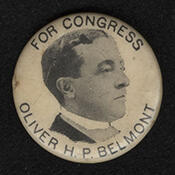
Here you will find contact information for Representative Oliver Hazard Perry Belmont, including email address, phone number, and mailing address.
| Name | Oliver Hazard Perry Belmont |
| Position | Representative |
| State | New York |
| District | 13 |
| Party | Democratic |
| Status | Former Representative |
| Term Start | December 2, 1901 |
| Term End | March 3, 1903 |
| Terms Served | 1 |
| Born | November 12, 1858 |
| Gender | Male |
| Bioguide ID | B000352 |
About Representative Oliver Hazard Perry Belmont
Oliver Hazard Perry Belmont (November 12, 1858 – June 10, 1908) was an American banker, socialite, and politician who served one term as a Democratic Representative from New York in the United States Congress from 1901 to 1903. A member of the banking firm of August Belmont and Co. in New York City and later the publisher of the weekly paper the Verdict, he was part of a prominent family whose influence extended into finance, politics, and society in the late nineteenth and early twentieth centuries.
Belmont was born on November 12, 1858, in New York City, New York. He was the son of August Belmont, a German-born (Hessian) Jewish financier who had come to the United States in 1837 as an agent for the Rothschilds and amassed substantial personal wealth; the Belmont Stakes, the oldest race in the Triple Crown of American thoroughbred racing, is named in his honor. Oliver’s mother, Caroline Slidell (née Perry) Belmont, was the daughter of Commodore Matthew Calbraith Perry, who commanded the United States naval expedition that opened Japan to the West in 1853–54. Belmont’s maternal great-uncle and namesake was Commodore Oliver Hazard Perry, the American naval officer celebrated for his victory at the Battle of Lake Erie in 1813. Raised in this milieu of financial power and naval distinction, Belmont attended St. Paul’s School in Concord, New Hampshire, receiving a preparatory education suited to his family’s social standing.
In 1874, at the age of fourteen, Belmont entered the United States Naval Academy at Annapolis. His academic performance was undistinguished, and he graduated one year later than scheduled, in June 1880, near the bottom of his class. Commissioned as a midshipman, he served in the United States Navy for approximately one year. While assigned to the USS Trenton, he resigned his commission as a cadet-midshipman in June 1881, ending his brief naval career and turning thereafter to pursuits in finance and society.
Following his departure from the Navy, Belmont joined the family banking firm of August Belmont and Co. in New York City, where he was associated with the financial enterprise that had underpinned his father’s fortune. In 1882, without the consent of his parents, he proposed marriage to the debutante Sara Swan Whiting, a popular and well-regarded socialite. August and Caroline Belmont opposed the engagement, believing their son, whose gambling and playboy lifestyle troubled them, to be insufficiently mature for marriage. To curb his excesses and train him in business, they sent him to Bremen, Germany, to learn the banking trade from the Rothschild family, where his father had once been trained. During this period abroad, Belmont became increasingly dissipated and developed a taste for absinthe. When his mother recognized the deterioration in his habits, she relented and consented to the marriage. Belmont married Sara Swan Whiting in Newport, Rhode Island, on December 27, 1882, at her family home, “Swanhurst.”
The marriage quickly deteriorated. The couple traveled to Paris for their honeymoon, and several weeks later they were joined by Sara’s mother and two older sisters, a visit to which Belmont had initially agreed but later resented. He began frequenting gambling houses and brothels and drinking absinthe heavily. Under its influence, his personality reportedly became volatile, and he engaged in a violent and abusive quarrel with his wife, leaving her terrified. Belmont abandoned her in Paris and was later observed in Bordeaux traveling with a French dancer. Sara and the Whiting family, shamed and distressed, returned to the United States. In April 1883, Sara discovered she was pregnant, but the couple divorced, and Belmont was barred from seeing the child. Their daughter, Natica Caroline Belmont (1883–1908), was born on September 5, 1883. Belmont disowned her, denying that she was his daughter and refusing to recognize her as a Belmont heir. Sara later remarried; Natica was adopted by her stepfather, former Assistant Secretary of State George Lockhart Rives, and took his surname. As Natica Rives, she became a prominent New York socialite and in 1907 married William Proudfoot Burden, the brother of industrialist James Abercrombie Burden Jr.
Belmont’s fortunes increased substantially after the death of his father in 1890, when he received a large inheritance. At that time a bachelor, he decided to construct an elaborate summer residence in Newport, Rhode Island. He commissioned the noted architect Richard Morris Hunt to design the mansion known as Belcourt. Belmont took an active role in the design, insisting on arrangements that reflected his personal tastes, particularly his passion for horses. Although Hunt was reportedly hesitant about some of Belmont’s unconventional ideas, he adhered to his principle that the client’s wishes should prevail. The first floor of Belcourt was dominated by stables and carriage spaces integrated into the main structure to accommodate Belmont’s prized horses. The house featured monumental Gothic rooms with large stained-glass windows emblazoned with the Belmont coat of arms, underscoring both his wealth and his interest in heraldic display. In addition to his architectural patronage, Belmont became publisher of the Verdict, a weekly paper, further extending his activities into the realm of public opinion and journalism.
In society and patriotic circles, Belmont held several affiliations. He was an early member of The Lambs, a New York theatrical and social club, having been elected in 1887. In 1896 he became a charter member of the Rhode Island Society of the Sons of the Revolution, qualifying through his descent from Captain Christopher Raymond Perry, who had served as a privateer during the American Revolution. These memberships reflected both his social prominence and his pride in his family’s naval and Revolutionary heritage. On January 11, 1896, Belmont remarried, taking as his second wife Alva Vanderbilt, the former wife of his friend William Kissam Vanderbilt. Belmont had been close to the Vanderbilt family since the late 1880s and had accompanied them on at least two extended voyages aboard their yacht, the Alva. Contemporary observers and later scholars have noted that the mutual attraction between Belmont and Alva appeared evident upon their return from one such voyage in 1889. Their marriage united two of the era’s most prominent fortunes and social dynasties. After Belmont’s death, Alva Belmont became a leading figure in the women’s suffrage movement.
Belmont’s direct involvement in electoral politics came at the turn of the century. He served as a delegate to the Democratic National Convention in 1900, participating in national party deliberations during a period of significant economic and political change in the United States. The following year he was elected as a Democrat from New York’s 13th Congressional District to the Fifty-seventh Congress. His term in the U.S. House of Representatives began on March 4, 1901, and ended on March 3, 1903. During this single term in office, he contributed to the legislative process and represented the interests of his New York constituents in a Congress that confronted issues arising from rapid industrialization, expanding American influence abroad, and domestic political realignments. He did not seek renomination in 1902 and returned to private life at the conclusion of his term.
In his later years, Belmont divided his time among his various residences, including his Brookholt estate in East Meadow, New York. On June 10, 1908, he died at Brookholt from appendicitis. He was interred in Woodlawn Cemetery in the Bronx, New York City. His mausoleum there, designed by Richard Morris Hunt, is an exact replica of the Chapel of St. Hubert at the Château d’Amboise in France and contains Renaissance-inspired painted glass windows by artist Helen Maitland Armstrong. His second wife, Alva Belmont, who survived him by a quarter-century and achieved prominence as a suffrage leader, was buried alongside him after her death in 1933.