Representative Oliver Hart Dockery
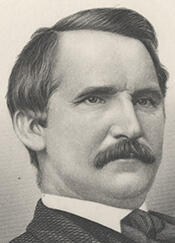
Here you will find contact information for Representative Oliver Hart Dockery, including email address, phone number, and mailing address.
| Name | Oliver Hart Dockery |
| Position | Representative |
| State | North Carolina |
| District | 3 |
| Party | Republican |
| Status | Former Representative |
| Term Start | March 4, 1867 |
| Term End | March 3, 1871 |
| Terms Served | 2 |
| Born | August 12, 1830 |
| Gender | Male |
| Bioguide ID | D000386 |
About Representative Oliver Hart Dockery
Oliver Hart Dockery (August 12, 1830, near Rockingham, Richmond County, North Carolina – March 21, 1906) was an American farmer, lawyer by training, and Republican politician who represented North Carolina in the United States House of Representatives during the Reconstruction era. He was the son of Alfred Dockery, a prominent Whig politician and former member of Congress, and grew up in a family deeply engaged in public affairs. Raised in rural North Carolina, he attended local public schools before pursuing higher education. Dockery studied at Wake Forest College and subsequently enrolled at the University of North Carolina at Chapel Hill, from which he was graduated in 1848. After completing his university studies, he read law, but although he qualified in the field, he never entered into active legal practice, instead turning his attention primarily to agriculture and politics.
Following his education, Dockery engaged in agricultural pursuits in North Carolina, managing and working his lands in the period leading up to the Civil War. His interest in public life led him to seek elective office, and he was elected to the North Carolina House of Commons (later the State House of Representatives) in 1858. He served a term beginning in 1858 and continuing into 1859, marking his first formal role in state-level politics. In this early legislative service, he aligned with the political traditions of his family and gained experience that would later inform his role in national affairs.
During the American Civil War, Dockery initially served for a short time in the Confederate service. However, he soon withdrew and became an advocate of sustaining the Federal Government, a stance that distinguished him from many of his contemporaries in North Carolina. In the postwar period, as the state and the South at large underwent Reconstruction, Dockery’s Unionist sympathies and his alignment with emerging Republican policies positioned him to play a role in the reorganization of political life in North Carolina.
Upon the readmission of North Carolina to representation in the United States Congress after the Civil War, Dockery was elected as a Republican to the Fortieth Congress. He took his seat on July 13, 1868, and was reelected to the Forty-first Congress, serving continuously until March 3, 1871. During his two terms in the House of Representatives, he participated actively in the legislative process at a critical moment in American history, representing the interests of his North Carolina constituents during Reconstruction. He served as chairman of the Committee on the Freedmen’s Bureau in the Forty-first Congress, a position that placed him at the center of federal efforts to assist formerly enslaved people and to shape the postwar social and economic order in the South. A member of the Republican Party, he contributed to the development and defense of Reconstruction policies in Congress. Dockery was an unsuccessful candidate for reelection in 1870 to the Forty-second Congress, and his congressional service concluded in March 1871.
After leaving Congress, Dockery returned to his agricultural pursuits in North Carolina, resuming the management of his farming interests. Nonetheless, he remained active in public affairs. In 1875, amid political tensions and violence that had intensified during and after the election campaign of 1874, in which a Democratic governor was elected in North Carolina, Dockery served as a member of the state constitutional convention. In that role, he participated in debates over the structure of state government and the legal framework that would govern North Carolina in the post-Reconstruction period.
Dockery continued to seek higher office and broader influence within the Republican Party. In 1888 he was the unsuccessful Republican nominee for Governor of North Carolina, running in a political climate increasingly dominated by Democrats in the state. The following year, on June 14, 1889, he was appointed by the national Republican administration as United States consul general at Rio de Janeiro, Brazil. He served in that diplomatic post until July 1, 1893, representing American commercial and political interests in one of South America’s principal ports. When the national administration changed and Democrats returned to power, Dockery left his consular position and again resumed his agricultural pursuits in North Carolina.
In the final phase of his public career, Dockery made additional attempts to reenter elective politics. In 1896, amid the rise of the Populist movement and a period of fusion politics in North Carolina, he sought the nomination of the Populist Party for Lieutenant Governor of North Carolina but did not secure the nomination. That same year, Republican Daniel Lindsay Russell was elected governor with the aid of Populist support, reflecting the complex political realignments in which Dockery was attempting to participate. In 1898, he contested the election of Democrat John D. Bellamy to the U.S. House of Representatives, alleging fraud and voter intimidation in the conduct of the election. Despite these challenges, he was unable to overturn the result, and Bellamy’s election was sustained.
Oliver Hart Dockery spent his later years largely removed from public office, residing principally in North Carolina and continuing to oversee his agricultural interests. He died in Baltimore, Maryland, on March 21, 1906. His remains were returned to his home state, and he was interred in his family cemetery at Mangum, North Carolina, closing the life of a figure who had been active in state and national politics from the antebellum period through Reconstruction and into the late nineteenth century.