Representative Oren Harris
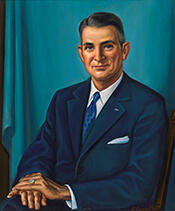
Here you will find contact information for Representative Oren Harris, including email address, phone number, and mailing address.
| Name | Oren Harris |
| Position | Representative |
| State | Arkansas |
| District | 4 |
| Party | Democratic |
| Status | Former Representative |
| Term Start | January 3, 1941 |
| Term End | January 3, 1967 |
| Terms Served | 13 |
| Born | December 20, 1903 |
| Gender | Male |
| Bioguide ID | H000249 |
About Representative Oren Harris
Oren Harris (December 20, 1903 – February 5, 1997) was a United States representative from Arkansas and later a United States district judge of the United States District Court for the Eastern District of Arkansas and the United States District Court for the Western District of Arkansas. A member of the Democratic Party, he served in the United States House of Representatives from 1941 to 1967, contributing to the legislative process during 13 terms in office and representing the interests of his Arkansas constituents during a significant period in American history.
Harris was born on December 20, 1903, in Belton, a historical populated place in Hempstead County near Hope, Arkansas. He attended public schools in Prescott in neighboring Nevada County, Arkansas. Pursuing higher education in his home state, he graduated in 1929 from Henderson State College in Arkadelphia, Arkansas, receiving an Artium Baccalaureus degree. He then studied law at Cumberland School of Law, then part of Cumberland University in Lebanon, Tennessee, where he earned a Bachelor of Laws in 1930. That same year he was admitted to the bar and commenced the practice of law in El Dorado, the seat of Union County, Arkansas.
Before entering Congress, Harris built a career in local and regional public service. He served as deputy prosecuting attorney in Union County from 1933 to 1936, and as prosecuting attorney of the 13th Judicial Circuit of Arkansas from 1937 to 1940. Active in Democratic Party politics, he was a delegate to the Democratic state conventions in 1936 and 1940. His growing prominence in Arkansas politics led to his election to national office in 1940.
In 1940, Harris was elected as United States Representative for Arkansas’s 7th congressional district and took his seat on January 3, 1941. Following redistricting in 1950, he represented Arkansas’s 4th congressional district, which encompassed the southern portion of the state. He served without interruption in the House of Representatives for more than twenty-five years, from January 3, 1941, until February 2, 1966. During this period he participated actively in the democratic process and legislative deliberations of the mid‑twentieth century, including World War II, the early Cold War, and the civil rights era. Harris was a delegate to the Democratic National Conventions in 1944, 1952, 1956, and 1960, reflecting his continuing influence within the party.
Within the House, Harris rose to positions of substantial responsibility. He became chairman of the Subcommittee on Legislative Oversight of the Committee on Interstate and Foreign Commerce and in 1959 presided over nationally watched hearings on the “quiz show scandal,” which investigated the rigging of television quiz programs. In the 1960s, he served as chairman of the full Committee on Interstate and Foreign Commerce during the Eighty-fifth through Eighty-ninth Congresses. In that role, he was the lead House sponsor of the Kefauver–Harris Amendment, an important amendment to the federal Pure Food and Drug Act that strengthened federal regulation of pharmaceuticals and mandated that pharmaceutical companies disclose the side effects of medications approved by the United States Food and Drug Administration for sale in the United States. During the civil rights era, Harris was among the southern lawmakers who opposed the Supreme Court’s decision in Brown v. Board of Education; he was a signatory to the 1956 Southern Manifesto, which denounced the Court’s order for desegregation of public schools.
Harris’s long tenure contributed to the stability of the Arkansas congressional delegation. At the time of his resignation from the House, the entire Arkansas delegation had been in office since 1953 or earlier, and the prolonged period without an open seat had created a backlog of candidates awaiting a vacancy. When he stepped down, a special Democratic primary was held in which future United States Senator David Pryor defeated future federal judge Richard S. Arnold and several other candidates. Pryor then won the special general election, defeating Republican A. Lynn Lowe of Texarkana, and succeeded Harris in representing the district.
While still serving in Congress, Harris was nominated by President Lyndon B. Johnson on July 26, 1965, to a new joint seat on the United States District Court for the Eastern District of Arkansas and the United States District Court for the Western District of Arkansas, a position authorized by 75 Stat. 80. He was confirmed by the United States Senate on August 11, 1965, and received his commission on August 12, 1965. Harris resigned from the House effective February 2, 1966, and took the judicial oath and commenced service on the federal bench on February 3, 1966. He served as Chief Judge of the Western District from 1967 to 1973, overseeing the administration of the court during a period of expanding federal jurisdiction and caseload.
Harris assumed senior status on February 3, 1976, but continued to maintain a full docket of cases for many years thereafter, remaining active on the bench until about the last year of his life, when his health began to fail. His service as a federal judge terminated on February 5, 1997, upon his death from pneumonia in Little Rock, Arkansas.