Senator Oren Ethelbirt Long
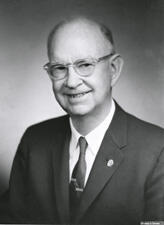
Here you will find contact information for Senator Oren Ethelbirt Long, including email address, phone number, and mailing address.
| Name | Oren Ethelbirt Long |
| Position | Senator |
| State | Hawaii |
| Party | Democratic |
| Status | Former Representative |
| Term Start | January 7, 1959 |
| Term End | January 3, 1963 |
| Terms Served | 1 |
| Born | March 4, 1889 |
| Gender | Male |
| Bioguide ID | L000425 |
About Senator Oren Ethelbirt Long
Oren Ethelbirt Long (March 4, 1889 – May 6, 1965) was an American politician who served as the tenth Territorial Governor of Hawaii from 1951 to 1953 and later as a United States Senator from the State of Hawaii from 1959 to 1963. A member of the Democratic Party of Hawaii, he was appointed territorial governor following the term of Ingram Stainback and, after Hawaii achieved statehood, became one of the first two U.S. Senators to represent the new state, serving alongside Republican Hiram Fong. Long was the only non–Asian American U.S. Senator from Hawaii until the appointment of Brian Schatz to the position in 2012.
Long was born in Altoona, Kansas, on March 4, 1889. He pursued higher education at several institutions, reflecting a strong early commitment to public service and learning. He attended Johnson Bible College in Knoxville, Tennessee, and went on to study at the University of Michigan. He later continued his education at Columbia University in New York City, gaining academic preparation that would underpin his later work in social services, education, and government administration.
Long first came to Hawaii in 1917, settling in Hilo, where he worked as a social worker. His early career in the islands was marked by service-oriented positions that brought him into close contact with local communities. He soon entered the public school system of the Territory of Hawaii, where he held various educational posts over the following decades. Demonstrating administrative ability and a commitment to improving education, he rose through the ranks and ultimately served as a superintendent in the territorial public school system from 1933 to 1946, playing a significant role in shaping educational policy and administration during a formative period in Hawaii’s modern development.
Long’s experience in education and public administration led to his appointment as Governor of the Territory of Hawaii by President Harry S. Truman in 1951. As the tenth Territorial Governor, he served from 1951 to 1953, overseeing the territorial government during the post–World War II era, when questions of political status and eventual statehood were increasingly prominent. A member of the Democratic Party of Hawaii, he followed Ingram Stainback in the governorship and continued the process of modernizing territorial institutions and preparing the islands for a closer political relationship with the continental United States. After leaving the governorship, Long remained active in territorial politics and public affairs.
In the mid-1950s, Long returned to elective office. He served in the Hawaii Territorial Senate from 1956 to 1959, participating in legislative deliberations during the crucial years immediately preceding statehood. His legislative experience, combined with his prior executive service, positioned him as a prominent Democratic leader in the islands as the movement for admission to the Union reached its culmination.
Following the admission of Hawaii as the fiftieth state in 1959, Long was elected to the United States Senate. On July 28, 1959, he won election to one of the two newly created Senate seats from the State of Hawaii, and he took office on August 21, 1959, the same day Hawaii formally entered the Union. The other Senator elected was Republican Hiram Fong. Long’s service in Congress thus occurred during a significant period in American history, as Hawaii transitioned from territorial status to full statehood. For his entire tenure, he was considered Hawaii’s senior Senator; although he and Fong took office on the same day, Long held a seniority edge by virtue of his prior service as territorial governor. A member of the Democratic Party, he contributed to the legislative process during his single term in office, representing the interests of his constituents in the Senate from 1959 to 1963. Long chose not to run for a full six-year term in 1962 and was succeeded by fellow Democrat and then-Representative Daniel Inouye in January 1963.
During his time in the Senate, Long also gained a measure of national public recognition beyond the legislative arena. Shortly after taking office, he appeared as a contestant on the popular television program “What’s My Line?” One of the panelists, Bennett Cerf, recognized him immediately and disqualified himself from the round. After three rounds of questioning, the remaining panelists successfully identified him as a senator from Hawaii, underscoring the public interest in Hawaii’s new status and its first federal representatives.
In his later years, Long remained associated with Hawaii, where he had spent the majority of his adult life in public service. He died on May 6, 1965, in Honolulu, Hawaii, after suffering an attack of asthmatic bronchitis. He was buried in Oahu Cemetery. His papers and official records are preserved at the University of Hawaiʻi at Mānoa, where they are maintained in the institution’s archival collections, providing a documentary record of his contributions to Hawaii’s educational system, territorial governance, and early statehood representation in the United States Senate.