Representative Orestes Cleveland
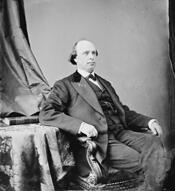
Here you will find contact information for Representative Orestes Cleveland, including email address, phone number, and mailing address.
| Name | Orestes Cleveland |
| Position | Representative |
| State | New Jersey |
| District | 5 |
| Party | Democratic |
| Status | Former Representative |
| Term Start | March 4, 1869 |
| Term End | March 3, 1871 |
| Terms Served | 1 |
| Born | March 2, 1829 |
| Gender | Male |
| Bioguide ID | C000514 |
About Representative Orestes Cleveland
Orestes Cleveland (March 2, 1829 – March 30, 1896) was an American manufacturer and Democratic Party politician who represented New Jersey’s 5th congressional district in the United States House of Representatives from 1869 to 1871 and served two separate stints as mayor of Jersey City. His congressional service occurred during a significant period in American history, in the aftermath of the Civil War and during Reconstruction, when he participated in the legislative process and represented the interests of his New Jersey constituents.
Cleveland was born in Duanesburg, Schenectady County, New York, on March 2, 1829, the son of Elijah Cleveland and Mary Ann (Bartlett) Cleveland. He attended the common schools of the area and, as a young man, moved to New York City to begin a business career. There he entered the employ of William Miller, an importer of silverware and fancy goods, starting as a clerk. Through diligence and business acumen, he advanced steadily and ultimately became a partner in the firm, gaining experience that would shape his later work as an industrialist.
In 1850, Cleveland relocated to Jersey City, New Jersey, where he turned to manufacturing. He specialized in the production of black lead, stove polish, and pencils, sectors that were expanding with the growth of American industry. In partnership with Joseph Dixon, he helped organize the Dixon Crucible Company, which became one of the world’s largest manufacturers of graphite products in the 1870s. Cleveland served as president of the company, overseeing its development into a major industrial enterprise. In 1853 he married Jane Hitchins Dixon, the daughter of Joseph Dixon. The couple had four sons and two daughters—Joseph, Orestes, Louise, Josephine, Francis, and Converse—establishing family ties that were closely intertwined with his business interests.
Cleveland’s prominence in Jersey City’s commercial life led naturally to involvement in local politics. He served on the Jersey City Board of Aldermen in 1861 and 1862, acting as president of the board in 1862. Building on this municipal experience, he was elected mayor of Jersey City and served his first term from 1864 to 1867. In this role he was part of the city’s leadership during the closing years of the Civil War and the beginning of Reconstruction, a time of rapid urban and industrial growth in northern New Jersey.
A member of the Democratic Party, Cleveland was elected to the United States House of Representatives in 1868 as the representative of New Jersey’s 5th congressional district. He served one term in Congress from March 4, 1869, to March 3, 1871. During this period he contributed to the legislative process in the House of Representatives and participated in the democratic governance of the nation at a time when questions of Reconstruction, economic development, and industrial regulation were central to national debate. He was an unsuccessful candidate for reelection in 1870, bringing his congressional service to a close after a single term.
After leaving Congress, Cleveland returned to his business pursuits in Jersey City. He became associated with the Forbes Fibre Company, continuing his involvement in manufacturing and industrial enterprise. Remaining active in Democratic politics, he was the party’s candidate for Governor of New Jersey in 1880, though he was unsuccessful in that race, losing to George C. Ludlow. Despite this setback, he retained a significant role in public life and in the civic affairs of Jersey City.
Cleveland again served as mayor of Jersey City from 1886 to 1892, marking his second tenure as the city’s chief executive. During these years he presided over a period of continued urban expansion and commercial development. In 1888 he was one of the organizers of the Jersey City Board of Trade and served as its first president, reflecting his standing as both a political leader and a leading figure in the city’s business community. In 1892 he moved from Jersey City to Tenafly, New Jersey, and later took up residence in Englewood, New Jersey, while remaining a respected elder statesman of the state’s Democratic Party and industrial circles.
In declining health toward the end of his life, Cleveland traveled to Norwich, Vermont, in search of improved health. He died there on March 30, 1896. He was interred in Fairview Cemetery in Norwich, Vermont. His career as a manufacturer, municipal leader, and member of Congress linked the emerging industrial economy of New Jersey with the political life of the state and the nation in the latter half of the nineteenth century.