Representative Orland Kay Armstrong
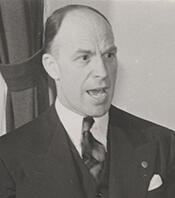
Here you will find contact information for Representative Orland Kay Armstrong, including email address, phone number, and mailing address.
| Name | Orland Kay Armstrong |
| Position | Representative |
| State | Missouri |
| District | 6 |
| Party | Republican |
| Status | Former Representative |
| Term Start | January 3, 1951 |
| Term End | January 3, 1953 |
| Terms Served | 1 |
| Born | October 2, 1893 |
| Gender | Male |
| Bioguide ID | A000218 |
About Representative Orland Kay Armstrong
Orland Kay Armstrong (October 2, 1893 – April 15, 1987) was an American Republican politician, journalist, social activist, and member of the United States House of Representatives from Missouri. Serving one term in Congress from 1951 to 1953, he represented Missouri as a Republican during a significant period in American history marked by the early Cold War and the Korean War. Over the course of a long and varied career, he was also an educator, military aviator, investigative journalist, and prominent contributor to national magazines.
Armstrong was born on October 2, 1893, in Willow Springs, Missouri, the third of nine children of Reverend William Armstrong, a schoolteacher and minister. His family moved frequently throughout southern Missouri as his father alternated between teaching posts and founding new churches. In 1907 the family settled in Carterville, Missouri, where Armstrong attended Carterville High School and graduated as valedictorian in 1912. He then enrolled at Drury College in Springfield, Missouri, and graduated summa cum laude in 1916 with a bachelor’s degree in education, laying the foundation for his early career in teaching and academic work.
Following his graduation from Drury, Armstrong accepted a position at Southwest Baptist College in Bolivar, Missouri, where he taught English and served as basketball coach. The college had a personal significance for him, as his maternal grandfather, Reverend Daniel Preston, had been one of its founders. With the entry of the United States into World War I in April 1917, Armstrong took a leave of absence from teaching to join the U.S. Army. Assigned to the Army Signal Corps, he received pilot training and served as an instructor pilot for the duration of the war. During this period he made his first substantive entry into journalism by editing the aviation magazine Propeller. After the Armistice, he worked with the YMCA in France for two years, helping care for Russian prisoners of war awaiting repatriation, an experience that broadened his international outlook and humanitarian interests.
Upon his return to the United States in 1920, Armstrong pursued further education at Cumberland University in Tennessee, where he earned a second bachelor’s degree and a law degree in 1922. Although he passed the Missouri Bar examination, he chose not to enter legal practice. Instead, he turned toward journalism, enrolling at the University of Missouri and earning both a bachelor’s and a master’s degree in journalism in 1925. He then joined the faculty of the University of Florida, where he founded the University of Florida School of Journalism, helping to institutionalize journalism education in the state. From the mid-1920s onward, Armstrong worked as a freelance journalist for newspapers and national magazines. One of his most notable early pieces was a rare 1927 interview with aviator Charles Lindbergh for Boys’ Life magazine; the two men, both with Missouri ties and aviation backgrounds, became lifelong friends.
Armstrong returned to Missouri in 1929 and soon entered electoral politics. His first attempt, an unsuccessful run for the state senate in 1930, was followed by a successful campaign in 1932 for the Missouri House of Representatives. In a year dominated by Democratic landslides from the presidency down to state offices, he was one of only ten Republicans elected to the Missouri House. He served there from 1933 to 1936 and again from 1942 to 1944. While in the state legislature, he continued his journalism, and his investigative reporting had national implications. In 1934 he wrote a series of articles exposing gambling, corruption, and the political machine of Kansas City boss Tom Pendergast, then the principal political backer of future President Harry S. Truman. These articles led to his appointment in 1938 by Missouri Governor Lloyd Stark as a special investigator and to his testimony in 1939 before a Jackson County grand jury probing the activities of the Pendergast organization. During the late 1930s and early 1940s, Armstrong also became identified with isolationist sentiment and was among the earliest to join his friend Charles Lindbergh in the America First Committee. After the Japanese attack on Pearl Harbor, however, he shifted his stance and strongly supported the American war effort. He was again elected to the Missouri House in 1942 but declined to seek reelection in 1944, instead running unsuccessfully for lieutenant governor of Missouri. From 1944 until 1950 he held a variety of appointed governmental posts, including work with a U.S. Senate committee on the Post Office and Civil Service.
In 1950 Armstrong was elected as a Republican to the United States House of Representatives, serving from 1951 to 1953. His term in Congress coincided with the Korean War and heightened Cold War tensions. Although a freshman legislator, he became involved in matters of international significance. On a 1951 fact-finding trip to the Far East and Taiwan, he met with Nationalist Chinese leader Chiang Kai-shek to discuss a plan for bringing Nationalist forces into the Korean War, a proposal strongly opposed by President Harry S. Truman’s administration. Later, during the Japanese Allied Peace Conference, Armstrong engaged in a public and heated exchange with Soviet chief delegate Andrei Gromyko over the issue of Soviet slave labor camps. Gromyko denied Armstrong’s charges, but the confrontation further strained Cold War relations and complicated U.S. diplomatic efforts to secure Soviet influence over North Korean and Chinese Communist leadership in pursuit of a Korean peace settlement. Due to congressional redistricting following the 1950 census, Armstrong’s district was altered in such a way that he would have had to run against his friend and fellow Republican Dewey Jackson Short in 1952. Rather than challenge Short, Armstrong chose not to seek reelection, concluding his single term in Congress in 1953.
After leaving Congress, Armstrong was selected by Secretary of State John Foster Dulles, an old friend, to serve as Director of Publicity for the U.S. Department of State. Before he could assume the position, however, it emerged that he was under criminal investigation by the Internal Revenue Service. He was eventually convicted on three counts of tax evasion, required to pay a substantial sum in back taxes and penalties, but he avoided imprisonment. In 1965 the IRS concluded that Armstrong had not intentionally defrauded the government and refunded nearly $12,000 to him in overpaid taxes, previously assessed fines, and interest. He sought a return to elective office with two further campaigns for the Missouri House of Representatives, in 1966 and again in 1982, but was unsuccessful both times.
Parallel to his political career, Armstrong maintained a long and influential presence in American journalism. Employed by Reader’s Digest in various capacities beginning in the mid-1940s, he wrote more than 125 articles for the magazine and served on its editorial board. Some of his work appeared under pen names. His articles frequently championed civil rights, warned against the growth of the national debt, and condemned what he viewed as the moral and social harms of pornography. Reflecting his activism on issues of public morality, in 1970 he helped organize the Springfield Citizens Council for Decency, an anti-pornography group in Springfield, Missouri. He also continued to be recognized for his earlier work in aviation and public affairs; among other appearances, he was featured in a filmed interview, “Longines Chronoscope with Rep. Orland K. Armstrong,” recorded on October 1, 1951, which is preserved at the Internet Archive.
Armstrong’s personal life was marked by two long marriages and a large family. In 1920, while visiting and briefly working with his parents in Florida, he met Louise McCool. The couple married in 1922 and had five children. Louise Armstrong died of cancer in 1947. In 1949 he married Marjorie Moore, a friend and fellow writer, and they remained married until his death. Orland K. Armstrong died in Springfield, Missouri, on April 15, 1987, and was buried in Greenlawn Cemetery in that city. His life and career later became the subject of an authorized biography, approved by the Armstrong family and published in October 2020.