Senator Orrin G. Hatch
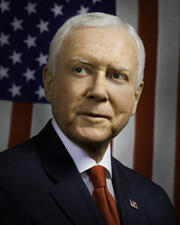
Here you will find contact information for Senator Orrin G. Hatch, including email address, phone number, and mailing address.
| Name | Orrin G. Hatch |
| Position | Senator |
| State | Utah |
| Party | Republican |
| Status | Former Representative |
| Term Start | January 4, 1977 |
| Term End | January 3, 2019 |
| Terms Served | 21 |
| Born | March 22, 1934 |
| Gender | Male |
| Bioguide ID | H000338 |
About Senator Orrin G. Hatch
Orrin Grant Hatch (March 22, 1934 – April 23, 2022) was an American attorney and politician who served as a United States senator from Utah from January 3, 1977, to January 3, 2019. A member of the Republican Party, he represented Utah in the Senate for seven consecutive terms, a 42‑year tenure that made him the longest‑serving Republican U.S. senator in history, overtaking Ted Stevens, a distinction he held until Chuck Grassley surpassed him in 2023. At the time of his retirement, he was also the longest‑serving U.S. senator in Utah history, having eclipsed previous record‑holder Reed Smoot in 2007, and one of the longest‑serving Republican members of Congress in United States history.
Hatch was born in Homestead, Pennsylvania, a suburb of Pittsburgh, the son of Jesse Hatch (1904–1992), a metal lather, and Helen Frances Hatch (née Kamm; 1906–1995). He grew up in a large family with eight brothers and sisters, two of whom died in infancy. His early life was marked by poverty and by the profound impact of World War II: his older brother Jesse, a U.S. Army Air Forces nose‑turret gunner with the 725th Bombardment Squadron, was killed on February 7, 1945, when the B‑24 bomber on which he served was shot down over German‑occupied Austria. This loss deeply affected Hatch and remained a formative experience throughout his life.
The first in his family to attend college, Hatch enrolled at Brigham Young University in Provo, Utah, where he earned a Bachelor of Arts degree in history in 1959. During his youth and college years he also fought in 11 bouts as an amateur boxer, an experience he later cited as shaping his discipline and tenacity. He went on to study law at the University of Pittsburgh School of Law, receiving his Juris Doctor in 1962. While in law school, Hatch and his young family lived in extremely modest circumstances, residing in a refurbished chicken coop behind his parents’ house, an oft‑recounted illustration of his early financial hardship. After admission to the bar, he practiced law in Pittsburgh before relocating to Utah in 1969, where he continued his legal career and became increasingly involved in Republican politics and civic affairs.
Hatch’s entry into elective politics came in 1976, when he ran for the United States Senate in his first campaign for public office. He challenged Democratic Senator Frank Moss, a three‑term incumbent, criticizing Moss’s 18 years in office and campaigning on a theme of change and term limits. Hatch famously asked, “What do you call a Senator who’s served in office for 18 years? You call him home.” Running as a conservative Republican who argued that long‑serving senators had lost touch with their constituents, he defeated Moss in the general election. He took office on January 3, 1977, beginning a Senate career that would span more than four decades.
Once in the Senate, Hatch quickly established himself as an influential conservative voice and an active legislator. He won re‑election in 1982, defeating Salt Lake City mayor Ted Wilson by 17 points; in 1988, he defeated Brian Moss, the son of his original opponent Frank Moss, by 35 points. He was subsequently re‑elected in 1994, 2000, 2006, and 2012. Over the course of his tenure, he served on and led several key committees. From 1981 to 1987, he chaired the Senate Committee on Health, Education, Labor, and Pensions, playing a central role in health and education policy. He later served as chair of the Senate Judiciary Committee from 1995 to 2001 and again from 2003 to 2005, where he was deeply involved in judicial nominations and major legal and constitutional issues. In 2015, at the opening of the 114th Congress, he became president pro tempore of the Senate, placing him third in the presidential line of succession, and he simultaneously assumed the chairmanship of the Senate Finance Committee, a post he held from 2015 to 2019. In that capacity he was a principal architect of the Tax Cuts and Jobs Act of 2017, leading Republican efforts to enact a sweeping overhaul of the federal tax code.
Throughout his congressional service, Hatch participated prominently in many of the major legislative and political debates of his era. He was known as a strong social conservative and was firmly opposed to abortion. He authored the proposed “Hatch Amendment” to the U.S. Constitution, which stated that there is no constitutional right to abortion and would have empowered the states to restrict abortion as they saw fit. At the same time, he developed a reputation for working across the aisle on select issues, and he was credited with helping to pass landmark bipartisan legislation, including the Americans with Disabilities Act and the Children’s Health Insurance Program. As a senior member of the Senate Select Committee on Intelligence, he was instrumental in the 2008 extension of the Foreign Intelligence Surveillance Act, arguing that the bipartisan bill, though imperfect, was necessary to ensure that judicial oversight did not unduly hamper U.S. intelligence efforts. In economic policy, he voted in favor of the 2008 legislation establishing the Troubled Asset Relief Program (TARP), later stating in 2011 that he “probably made a mistake” in supporting it but believed at the time that it was necessary to avert a depression. He opposed the renewal of TARP in 2009, a renewal that failed in the Senate by 10 votes, and he supported the Housing and Economic Recovery Act of 2008, which authorized $300 billion to guarantee mortgages and bolster confidence in Fannie Mae and Freddie Mac.
Hatch’s role in national security and judicial matters was particularly visible. In 1995, he was the leading figure behind the Senate’s major anti‑terrorism bill, drafted largely in response to the Oklahoma City bombing. Elements of the legislation, particularly new limits on habeas corpus in capital cases, drew criticism from civil liberties organizations such as the Anti‑Defamation League and the American Jewish Committee. He long expressed interest in serving on the United States Supreme Court and was reported to have been on President Ronald Reagan’s short list to succeed Justice Lewis F. Powell Jr., though he was passed over, in part due to concerns related to the Constitution’s Ineligibility Clause. As chair and senior member of the Judiciary Committee, he played a central role in Supreme Court confirmation battles. He vocally supported Robert Bork’s unsuccessful nomination and, during the 1991 hearings on the nomination of Clarence Thomas, he became widely known for his vigorous defense of Thomas, including reading aloud from the novel “The Exorcist” in an effort to suggest that Anita Hill had borrowed details of her sexual harassment allegations from the book.
Hatch also sought higher office within the national Republican Party. In the 2000 election cycle, he campaigned for the Republican nomination for president, positioning himself as a conservative alternative with extensive legislative experience. After finishing last in the Iowa caucuses, he withdrew from the race on January 27, 2000, and endorsed Texas Governor George W. Bush, who went on to win the nomination and the presidency. Within the Senate, he remained a key party figure. In September 1989, Senate Republican Leader Bob Dole appointed him as one of nine Republican senators to negotiate with Democrats over the financing of President George H. W. Bush’s $7.8 billion anti‑drug plan, part of the administration’s broader effort to combat narcotics domestically and abroad. His seniority and committee assignments ensured that he was frequently at the center of negotiations on judicial, health, tax, and national security legislation.
In his later Senate years, Hatch continued to be deeply involved in partisan and national political developments. After the defeat of Utah Senator Bob Bennett at the state Republican convention in 2010, speculation mounted that the six‑term Hatch might retire rather than seek a seventh term in 2012, and that Congressman Jason Chaffetz might challenge him. Chaffetz ultimately declined to run, and in January 2011 Hatch announced that he would seek re‑election. Nine other Republicans entered the race, including former state senator Dan Liljenquist and state legislator Chris Herrod. At the April 21, 2012, Republican state convention, Hatch failed to secure the 60 percent of delegate votes needed to clinch the nomination, forcing a primary against Liljenquist on June 26, which he won easily—his first primary contest since 1976. In the general election, he faced Democratic nominee Scott Howell, a former state senator and IBM executive, and prevailed with 65.2 percent of the vote to Howell’s 30.2 percent. During the 2016 presidential election, Hatch initially supported former Florida Governor Jeb Bush and later endorsed Senator Marco Rubio after Bush withdrew. After Donald Trump became the presumptive Republican nominee, Hatch endorsed him on May 12, 2016. He criticized some of Trump’s rhetoric, including remarks about federal judge Gonzalo P. Curiel, saying that Trump was not a racist but made “a lot of outrageous statements” and that criticism of judges should be done “in a formal way.” Following the release of the Access Hollywood tape on October 7, 2016, Hatch called Trump’s comments “offensive and disgusting” and said there was “no excuse for such degrading behavior” toward women, but he maintained his endorsement.
As president pro tempore beginning January 3, 2015, Hatch held one of the highest offices in the Senate. On January 20, 2017, during the presidential inauguration of Donald Trump, he served as the designated survivor at the president‑elect’s request and was kept at a secure, undisclosed location rather than attending the ceremonies in Washington, D.C. His leadership of the Senate Finance Committee placed him at the forefront of fiscal and tax policy. His role in the passage of the Tax Cuts and Jobs Act of 2017, as well as his support for reducing the size of the Grand Staircase–Escalante National Monument in Utah, drew both praise and criticism. On December 25, 2017, The Salt Lake Tribune named him “Utahn of the Year,” explaining that the designation was for the Utahn who had the greatest impact—“for good or for ill”—over the previous 12 months. The editorial sharply criticized Hatch’s role in the monument reduction and the tax legislation and accused him of lacking integrity, underscoring the polarizing nature of his late‑career influence.
On January 2, 2018, Hatch announced that he would retire from the Senate at the end of his term rather than seek re‑election in November. He left office on January 3, 2019, concluding 42 years of continuous service in the Senate. Over the course of his long tenure, he participated in the democratic process during a significant period in American history, representing the interests of his Utah constituents while helping to shape national policy on issues ranging from health care and taxation to judicial appointments, national security, and social policy. Hatch died on April 23, 2022, closing a public career that had spanned more than half a century in law and politics.