Representative Oscar Sherman Gifford
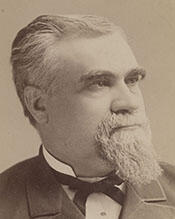
Here you will find contact information for Representative Oscar Sherman Gifford, including email address, phone number, and mailing address.
| Name | Oscar Sherman Gifford |
| Position | Representative |
| State | South Dakota |
| District | -1 |
| Party | Republican |
| Status | Former Representative |
| Term Start | December 7, 1885 |
| Term End | March 3, 1891 |
| Terms Served | 3 |
| Born | October 20, 1842 |
| Gender | Male |
| Bioguide ID | G000170 |
About Representative Oscar Sherman Gifford
Oscar Sherman Gifford (October 20, 1842 – January 16, 1913) was an American lawyer and Republican politician who represented Dakota Territory and later the State of South Dakota in the United States House of Representatives. Over the course of six years in Congress, he served first as the non-voting territorial delegate and then as a full voting member, contributing to the legislative process during three terms in office at a formative period in the region’s and the nation’s history.
Gifford was born on October 20, 1842, in Watertown, Jefferson County, New York. During his childhood he moved with his parents westward, first to Wisconsin, where the family settled in Rock County, and later to Brown County, Illinois. As a young man he served as a private in the Union Army during the American Civil War, participating in the conflict that preserved the Union and shaped his generation’s political outlook.
After the Civil War, Gifford pursued legal studies and was admitted to the bar in 1871. He moved to the Dakota Territory and established a law practice in Canton, in what is now South Dakota. Building a reputation as a capable attorney, he became an influential figure in local affairs. He served as district attorney for Lincoln County, where he prosecuted cases on behalf of the territory, and was elected mayor of Canton, reflecting the confidence of his community in his leadership. He also took part in the movement toward statehood, serving as a member of the South Dakota constitutional convention that convened at Sioux Falls on September 7, 1883, helping to frame the basic law for the future state.
A committed member of the Republican Party, Gifford entered national politics as a representative of the Dakota Territory. He was twice elected as the territorial delegate to the United States Congress and served in that capacity from March 4, 1885, to March 3, 1889. As a non-voting delegate in the House of Representatives, he participated in debates, served on committees, and worked to advance the interests of the territory, even though he lacked a formal vote on the House floor. His service in Congress occurred during a significant period in American history, marked by western expansion, debates over land and railroad policy, and the political process leading to the admission of new states.
When South Dakota was admitted to the Union as a state in 1889, it was allocated two at-large seats in the U.S. House of Representatives, designated Seat A and Seat B. Gifford ran for and was elected as the first Congressman from South Dakota to hold Seat B. He served as a full voting member of the House from November 2, 1889, to March 3, 1891. During this term he represented the interests of his South Dakota constituents in the federal legislature, participating fully in the democratic process at a time when the new state was establishing its place within the Union. He chose not to be a candidate for re-election in 1890, thereby concluding his service in Congress after three consecutive terms—two as territorial delegate and one as state representative—spanning the years 1885 to 1891.
Following his departure from Congress, Gifford returned to Canton and resumed the practice of law. He remained active in public service and was appointed the first superintendent of the Canton Asylum for Insane Indians, a federal institution established near Canton to house Native American patients. In this role he oversaw the early administration of the facility, serving until his resignation in 1908. His work at the asylum reflected the federal government’s evolving, if often controversial, policies toward Native Americans and mental health in the early twentieth century.
Oscar Sherman Gifford continued to reside in Canton, South Dakota, after leaving the superintendency. He lived there until his death on January 16, 1913. He was interred in Forest Hill Cemetery in Canton, leaving a legacy as a Civil War veteran, frontier lawyer, local official, constitutional convention delegate, territorial representative, and early statehood-era Congressman who helped guide Dakota Territory into the Union as the State of South Dakota.