Representative Oscar Lawrence Jackson
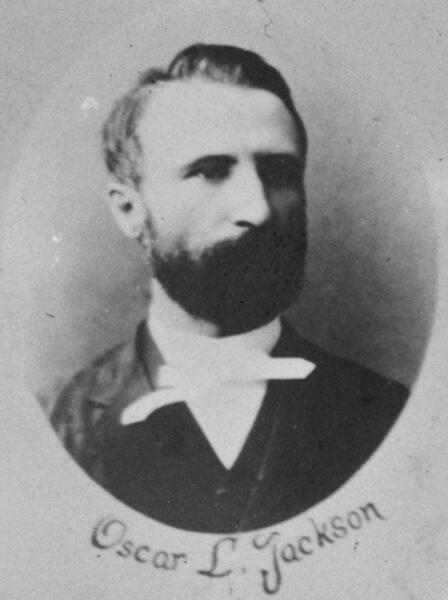
Here you will find contact information for Representative Oscar Lawrence Jackson, including email address, phone number, and mailing address.
| Name | Oscar Lawrence Jackson |
| Position | Representative |
| State | Pennsylvania |
| District | 24 |
| Party | Republican |
| Status | Former Representative |
| Term Start | December 7, 1885 |
| Term End | March 3, 1889 |
| Terms Served | 2 |
| Born | September 2, 1840 |
| Gender | Male |
| Bioguide ID | J000024 |
About Representative Oscar Lawrence Jackson
Oscar Lawrence Jackson (September 2, 1840 – February 16, 1920) was a Republican member of the U.S. House of Representatives from Pennsylvania and a Union Army officer who commanded an Ohio infantry regiment during the American Civil War. He served as a Representative from Pennsylvania in the United States Congress from 1885 to 1889, completing two terms in office and contributing to the legislative process during a significant period in American history.
Jackson was born in Shenango Township, Pennsylvania, to Samuel Stewart Jackson and Nancy (Mitchell) Jackson. He was educated in the common schools and later attended Tansy Hill Select School and Darlington Academy, institutions that provided him with a solid preparatory education. As a young man he moved to Ohio for a time, where he taught school in Hocking County, gaining early experience in public service and community leadership before the outbreak of the Civil War.
With the onset of the Civil War, Jackson entered the Union Army in 1861 and served until 1865. He began his military career as captain of Company H of the 63rd Regiment, Ohio Volunteer Infantry. Over the course of the war he distinguished himself in service and, after the conflict, received brevet promotions to major, lieutenant colonel, and colonel. During the Second Battle of Corinth in Mississippi, he was shot in the face by a Confederate soldier armed with a squirrel rifle and was left for dead on the field, an incident that became one of the defining episodes of his wartime experience. His service culminated in his command of an Ohio infantry regiment, and he later recorded his experiences in the volume The Fiery Trail: A Union Officer’s Account of Sherman’s Last Campaigns, providing a firsthand narrative of the closing operations of the war in the Western Theater.
After the war, Jackson returned to Pennsylvania and turned to the study of law. He was admitted to the bar in 1867 and commenced practice in New Castle, Pennsylvania. His legal abilities and growing reputation led to his election as district attorney of Lawrence County, a position he held from 1868 to 1871. Beyond his prosecutorial duties, he took part in statewide legal and governmental reform, serving as a member of the commission to codify the laws and devise a plan for the government of cities of Pennsylvania in 1877 and 1878. This work reflected his interest in orderly municipal governance and legal modernization during a period of rapid urban and industrial growth in the Commonwealth.
Jackson’s prominence in local and state affairs paved the way for his election to national office. A member of the Republican Party, he was elected to the Forty-ninth and Fiftieth Congresses and served in the U.S. House of Representatives from March 4, 1885, to March 3, 1889. Representing his Pennsylvania constituency during a transformative era in American politics, he participated in the democratic process and represented the interests of his constituents as the nation grappled with issues of industrial expansion, veterans’ affairs, and post-Reconstruction policy. His two terms in Congress marked the peak of his federal legislative career. In 1888 he was an unsuccessful candidate for renomination, bringing his congressional service to a close at the end of his second term.
Following his departure from Congress, Jackson resumed the practice of law in New Castle. He remained active in Republican politics and was chosen as a delegate to the 1896 Republican National Convention, underscoring his continued influence within the party and his engagement with national political developments at the close of the nineteenth century. In his later years he also remained known as a Civil War veteran and author, with his published reminiscences contributing to the historical record of the Union Army’s campaigns.
Oscar Lawrence Jackson died in New Castle, Pennsylvania, on February 16, 1920. He was interred in Greenwood Cemetery in that city. His life spanned from the antebellum era through the First World War, and his career encompassed service as a soldier, lawyer, local prosecutor, legal reformer, congressman, political delegate, and author, reflecting the varied public roles assumed by many nineteenth-century American statesmen.