Representative Otha Donner Wearin
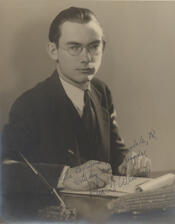
Here you will find contact information for Representative Otha Donner Wearin, including email address, phone number, and mailing address.
| Name | Otha Donner Wearin |
| Position | Representative |
| State | Iowa |
| District | 7 |
| Party | Democratic |
| Status | Former Representative |
| Term Start | March 9, 1933 |
| Term End | January 3, 1939 |
| Terms Served | 3 |
| Born | January 10, 1903 |
| Gender | Male |
| Bioguide ID | W000221 |
About Representative Otha Donner Wearin
Otha Donner Wearin (January 10, 1903 – April 3, 1990) was an American writer, farmer, and Democratic politician who served as a Representative from Iowa in the United States Congress from 1933 to 1939. Elected at age twenty-nine as the youngest member of President Franklin D. Roosevelt’s first “New Deal” Congress, he represented Iowa’s 7th congressional district for three consecutive terms and became known for his progressive ideals. After his congressional career ended, he emerged as a prolific author whose work on rural life and the American West contributed to his later induction into the Cowboy Hall of Fame.
Wearin was born on a farm near Hastings, in Mills County, Iowa. He grew up in a rural environment that shaped his lifelong interest in agriculture and country life. He attended Grinnell College in Grinnell, Iowa, from which he graduated before returning to Mills County to farm on the family land. Early in adulthood, he traveled to Europe to study and inspect agricultural practices abroad. The observations from this trip formed the basis of his first book, “An Iowa Farmer Abroad,” and were also described in articles that appeared in rural Iowa newspapers. By the age of twenty-five, he had “gained prominence as a farm bureau speaker and writer,” a reputation that helped launch his political career.
Building on his growing public profile as a writer and agricultural advocate, Wearin entered state politics as a Democrat at a time when his home county and much of Iowa were strongholds of the Republican Party. In 1928, despite the influence of native-son Republican presidential candidate Herbert Hoover at the top of the ticket and widespread Republican gains across the state, Wearin was elected to the Iowa House of Representatives. He represented his district in the Iowa House for two terms, winning re-election in 1930. His early legislative work in Des Moines helped establish him as a young, reform-minded Democrat in a predominantly Republican political environment.
In 1932, Wearin achieved a historic victory when he became the first Democrat ever elected to the U.S. House of Representatives from Iowa’s 7th congressional district. Taking office on March 4, 1933, he entered the Seventy-third Congress as the youngest member of the House of Representatives and the youngest member of Roosevelt’s initial New Deal Congress. A member of the Democratic Party, he contributed to the legislative process during three terms in office, serving in the Seventy-third, Seventy-fourth, and Seventy-fifth Congresses. He was re-elected in 1934 and 1936, though by increasingly narrow margins, reflecting the competitive political climate of his district. During his tenure, he participated actively in the democratic process, represented the interests of his constituents during a period of profound economic and social change, and was associated with progressive policies aligned with the New Deal.
Wearin’s congressional service occurred during a significant period in American history, as the federal government responded to the Great Depression with sweeping reforms. In 1938, at the urging of President Roosevelt, who was attempting to reshape the Democratic Party and “purge” certain incumbents, Wearin gave up his House seat to seek the Democratic nomination for the United States Senate. He challenged incumbent Democratic Senator Guy M. Gillette in the primary, with Roosevelt’s support, but primary voters rallied behind Gillette, and Wearin was defeated. This unsuccessful bid effectively stalled his national political career, as he left Congress on January 3, 1939, at the close of his third term.
Although his initial Senate campaign ended his service in the U.S. House, Wearin continued to pursue higher office in the postwar era. In 1950, he made a second attempt to win the Democratic nomination for the U.S. Senate, but finished a distant third in the primary behind Al Loveland and former Governor Nelson Kraschel. Two years later, in 1952, he sought the Democratic nomination for Governor of Iowa, losing in the primary to Herschel C. Loveless. Later, in 1969, after Charles Vernon Lisle resigned one year before his Iowa Senate term ended, Wearin was nominated by the Democratic Party as its candidate in the special election to fill the vacancy. In that race he was defeated by the Republican nominee, Earl Bass, marking the close of his efforts to return to elected office.
Following the end of his active political career, Wearin devoted himself to agriculture, writing, and historical and conservation work. He raised purebred Angus cattle on the 1,000-acre family estate known as “Nishna Vale,” near Hastings, Iowa. Despite deterioration of his eyesight in later years, he continued to write books and articles, study Iowa history, and participate in conservation efforts. His literary output was substantial and spanned several decades, reflecting both his rural Iowa roots and his fascination with the American West and its cultural history.
Wearin became a prolific writer of westerns and rural reminiscences, producing works that included “Before the Colors Fade” (1971), “I Remember Yesteryear” (1974), “Heinhold’s First and Last Chance Saloon: Jack London’s Rendezvous” (1974), “Grass Grown Trails” (1981), and “Along Our Country Road” (1985). Beyond western themes, he authored numerous other books, such as “Century on an Iowa Farm” (1959), “I Remember Hastings” (1965), “Political Americana” (1967), “Clarence Arthur Ellsworth: Artist of the Old West, 1885–1964” (1967), “Country Roads to Washington” (1976), and “Rhymes of a Plain Countryman” (1980). His body of work, which celebrated rural life, western history, and American political culture, was cited in connection with his 1985 induction into the Cowboy Hall of Fame, underscoring his dual legacy as both public servant and chronicler of American life.
Otha Donner Wearin died on April 3, 1990, in Glenwood, Iowa. He was buried in Malvern, Iowa, not far from the Mills County countryside where he had been born and to which he remained closely tied throughout his life.