Senator Ovington Eugene Weller
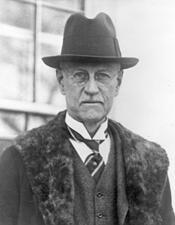
Here you will find contact information for Senator Ovington Eugene Weller, including email address, phone number, and mailing address.
| Name | Ovington Eugene Weller |
| Position | Senator |
| State | Maryland |
| Party | Republican |
| Status | Former Representative |
| Term Start | April 11, 1921 |
| Term End | March 4, 1927 |
| Terms Served | 1 |
| Born | January 23, 1862 |
| Gender | Male |
| Bioguide ID | W000276 |
About Senator Ovington Eugene Weller
Ovington Eugene Weller (January 23, 1862 – January 5, 1947) was an American banker, attorney, and Republican member of the United States Senate who represented the State of Maryland from 1921 to 1927. He was born on January 23, 1862, in Reisterstown, Maryland, to Wilmina (née Berryman) and William F. Weller. He attended local schools and graduated from Franklin High School in 1877. Demonstrating early academic distinction and leadership, he entered the United States Naval Academy at Annapolis, from which he graduated in 1881, serving as president of his class.
Following his graduation from the Naval Academy, Weller served for two years as an officer in the United States Navy. He was honorably discharged in 1883, after which he turned to the study of law. That same year he enrolled at the National Law School in Washington, D.C. While pursuing his legal education, he was employed as a clerk in the Post Office Department in Washington, D.C., from 1883 to 1887. He received his Bachelor of Laws degree in 1887 and was admitted to the bar in 1888.
Weller began his legal career in the Midwest, practicing law in Wichita, Kansas, from 1888 to 1891. After several years in practice, he shifted his focus to business and finance, engaging in banking and manufacturing and becoming a member of a stock brokerage firm. He remained active in these enterprises until his retirement from business in 1901. Around 1888, Weller married Elizabeth Bailey of Baltimore County, Maryland; the couple had one son, Felton Parker Weller.
Returning to Maryland, Weller became increasingly involved in public affairs and Republican Party politics. In 1912, Governor Phillips Lee Goldsborough appointed him chairman of the State Roads Commission of Maryland, a position he held until 1915. In that role he oversaw the development and administration of the state’s road system during a period of expanding automobile use and infrastructure growth. In 1915 he was the Republican candidate for governor of Maryland, but he was narrowly defeated by Democrat Emerson C. Harrington by a margin of 3,181 votes. He continued to rise in party ranks, serving as treasurer of the Republican National Senatorial Committee from 1918 to 1920 and participating as a delegate-at-large to the Republican National Convention in 1916.
Weller was elected to the United States Senate in 1920 as a Republican, defeating incumbent Democrat John Walter Smith. He served one term, from March 4, 1921, to March 3, 1927, representing Maryland during a significant period in American history marked by post–World War I adjustment and the early years of the 1920s economic expansion. As a member of the Senate, Ovington Eugene Weller contributed to the legislative process, participated in the democratic governance of the nation, and represented the interests of his Maryland constituents. During his tenure he served as chairman of the U.S. Senate Committee on Manufactures, reflecting both his party’s pro-business orientation and his own background in banking and industry. A member of the Republican Party throughout his career, he sought reelection in 1926 but was defeated by Democrat Millard Tydings, bringing his Senate service to a close in 1927.
Even before leaving office, Weller resumed the practice of law in Baltimore in 1926 and continued in active legal practice for many years. He was also affiliated with law firms in Boston and New York, extending his professional activities beyond Maryland. Within the Republican Party, he remained an influential figure: he served again as a delegate-at-large to the Republican National Conventions in 1924 and 1936 and was a member of the Republican National Committee in 1932, 1936, and 1940. After the election of Republican Governor Harry W. Nice in 1934, Weller was appointed chairman of the Maryland Public Service Commission, a regulatory body overseeing public utilities and related services. He held that post from 1935 to 1940, further cementing his role in state governance and public regulation.
In his later years, Weller resided for a time in Silver Spring, Maryland, during the 1930s. His wife, Elizabeth Bailey Weller, died in 1934. After his retirement from public office and the gradual winding down of his legal practice, he traveled extensively, maintaining an active life well into his eighties. Ovington Eugene Weller died on January 5, 1947, at Johns Hopkins Hospital in Baltimore, Maryland. He was interred in Arlington National Cemetery in Arlington, Virginia, in recognition of his service as a Naval Academy graduate, naval officer, and United States senator.