Representative Owen Lovejoy
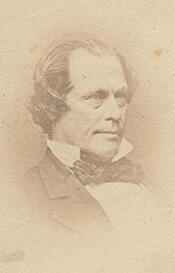
Here you will find contact information for Representative Owen Lovejoy, including email address, phone number, and mailing address.
| Name | Owen Lovejoy |
| Position | Representative |
| State | Illinois |
| District | 5 |
| Party | Republican |
| Status | Former Representative |
| Term Start | December 7, 1857 |
| Term End | March 3, 1865 |
| Terms Served | 4 |
| Born | January 6, 1811 |
| Gender | Male |
| Bioguide ID | L000462 |
About Representative Owen Lovejoy
Owen Lovejoy (January 6, 1811 – March 25, 1864) was an American lawyer, Congregational minister, abolitionist, and Republican congressman from Illinois who served as a Representative in the United States Congress from 1857 to 1865. A prominent “conductor” on the Underground Railroad and a close friend of Abraham Lincoln, he became one of the leading antislavery voices in the Midwest and a key figure in the formation of the Republican Party in Illinois. Over four terms in office, he contributed actively to the legislative process during a critical period in American history, representing the interests of his constituents while pressing for the restriction and eventual abolition of slavery.
Lovejoy was born in Albion, Kennebec County, Maine, on January 6, 1811, one of five brothers born to Daniel Lovejoy, a Congregational minister and farmer, and Elizabeth (Patee) Lovejoy, who was deeply devout. He worked with his family on the farm until about the age of eighteen, while his parents strongly encouraged his education and religious formation. He attended Bowdoin College from 1830 to 1833, where he pursued classical studies. He later studied law, but although he qualified in the field, he never entered into legal practice, turning instead toward theology and reform.
In the mid-1830s, Lovejoy migrated west to Alton, Illinois, where his older brother, Elijah Parish Lovejoy, had relocated in 1836 from St. Louis because of violent hostility to his antislavery activities. Elijah, by then an outspoken anti-slavery Presbyterian minister and editor of the Alton Observer, an abolitionist newspaper, became a central figure in the local antislavery movement. Owen studied theology in Alton and became increasingly involved in the cause. On the night of November 7, 1837, he was present when a pro-slavery mob attacked the warehouse where Elijah and his supporters were defending the printing press of the Illinois Anti-Slavery Society. Elijah was murdered in the assault, an event that shocked the nation. Owen is reported to have sworn at his brother’s grave that he would “never forsake the cause that had been sprinkled with my brother’s blood.” In 1838, he and his brother Joseph C. Lovejoy co-authored the Memoir of Elijah P. Lovejoy, which was widely distributed by the American Anti-Slavery Society, greatly increasing Elijah’s posthumous fame and further galvanizing the abolitionist movement.
Following his brother’s death, Lovejoy settled in Bureau County, Illinois, and in 1838 became pastor of the Congregational Church in Princeton, Illinois, a position he held until 1856. During these years he emerged as a leading abolitionist in Illinois, condemning slavery from the pulpit and in public speeches and actively assisting runaway slaves in their escape to freedom. He was widely known as a “conductor” on the Underground Railroad, using his home and community connections to shelter fugitives from slavery. Working with the American Missionary Association, founded in 1846, he helped organize many of the 115 anti-slavery Congregational churches established in Illinois, which provided an institutional base for evangelical abolitionism in the region. His pastoral and organizing work brought him increasing public prominence and made him a central figure in the growing antislavery coalition of clergy, African Americans, and reform-minded women in the state.
Lovejoy’s public prominence naturally led him into politics. In 1854 he was elected to the Illinois State Legislature, where he worked closely with Abraham Lincoln and other former Whigs and antislavery Democrats to form the Republican Party in Illinois. He and Lincoln developed a close personal and political friendship that would endure through the Civil War. In 1856, Lovejoy was elected as a Republican to the Thirty-fifth Congress from Illinois and was subsequently re-elected to succeeding Congresses, serving from March 4, 1857, until his death in 1864. His congressional service thus spanned the tumultuous years leading up to the Civil War and the early years of the conflict itself. As a member of the House of Representatives, he participated vigorously in debates over slavery, territorial policy, and the preservation of the Union, and he consistently represented the antislavery convictions of his Illinois constituents.
In Congress, Lovejoy quickly gained a reputation as one of the body’s most uncompromising abolitionists. In February 1859, responding on the House floor to pro-slavery and anti-abolitionist critics who denounced him as a “negro stealer” for aiding fugitive slaves, he openly embraced the charge, declaring that if asked whether he assisted runaway slaves, he would “march right up to the confessional and say, I do!” He urged that this fact be proclaimed “upon the house-tops” and “write it upon every leaf that trembles in the forest,” defiantly announcing that he lived at Princeton, Illinois, “three-quarters of a mile east of the village,” and that he aided every fugitive who came to his door. Addressing slavery as an “invisible demon,” he proclaimed his defiance “in the name of my God” to any attempt to prevent him from giving “bread to the hungry and shelter to the houseless.” His oratory, often described as fiery and uncompromising, made him a hero to abolitionists and a lightning rod for pro-slavery forces.
Lovejoy continued to use the House floor as a platform for moral denunciation of slavery. In an April 5, 1860 speech, he castigated Democrats for what he viewed as their racist and immoral justifications for human bondage, arguing that the principle of enslaving human beings because they were deemed inferior was equivalent to tripping a cripple, striking the aged and weak, taking advantage of the idiotic, and deceiving a child. He declared that such a doctrine was “the doctrine of Democrats and the doctrine of devils as well,” and that nowhere in the universe outside “the five points of hell and the Democratic Party” would such practices not be a disgrace. His remarks provoked an uproar among Democratic members, including Roger Atkinson Pryor of Virginia, who brandished pistols and canes and threatened him with physical harm. Republicans in the chamber pledged to defend Lovejoy if attacked. Standing his ground, he replied, “I will stand where I please” and “Nobody can intimidate me.” The speech was reprinted the next day in 55 newspapers across the country. In a letter to his wife Eunice, he wrote that he had “poured on a rainstorm of fire and brimstone as hot as I could,” adding that he believed he had never said anything “more Savage in the pulpit or on the stump.”
Beyond his rhetoric, Lovejoy played a substantive role in shaping antislavery legislation. He introduced the final bill that ended slavery in the District of Columbia, achieving a long-sought objective of the American Anti-Slavery Society. He also helped secure passage of legislation prohibiting slavery in the federal territories, aligning congressional policy with the Republican platform’s opposition to the expansion of slavery. During the 1858 Illinois Senate campaign, he was a platform speaker in support of Abraham Lincoln in the famous debates with Stephen A. Douglas, helping to articulate the Republican case against the spread of slavery. During the Civil War, he was one of Lincoln’s most steadfast supporters in Congress, backing the administration’s war measures and its gradual move toward emancipation. Lincoln later wrote that “to the day of his death, it would scarcely wrong any other to say, he was my most generous friend,” and upon Lovejoy’s passing the President lamented, “I’ve lost the best friend I had in the house [of representatives].”
Lovejoy’s later years were marked by the strain of wartime service and the burdens of national crisis. He continued to serve in Congress through the early years of the Civil War, maintaining his advocacy for emancipation and equal rights while working within the Republican coalition to support the Union war effort. He died in office in Brooklyn, New York, on March 25, 1864. His body was returned to Illinois and interred in Oakland Cemetery in Princeton, the community where he had long lived, preached, and aided fugitives from slavery. After his death, an obelisk was erected in his honor in Princeton. In a letter concerning the monument, President Lincoln wrote, “Let him have his marble monument along with the well assured and more enduring one in the hearts of all those who love Liberty unselfishly and for all.”
Lovejoy’s family and legacy extended beyond Illinois. He was a cousin of Nathan A. Farwell, who later served as a United States Senator from Maine, linking him to a broader network of New England reformers and politicians. The city of Princeton maintains and preserves his former residence, the Owen Lovejoy House, as a house museum. Designated a National Historic Landmark in 1997 by the National Park Service as part of the Underground Railroad, the house contains a secret compartment once used to hide fugitives liberated from slavery and is open to the public. Lovejoy’s life and work have continued to attract scholarly attention, and his speeches and writings from 1838 to 1864, along with modern studies of his collaboration with Lincoln and his role in the Illinois antislavery movement, underscore his importance as a clergyman, reformer, and legislator who helped shape the nation’s path toward emancipation.