Senator Park Trammell
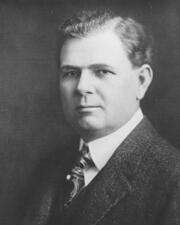
Here you will find contact information for Senator Park Trammell, including email address, phone number, and mailing address.
| Name | Park Trammell |
| Position | Senator |
| State | Florida |
| Party | Democratic |
| Status | Former Representative |
| Term Start | April 2, 1917 |
| Term End | May 8, 1936 |
| Terms Served | 4 |
| Born | April 9, 1876 |
| Gender | Male |
| Bioguide ID | T000353 |
About Senator Park Trammell
Park Monroe Trammell (April 9, 1876 – May 8, 1936) was an American attorney and Democratic politician from the state of Florida who served as a United States Senator from 1917 until his death in 1936. Over four terms in the Senate, he represented Florida during a significant period in American history, including World War I, the interwar years, and the Great Depression. As chair of the Senate Naval Affairs Committee, he was instrumental in the creation of several laws that revitalized the United States Navy. Before his long congressional service, Trammell served as governor of Florida and as Florida attorney general, and he held a series of local and state legislative offices.
Trammell was born on April 9, 1876, in Macon County, Alabama. When he was a young child, he and his parents moved to a citrus farm near Lakeland, Florida, where he grew up in the central part of the state that would later form the base of his political support. In 1898 he attended Vanderbilt University, but his studies were interrupted by the outbreak of the Spanish–American War. During the war he enlisted in the United States Army, serving in the Quartermaster Corps and being stationed in Tampa, Florida, a major embarkation point for U.S. forces. After his military service, Trammell enrolled at Cumberland University in Lebanon, Tennessee, where he studied law and graduated in 1899. That same year he was admitted to the Florida Bar and began practicing law, laying the professional foundation for his subsequent political career.
Trammell’s rise in public life began at the local level in Lakeland. A Democrat, he was elected mayor of Lakeland in 1900 and was re-elected to a second term in 1901. In 1902 he won election to the Florida House of Representatives, representing Polk County, and served there until 1904. That year he was elected to the Florida Senate for Polk County, and from 1905 until 1907 he served as president of the Florida Senate. He resigned from the state senate the following year and returned to private legal practice, but remained an influential figure in state politics. In 1909 Governor Albert W. Gilchrist appointed him the 19th attorney general of Florida, a post in which he served through a period marked by both legal reform and severe racial violence. During his tenure as attorney general, none of the 29 lynchings of Black men that occurred in Florida were prosecuted.
In the 1912 gubernatorial election, Trammell ran to succeed Gilchrist as governor of Florida. After securing the Democratic nomination, he won the general election decisively, defeating four other candidates and receiving approximately 80 percent of the vote; his closest competitor was Socialist candidate Thomas W. Cox. As governor, Trammell presided over the enactment of various labor laws and endorsed legislation in the Florida Legislature to control spending in election campaigns. He also supported the establishment of a state tax commission to equalize property assessments across counties, an effort aimed at creating a more uniform tax structure. At the same time, his governorship was marked by overt racism and support for racial segregation. Trammell endorsed segregationist policies and failed to act against racial violence; during his governorship, none of the 21 lynchings of African Americans in Florida were prosecuted, continuing the pattern from his years as attorney general.
With the ratification of the Seventeenth Amendment on April 8, 1913, U.S. senators began to be chosen by popular election rather than by state legislatures, reshaping the path to federal office. In this new environment, Trammell sought a seat in the United States Senate. In the 1916 election he challenged incumbent Senator Nathan P. Bryan in the Democratic primary and defeated him, then went on to win the general election against Republican newsman William R. O’Neal with nearly 83 percent of the vote. Trammell took office in 1917 and would serve continuously until his death in 1936, participating in the legislative process through four terms in office and representing the interests of his Florida constituents during a transformative era in national politics.
During his Senate career, Trammell developed a reputation as an independent-minded Democrat who was willing to deviate from his party’s leadership on key issues. He opposed the confirmation of U.S. Supreme Court nominee Harlan F. Stone in 1925 and again opposed nominee John J. Parker in 1930, although Stone was ultimately confirmed to the Court. He served as chairman of the Senate Committee on Expenditures in the Treasury Department from 1917 to 1919, overseeing aspects of federal fiscal administration during and immediately after World War I. In the early 1930s, as the country grappled with the Great Depression, Trammell, who had previously been regarded as a liberal, joined the emerging Conservative Coalition in Congress. This group of conservative lawmakers opposed certain elements of President Franklin D. Roosevelt’s New Deal, which they viewed as too expansive, even as Trammell maintained overall support for Roosevelt. His stance reflected a broader shift among Southern Democrats, many of whom initially backed the New Deal but later voted against key measures as the program evolved.
Trammell’s most notable legislative work in the Senate involved naval policy. In 1933 he became chairman of the Senate Naval Affairs Committee, a position he held until his death. In this role he was central to efforts to modernize the U.S. fleet. Earlier, in 1934, he co-sponsored the Vinson–Trammell Act with Representative Carl Vinson, chair of the House Naval Affairs Committee. The act authorized the replacement of obsolete ships with new construction, enabling the United States to maintain naval parity with other powers, particularly the Japanese Empire, within the limits of existing naval treaties. Despite his influence on naval legislation, Trammell was sometimes criticized for his overall performance in the Senate; he was frequently referred to as one of the least active members, having missed 642 out of 3,168 roll call votes over his tenure. Nevertheless, he remained popular with Florida voters. In the 1934 Democratic primary for the U.S. Senate, a referendum of sorts on the New Deal in Florida, he faced the most serious challenge of his career from former state representative Claude Pepper, along with attorney Charles A. Mitchell, state senator James F. Sikes, and Florida Democratic committeewoman Hortense K. Wells. Although the race largely came down to Trammell and Pepper, the presence of the other candidates forced a runoff. Trammell narrowly defeated Pepper in the runoff by a margin of about 2 percent and was unopposed in the general election.
In his personal life, Trammell married Virginia Darby on November 21, 1900, and the couple remained married until her death in 1922. In 1934 he married Beatrice Padgett, a divorced woman with a son. Trammell had no children of his own with either wife. He was active in several fraternal organizations, including the Freemasons, the Knights of Pythias, and the Woodmen of the World. His extended family remained engaged in public affairs; his great-nephew Jeffrey Trammell would later become known in his own right.
Park Trammell died at his home in Washington, D.C., on May 8, 1936, while still serving in the United States Senate, placing him among the members of Congress who died in office in the first half of the twentieth century. He was buried in Roselawn Cemetery in Lakeland, Florida, the city where his political career had begun decades earlier. After his death, his senatorial papers were donated to the Lakeland Public Library and the University of Florida, while his gubernatorial papers were placed in the Florida State Archives, preserving a record of his long public career. His legacy is also reflected in several buildings named in his honor. In 1955 the Lakeland Public Library building was designated the Park Trammell Building; it now houses the Greater Lakeland Chamber of Commerce. That same year, a nine-story low-rise office building constructed in Tampa was named the Park Trammell Building and now serves as the home of the Greater Tampa Chamber of Commerce. In 1956, the Park Trammell Building at the Florida State Mental Hospital in Chattahoochee, Florida, was dedicated to house the institution’s geriatric population, further commemorating his name in the state he served throughout his life.