Representative Parker Corning
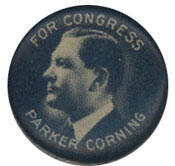
Here you will find contact information for Representative Parker Corning, including email address, phone number, and mailing address.
| Name | Parker Corning |
| Position | Representative |
| State | New York |
| District | 28 |
| Party | Democratic |
| Status | Former Representative |
| Term Start | December 3, 1923 |
| Term End | January 3, 1937 |
| Terms Served | 7 |
| Born | January 22, 1874 |
| Gender | Male |
| Bioguide ID | C000785 |
About Representative Parker Corning
Parker Corning (January 22, 1874 – May 24, 1943) was an American businessman and Democratic politician from Albany, New York, most notable for his service as a United States Representative from New York from 1923 to 1937. A member of the Albany area’s prominent Corning family, he was born into a lineage deeply involved in business and public affairs; his grandfathers Erastus Corning and Amasa J. Parker had both served as U.S. Representatives from New York. His brother Edwin Corning later became lieutenant governor of New York, his nephew Erastus Corning 2nd served as mayor of Albany, and another nephew, Edwin Corning Jr., was a member of the New York State Assembly from 1955 to 1959. Raised in this politically influential and civically engaged family, Corning grew up in an environment that combined commercial enterprise with public service.
Educated in Albany and shaped by the city’s commercial culture, Corning entered the business world at a time when Albany was expanding as a regional industrial and transportation center. He became identified with several business ventures that made him wealthy, most notably the Albany Felt Company, which became a significant local industrial concern. His success in business reinforced his standing within the community and the Democratic political organization that dominated Albany and Albany County. This background in private enterprise later informed his generally conservative economic outlook and his approach to federal spending and public works while in Congress.
On November 1, 1910, Corning married Anne “Anna” Austin Cassin McClure, who had previously been married to Archibald Jermain McClure and had obtained a divorce. With her first husband, she was the mother of a son, Barclay Jermain McClure (1900–1966). With Parker Corning, she was the mother of a daughter, Mary Parker Corning (1912–1984). Anna Cassin was renowned for her physical beauty; Archibald McClure, whose family wealth derived from the wholesale drug business in Albany, had decided to marry her after seeing her photograph in a magazine and returned from California to New York to make her acquaintance. By 1910, when Corning proposed, she was a single mother with limited financial means and a Catholic, while the Corning family was Episcopal. Corning’s decision to marry her met with strong resistance from his family, and after the wedding his sister Harriet never spoke to him again, an estrangement that underscored the social and religious tensions surrounding the marriage.
Corning’s political career developed within the powerful Democratic organization in Albany County controlled by Daniel P. O’Connell and the Corning family. Active in this conservative local party structure, he emerged as a trusted figure in the organization and, in 1922, became its successful candidate for Congress. Elected as a Democrat to the Sixty-eighth Congress and to the six succeeding Congresses, he served in the U.S. House of Representatives from March 4, 1923, to January 3, 1937, representing his New York district for seven consecutive terms. His tenure in Congress coincided with a significant period in American history, spanning the prosperity of the 1920s, the onset of the Great Depression, and the early years of the New Deal.
During his years in the House of Representatives, Corning was a member of the influential Committee on Interstate and Foreign Commerce, a position that enabled him to shape legislation affecting transportation, trade, and infrastructure. He used this influence to secure federal support for projects that advanced the economic development of Albany and the surrounding region. He was particularly known for his efforts to obtain federal funding for the Port of Albany–Rensselaer, transforming it into a modern inland port and enhancing the city’s role in regional commerce. Corning also played a key role in obtaining a new federal building in Albany, reflecting his focus on channeling federal resources to his constituency and strengthening the city’s civic infrastructure.
Corning’s influence extended beyond federal projects to state-level development. A longtime friend and political ally of Governor Al Smith, he worked during Smith’s governorship to secure approval for a major new state office building in Albany. This effort culminated in the construction of the Alfred E. Smith Building, which became a prominent feature of the city’s skyline and a symbol of the state’s expanding administrative apparatus. In addition to the port and office-building initiatives, Corning obtained federal funding for important transportation links in the region, including the first Dunn Memorial Bridge and the Menands Bridge, both of which improved connectivity across the Hudson River and supported the area’s commercial growth.
Although a Democrat, Corning became increasingly identified as one of the relatively few members of his party who opposed President Franklin D. Roosevelt and the New Deal during the latter part of his congressional service. His opposition stemmed in part from personal and political loyalty to Al Smith, whose relationship with Roosevelt deteriorated after Roosevelt’s rise to the presidency, and in part from Corning’s more conservative economic views, which made him skeptical of expansive federal intervention in the economy. This stance placed him at odds with the dominant direction of national Democratic politics in the 1930s, even as he continued to participate in the legislative process and represent the interests of his constituents.
Corning chose not to seek renomination in 1936 and thus concluded his congressional service on January 3, 1937, after seven terms in office. Following his departure from the House of Representatives, he returned to his business interests in Albany, resuming a more private role while maintaining his connections to the city’s commercial and political life. He remained a figure of local prominence until his death on May 24, 1943. His career reflected both the power of Albany’s Democratic organization in the early twentieth century and the complex interplay between local interests, party loyalty, and national policy debates during a transformative era in American political and economic history.