Representative Parren J. Mitchell
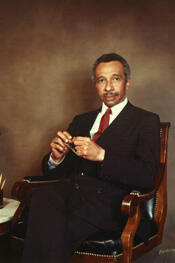
Here you will find contact information for Representative Parren J. Mitchell, including email address, phone number, and mailing address.
| Name | Parren J. Mitchell |
| Position | Representative |
| State | Maryland |
| District | 7 |
| Party | Democratic |
| Status | Former Representative |
| Term Start | January 21, 1971 |
| Term End | January 3, 1987 |
| Terms Served | 8 |
| Born | April 29, 1922 |
| Gender | Male |
| Bioguide ID | M000826 |
About Representative Parren J. Mitchell
Parren James Mitchell (April 29, 1922 – May 28, 2007) was an American politician and civil rights advocate who served as a Democratic Representative from Maryland in the United States Congress from January 3, 1971, to January 3, 1987. Representing Maryland’s 7th congressional district for eight consecutive terms, he was the first African American elected to Congress from Maryland and became a prominent voice for minority rights, small business development, and affirmative action during a significant period in American political and social history.
Mitchell was born in Baltimore, Maryland, on April 29, 1922, into a working-class family. His father, Clarence Maurice Mitchell, worked as a waiter, and his mother, Elsie Davis Mitchell, was a homemaker. He grew up in a segregated city and attended Baltimore’s public schools, graduating from Frederick Douglass Senior High School in 1940. Mitchell was part of a family deeply engaged in civil rights; his brother, Clarence Mitchell Jr., later became head of the NAACP’s Washington office and a key adviser to President Lyndon B. Johnson during the civil rights movement, helping to shape landmark federal civil rights legislation.
After high school, Mitchell served his country in World War II. He became an officer in the racially segregated 92nd Infantry Division of the United States Army, a unit composed primarily of African American soldiers. While serving in Italy, he was wounded in combat and was awarded the Purple Heart for his injuries. Returning to Baltimore after the war, he resumed his education, earning a bachelor’s degree from Morgan State University, a historically Black institution in Baltimore. Determined to break racial barriers in higher education, Mitchell sought graduate study at the then-segregated University of Maryland, College Park. In 1950, with the support of the Baltimore Branch of the NAACP, he successfully sued the university for admission to its graduate school. He was admitted and went on to earn his master’s degree, becoming the first African American graduate of that school.
Mitchell’s early career was closely intertwined with civil rights activism in Baltimore. Before entering graduate school, he participated in protests against segregated seating at Ford’s Theatre in downtown Baltimore and challenged unequal funding for teacher training programs in the city’s segregated Black school system in 1948. These efforts reflected his broader commitment to dismantling institutional racism and expanding opportunities for African Americans. In the years that followed, he worked in public service and community affairs, building a reputation as a skilled organizer and advocate. His activism and legal challenge to the University of Maryland helped position him as a rising leader in Maryland’s civil rights and political communities.
Mitchell first sought a seat in Congress in 1968, challenging nine-term Democratic incumbent Samuel Friedel in the primary for Maryland’s 7th congressional district. He narrowly lost that race but mounted a rematch in 1970. In the 1970 Democratic primary, he defeated Friedel by just 38 votes, a razor-thin margin that underscored both the changing demographics of Baltimore and the growing political strength of African American voters. He then won easily in the November general election, becoming the first African American elected to Congress from Maryland. Following the 1970 census, the 7th District was redrawn as Maryland’s first Black-majority congressional district. Mitchell was reelected seven more times, serving a total of eight terms and never receiving less than 75 percent of the vote. He ran unopposed in 1974 and 1984 and faced only minor-party opposition in 1976 and 1978, reflecting his strong support among constituents.
During his 16-year congressional career, Mitchell emerged as a national leader on issues of civil rights, economic justice, and minority business development. He was one of the founding members of the Congressional Black Caucus in the early 1970s. Among his first major actions with the caucus was a boycott of President Richard M. Nixon’s 1971 State of the Union address after Nixon initially refused to meet with the group; the president agreed to meet with the caucus several weeks later. Mitchell was a forceful advocate for affirmative action and used his legislative influence to promote economic opportunities for minority-owned businesses. As chairman of the House Small Business Committee, he sponsored and secured an amendment to a $4 billion public works bill that required state and local governments seeking federal grants to set aside 10 percent of the funds for contracts and subcontracts with minority firms. This measure became a landmark in federal efforts to support minority entrepreneurship.
Mitchell also took strong positions on foreign and domestic policy questions. In 1983, he joined seven other members of the House of Representatives in sponsoring a resolution to impeach President Ronald Reagan over the administration’s sudden and unexpected invasion of Grenada, reflecting his concerns about executive overreach and U.S. foreign policy in the Caribbean. He initiated a congressional investigation into the Wedtech Corporation, where allegations surfaced that bribes had been offered in exchange for no-bid military contracts. The scandal ultimately ensnared several public officials, including his nephews, Maryland State Senators Clarence Mitchell III and Michael Mitchell, who were later convicted and served time in federal prison for their roles in the affair. Throughout his tenure, Mitchell also devoted considerable energy to mentoring younger political and community leaders. Among those he mentored were future Maryland House of Delegates majority whip Talmadge Branch, as well as Delegates Nathaniel Oaks, Sandy Rosenberg, and Curt Anderson, many of whom had volunteered in his early campaigns or served on his staff.
In 1986, after eight terms in the House, Mitchell chose not to seek reelection to Congress and instead ran for statewide office. He became the running mate of Maryland Attorney General Stephen H. Sachs in an unsuccessful bid for lieutenant governor. Following this defeat, Mitchell gradually withdrew from frontline electoral politics, though he remained a respected elder statesman in Maryland and continued to appear at community events. In his later years, he suffered a series of strokes and was eventually placed in a nursing home, but he continued to be recognized for his pioneering role in Maryland politics and his contributions to civil rights and minority business development.
Parren James Mitchell died on May 28, 2007, at the age of 85, from pneumonia at Greater Baltimore Medical Center in Towson, Maryland, after being hospitalized for a week. On June 5, 2007, more than 1,000 people gathered at St. James’ Episcopal Church in west Baltimore to pay their last respects. Tributes were offered on behalf of the United States Senate by Maryland Senators Ben Cardin and Barbara Mikulski, on behalf of the House of Representatives by Speaker Nancy Pelosi, on behalf of the Congressional Black Caucus by Judiciary Committee Chairman Representative John Conyers, and on behalf of the State of Maryland by Governor Martin O’Malley. Congressman Elijah Cummings delivered the eulogy, stating that Mitchell “earned the trust of people throughout the country and the world because he was constantly building bridges for others to cross, while tearing down the walls that had excluded them.” His legacy continued to be honored in subsequent years. On December 3, 2015, the University of Maryland, College Park, held a dedication ceremony renaming its Art/Sociology Building in his honor, recognizing his historic legal challenge and academic achievements. In November 2023, Baltimore officials announced plans to renovate Mitchell’s former home into the West Baltimore Civic and Entrepreneurship Center, including a gallery devoted to his life and congressional career, with renovations projected to cost approximately $2.2 million, including $1.5 million in state funding, and to take two years to complete.