Representative Patricia Saiki
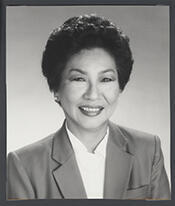
Here you will find contact information for Representative Patricia Saiki, including email address, phone number, and mailing address.
| Name | Patricia Saiki |
| Position | Representative |
| State | Hawaii |
| District | 1 |
| Party | Republican |
| Status | Former Representative |
| Term Start | January 6, 1987 |
| Term End | January 3, 1991 |
| Terms Served | 2 |
| Born | May 28, 1930 |
| Gender | Female |
| Bioguide ID | S000014 |
About Representative Patricia Saiki
Patricia Hatsue Saiki (née Fukuda; born May 28, 1930) is an American politician and former educator from Hilo, Hawaii, who served as a Republican member of the United States House of Representatives from 1987 to 1991 and later as Administrator of the Small Business Administration under President George H. W. Bush. Over the course of a long public career, she became one of the most prominent Republican figures in Hawaii, breaking several political barriers for both women and Asian Americans in the state.
Saiki was born in Hilo, Hawaii, on May 28, 1930. She graduated from Hilo High School in 1948 and went on to attend the University of Hawaiʻi at Mānoa, where she received her bachelor’s degree in 1952. Soon after completing her education, she embarked on a career in teaching, which would shape her early professional life and later inform much of her legislative focus. Her background as the daughter of Japanese American parents and her upbringing in territorial, and then statehood-era, Hawaii contributed to her later interest in civil rights and redress for Japanese Americans.
Upon graduating from college, Saiki became a teacher and taught at several schools in Honolulu, including Punahou School, Kaimuki Intermediate School, and Kalani High School. She also taught in Toledo, Ohio, during a period when she and her husband, physician Stanley Saiki, lived there while he completed his medical school residency. In Hawaii, Saiki became active in professional and civic affairs, and she played a key role in establishing the teachers’ chapter of the Hawaii Government Employees Association. Her leadership in organizing teachers and advocating for their interests led colleagues to encourage her to seek elective office, prompting her first run for public office in 1968.
In 1968, Saiki joined the Hawaii Republican Party and successfully ran for a seat in the Hawaii State House of Representatives. She served in the state House during a period of political dominance by the Democratic Party, making her one of the more visible Republican voices in the legislature. In 1974, she was elected to the Hawaii State Senate, where she represented her district until 1982. During her years in the state legislature, Saiki developed a reputation as a fiscally conservative lawmaker with a strong interest in education and government reform, and she built the political base that would later support her campaigns for federal office.
A vacancy in Hawaii’s congressional delegation arose when U.S. Representative Cecil Heftel resigned from Congress, prompting a special election held on September 20, 1986. Saiki ran in that special election but was defeated by Democrat Neil Abercrombie. In a separate, regularly scheduled election that same year, however, she ran for a full term and won, defeating Democrat Mufi Hannemann. With her election in 1986, Saiki became the first Republican elected to represent Hawaii in the U.S. House of Representatives since the islands achieved statehood in 1959. She was reelected in 1988, defeating Democratic challenger Mary Bitterman, former head of the Voice of America, and thus served two consecutive terms in Congress from 1987 to 1991. Until the swearing-in of Charles Djou on May 25, 2010, she was the only Republican ever to hold a House seat from the state of Hawaii and one of only two Republican Members of Congress—alongside Senator Hiram Fong—to represent the state in Washington since statehood. She was also the second woman elected to Congress from Hawaii, following Representative Patsy Mink, with whom she served for two years.
During her tenure in the U.S. House of Representatives, Saiki participated fully in the legislative process and represented the interests of her Hawaii constituents during a significant period in American political history. She focused particularly on education-related issues, drawing on her professional background as a teacher. She served as a commissioner for the Western Interstate Commission on Higher Education and was a member of the Fund for the Improvement of Higher Education, reflecting her commitment to expanding educational opportunities and strengthening higher education policy. Although she was known as a fiscal conservative, Saiki also strongly supported civil rights initiatives, including efforts to secure redress for Japanese Americans who had been interned during World War II. Among the legislation she supported was the Abandoned Shipwreck Act, which asserted United States title to certain abandoned shipwrecks located on or embedded in submerged lands under state jurisdiction and transferred title to the respective states. This measure was intended to help states manage cultural and historical underwater resources more effectively and to prevent damage by treasure hunters and salvagers; it was signed into law by President Ronald Reagan on April 28, 1988.
In 1990, Saiki chose not to seek reelection to the House and instead ran for the United States Senate, challenging incumbent Democrat Daniel Akaka. She was unsuccessful in that race, but her standing within the national Republican Party led to her appointment as Administrator of the Small Business Administration under President George H. W. Bush. In that capacity, she oversaw federal programs designed to support small businesses across the country, continuing her emphasis on economic opportunity and entrepreneurship. In 1994, she returned to electoral politics in Hawaii as the Republican nominee for governor, running against Democrat Ben Cayetano; she lost that race as well, in a state that remained strongly Democratic.
In the years following her gubernatorial campaign, Saiki remained active in Republican politics and public affairs. She chaired the Hawaii presidential campaign of former New York City Mayor Rudy Giuliani in 2008 and later played a prominent role in the 2010 and 2012 congressional campaigns of Charles Djou, the first Republican since Saiki to win a U.S. House seat from Hawaii. From 2014 to 2015, she served as chair of the Republican Party of Hawaii, continuing her long-standing role as one of the party’s leading figures in the state. Her congressional papers have been preserved in archival collections, and she has appeared in various public forums, including interviews and C-SPAN programs, reflecting enduring interest in her career as an educator, legislator, and trailblazing Republican representative from Hawaii.