Senator Paul Coverdell
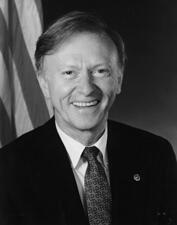
Here you will find contact information for Senator Paul Coverdell, including email address, phone number, and mailing address.
| Name | Paul Coverdell |
| Position | Senator |
| State | Georgia |
| Party | Republican |
| Status | Former Representative |
| Term Start | January 5, 1993 |
| Term End | January 3, 2000 |
| Terms Served | 4 |
| Born | January 20, 1939 |
| Gender | Male |
| Bioguide ID | C000813 |
About Senator Paul Coverdell
Paul Douglas Coverdell (January 20, 1939 – July 18, 2000) was an American politician who served as a United States senator from Georgia from January 3, 1993, until his death in 2000. A member of the Republican Party, he was a central figure in the modern development of the Georgia GOP and previously served as director of the Peace Corps from 1989 to 1991 under President George H. W. Bush. During his Senate career, he contributed significantly to federal education policy, most notably through the creation of what became known as Coverdell Education Savings Accounts, and he played a prominent role in foreign policy, fiscal, and small business issues.
Coverdell was born in Des Moines, Iowa, on January 20, 1939, and spent much of his childhood in the Midwest. He graduated from Lee’s Summit High School in Lee’s Summit, Missouri, and went on to attend the University of Missouri, where he graduated in 1961 with a degree in journalism. While in college, he was a member of the Phi Kappa Psi fraternity, an affiliation that reflected his early interest in civic engagement and public affairs. His Midwestern upbringing and journalistic training helped shape the understated, methodical style that later characterized his political career.
In 1962, Coverdell joined the United States Army and served as a captain, with postings in Okinawa, Taiwan, and Korea during a period of heightened Cold War tensions in East Asia. After completing his military service, he settled in Atlanta, Georgia, with his wife, Nancy. There he entered the insurance business, founding the firm Coverdell & Co. Inc. with his father and becoming president of the family business in 1965. His work in the private sector, particularly in insurance and financial services, informed his later legislative interests in economic policy, small business, and tax-advantaged savings.
Coverdell first sought elective office in 1968, when he ran unsuccessfully for the Georgia State Senate. Undeterred, he ran again and was elected in 1970 to represent north Fulton County. In 1974 he became Senate Minority Leader, a position he held for 15 years until he left the Georgia Senate in 1989. As minority leader, he worked closely with Democrats in a legislature long dominated by the opposing party, earning a reputation for civility, discretion, and bipartisan cooperation. Future Democratic governor Roy Barnes later recalled that when he entered the Georgia Senate, Republican Coverdell took him under his wing and showed that people of different parties could candidly discuss their strengths and weaknesses without fear of betrayal. During his tenure, Coverdell advocated pension reform, supported legislation to combat driving under the influence, and backed raising the legal drinking age in Georgia. He also sought federal office, running in 1977 in a special election for the U.S. House seat vacated by Andrew Young; he lost that race to Democrat Wyche Fowler.
Following his 1977 defeat, Coverdell turned his attention to building a viable statewide Republican Party organization in Georgia and strengthening the base for national Republican candidates. He became a key figure in the state GOP and, in 1985, was elected chairman of the Georgia Republican Party. His rise in national Republican circles was aided by a personal connection he forged in 1978 while vacationing in Maine, when he looked up former Republican National Committee chairman George H. W. Bush in the local phone book, went to Bush’s home, and introduced himself. The two men became close friends and political allies. Coverdell served as Bush’s finance chairman in Georgia during Bush’s 1980 presidential primary campaign and later as Southern steering committee chairman for Bush’s successful 1988 presidential campaign. His efforts helped Bush carry Georgia’s 12 electoral votes in 1988, and after Bush’s election Coverdell wrote to the new president offering his services. Bush responded by appointing him director of the Peace Corps.
Coverdell was sworn in as director of the Peace Corps on May 2, 1989, in a ceremony in the Oval Office. Upon taking the position, he stepped down from the Georgia State Senate, ending a 15-year legislative career there, and resigned as president of Coverdell & Co. Inc. to devote his full attention to the agency. As Peace Corps director, his primary initiative was the creation of the “World Wise Schools” program, which linked students in the United States with Peace Corps volunteers serving abroad. During his tenure, the program connected volunteers with approximately 5,000 classrooms across the country, broadening American students’ exposure to global cultures and development issues. Coverdell also oversaw the first deployment of Peace Corps volunteers to Eastern Europe after the fall of the Berlin Wall. On June 15, 1990, President Bush hosted a send-off at the White House for volunteers headed to Poland and Hungary, describing their work as part of America’s investment in the consolidation of democracy and independence in Central and Eastern Europe. Under Coverdell’s leadership, new programs were opened in countries emerging from decades of authoritarian rule, reflecting his view that English literacy and technical skills could support democratic and economic transitions. He was widely respected within the Peace Corps community, and in the fall of 2000, after his death, a tribute was held at Peace Corps headquarters to honor his life and legacy.
In 1991, Coverdell resigned as Peace Corps director and returned to Georgia, where he considered a run for the U.S. Senate seat held by Wyche Fowler, the same Democrat who had defeated him in the 1977 House special election. The Associated Press reported on September 4, 1991, that he had stepped down from the Peace Corps and was weighing a Senate campaign. His tenure at the agency became an issue in the 1992 Senate race; The New York Times reported in September 1992 that he had been accused by critics of using the directorship to plot his political future in Georgia. Supporters, however, including actor Charlton Heston, who campaigned for him in 1992, rejected that characterization. Writing in National Review, Heston argued that while Coverdell had served effectively as Peace Corps director, the position “hardly seemed an ideal launching pad for national elective office.” Questions about his travel to Georgia while leading the Peace Corps resurfaced in 2001 when some senators proposed renaming the Peace Corps building in his honor.
Coverdell’s 1992 Senate campaign was arduous and required him to prevail in four separate elections: an all-candidate primary, a Republican primary runoff, an all-party general election, and a general election runoff. Not considered a natural campaigner—Senator Phil Gramm, then chairman of the National Republican Senatorial Committee, recalled being initially unimpressed by Coverdell’s high-pitched voice and animated speaking style—he nonetheless impressed colleagues with his determination, which Gramm later described as “the heart of a lion.” In a crowded Republican primary field, Coverdell failed to secure a majority and was forced into a runoff with Bob Barr, which he won by roughly 1,600 votes. In the November general election, Democratic incumbent Wyche Fowler finished ahead of Coverdell by about 30,000 votes, but because Libertarian candidate Jim Hudson received approximately 3 percent of the vote, Georgia law required a runoff. On November 24, 1992, aided by Hudson’s endorsement and strong support from President George H. W. Bush and First Lady Barbara Bush, Coverdell won the runoff by slightly more than 16,000 votes. His campaign also benefited from a memorable advertising effort, including a “Jingle” television and radio spot featuring a ditty written and sung by senior citizen Margie Lopp. When he took office on January 3, 1993, he became only the second Republican that Georgia had sent to the U.S. Senate since Reconstruction.
As a United States senator from Georgia, Coverdell served from 1993 until his death in 2000, contributing to the legislative process during a significant period in American history. He initially held seats on the Senate Foreign Relations Committee, the Agriculture Committee, and the Small Business Committee, reflecting his interests in international affairs, rural and agricultural issues, and the needs of small enterprises. After the death of Senator John Chafee on October 24, 1999, a vacancy arose on the influential Senate Finance Committee, and Coverdell relinquished his Foreign Relations Committee seat to join Finance. He became best known legislatively for sponsoring the tax-advantaged education savings vehicles originally called Education IRAs, later renamed Coverdell Education Savings Accounts (CESAs) or Coverdell Plans in his honor. These accounts allow families to invest funds that grow tax-deferred and can be withdrawn tax-free for qualified education expenses at eligible institutions, and they have been used by millions of Americans to help finance their children’s education. He also sponsored the Volunteer Protection Act, a complex law designed generally to shield volunteers serving nonprofit organizations and governmental entities from personal liability for tort claims based on simple negligence, provided certain conditions are met. Supporters argued that the law encouraged volunteerism, while critics contended that granting immunity to careless volunteers conflicted with charitable goals and that nonprofits should be held to the same standard of care as for-profit entities or carry adequate liability insurance. In addition, Coverdell worked against tax increases, supported measures to protect federal lands in national parks, and advocated for various humanitarian concerns.
Coverdell maintained a strong interest in the Peace Corps and international development during his Senate service. On March 18, 1998, he testified before the House International Relations Committee in support of expanding the Peace Corps, noting that the goal of increasing the number of volunteers to 10,000 had spanned three presidencies. He recounted that under former director Loret Miller Ruppe in the Reagan administration, and during his own tenure as director, the agency had pursued expansion and had shifted emphasis toward opening new country programs in nations experiencing freedom for the first time in decades. He argued that these new countries could benefit from Peace Corps activities if the volunteer corps was enlarged. In 1998, running for a second full term under the slogan “Coverdell Works,” he made history by becoming the first Republican from Georgia ever to be re-elected to the U.S. Senate. In the 2000 presidential cycle, before any formal exploratory committee was formed on his behalf, he took on the role of liaison between Texas Governor George W. Bush’s campaign and the Senate Republican Conference. Early in the campaign, he worked to secure endorsements for Bush from Republican senators rather than from Senator John McCain, ultimately helping Bush win the backing of nearly all Senate Republicans. After Bush clinched the nomination, Coverdell coordinated requests from senators seeking access to the candidate, emphasizing that he wanted to avoid “black holes” and to ensure that his colleagues felt included in the effort and that goodwill was fostered within the party.
In July 2000, while on a trip to Georgia for a weekend of speaking engagements and constituency services, Coverdell complained of a severe headache. He was admitted to Piedmont Hospital in Atlanta, where he was diagnosed with a cerebral hemorrhage. He underwent surgery on July 17, 2000, but never regained consciousness and died early in the evening of July 18, 2000, while still in office. His death brought an abrupt end to a Senate career that had spanned more than seven years and two terms in office. More than 50 senators and representatives from both parties joined some 900 mourners at his funeral at Peachtree United Methodist Church in Atlanta. Texas Governor George W. Bush, then the Republican nominee for president, left the campaign trail to attend the service with his wife, Laura. President Bill Clinton issued a statement expressing condolences to the Coverdell family. Former President George H. W. Bush, a close friend, did not attend but sent a written tribute that was read by a family friend, praising Coverdell’s belief that politics was a noble calling and noting that he demonstrated that “quiet is good, caring about the other guy matters.”
In the years following his death, Coverdell was widely remembered as a quiet, soft-spoken lawmaker who nonetheless left a substantial imprint on both Georgia and national politics. His role in establishing a strong Republican Party in Georgia, his authorship of the Coverdell Education Savings Accounts, and his leadership at the Peace Corps were frequently cited as enduring elements of his legacy. Political columnist David Broder observed that Coverdell’s name rarely appeared in headlines and his face was seldom seen on magazine covers or Sunday television shows, yet he was admired and cherished by his colleagues. Democratic Senator Dianne Feinstein recalled that he was not only a good senator but “a good and decent man,” while Senator Olympia Snowe remarked that people like Paul Coverdell—“good, honorable, trustworthy people who call us to our better nature”—do exist in public life. On April 6, 2006, former President George H. W. Bush honored him at the inauguration of the University of Georgia’s Coverdell Center for Biomedical and Health Sciences, describing him as “the voice of reason” in a Washington often marked by bitter partisanship.