Representative Paul Albert Fino
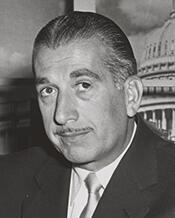
Here you will find contact information for Representative Paul Albert Fino, including email address, phone number, and mailing address.
| Name | Paul Albert Fino |
| Position | Representative |
| State | New York |
| District | 24 |
| Party | Republican |
| Status | Former Representative |
| Term Start | January 3, 1953 |
| Term End | January 3, 1969 |
| Terms Served | 8 |
| Born | December 15, 1913 |
| Gender | Male |
| Bioguide ID | F000137 |
About Representative Paul Albert Fino
Paul Albert Fino (December 15, 1913 – June 16, 2009) was an American lawyer, legislator, and jurist from New York who served as a New York State senator, a member of the United States House of Representatives, and a justice of the New York Supreme Court. A member of the Republican Party, he represented a Bronx-based district in Congress from 1953 to 1969, serving eight consecutive terms during a significant period in mid‑twentieth‑century American political history.
Fino was born on December 15, 1913, in the Bronx, New York, to Isidore and Lucia Fino. Raised in New York City, he was educated in local schools before pursuing legal studies. He attended St. John’s University School of Law, from which he graduated in 1937. After admission to the bar, he entered the practice of law in New York, establishing the professional foundation that would underpin his later political and judicial career.
Fino’s early political efforts were marked by persistence in the face of initial setbacks. He ran unsuccessfully for the New York State Assembly in 1940 and for the New York State Senate in 1942. In 1944, he again sought a Senate seat, this time in the 27th District, and defeated the then–Minority Leader of the State Senate, John J. Dunnigan. Fino represented the 27th District from 1945 to 1950, sitting in the 165th, 166th, and 167th New York State Legislatures. His tenure in Albany helped establish him as a prominent Republican figure from the Bronx and provided him with legislative experience that would carry into his later federal service.
In 1952, Fino successfully ran for the United States House of Representatives, defeating Bernard O’Connell to win a seat in the 83rd Congress. He took office on January 3, 1953, and went on to win seven additional terms, serving in the 84th, 85th, 86th, 87th, 88th, 89th, and 90th Congresses. His service in the House of Representatives extended from January 3, 1953, until his resignation on December 31, 1968. As a member of Congress, Fino participated actively in the legislative process and represented the interests of his Bronx constituents during an era that encompassed the Cold War, the civil rights movement, and the Great Society programs.
In Congress, Fino generally leaned conservative and took firm positions on several contentious issues. He opposed racial busing and abortion and at one point introduced a bill to outlaw the Communist Party. At the same time, he supported a number of major civil rights and social welfare measures. Fino voted in favor of the Civil Rights Acts of 1957, 1960, 1964, and 1968, the 24th Amendment to the United States Constitution, and the Voting Rights Act of 1965. He championed the creation of a national lottery, arguing that it would allow the federal government to raise revenue for important programs without increasing taxes. He also supported traditionally liberal programs such as Medicare—favoring national health insurance—Social Security, and mass transit. In 1964, he proposed changes to Social Security that would have allowed recipients to draw benefits at age 60 with no income limits, a plan more generous than that advanced by the Democratic Party at the time.
Fino’s congressional career was also marked by vigorous involvement in party politics and high‑profile political rivalries. He served as a delegate to the Republican National Conventions in 1960, 1964, and 1968, and from 1961 to 1968 he was the Republican leader in the Bronx. In 1961 he ran unsuccessfully for president of the New York City Council on a ticket headed by Louis J. Lefkowitz, the Republican candidate for mayor against Robert F. Wagner. The slate, which also included John J. Gilhooley for city comptroller, was noted for its ethnic balance—an Italian, a Jew, and an Irishman—and for its memorable campaign jingle urging voters to support “Lefkowitz, Gilhooley and Fino.” During his time in Congress he became an outspoken opponent of John V. Lindsay, then a fellow Republican representative. After Lindsay was elected mayor of New York City in 1965 and took office in 1966, their feud intensified. Fino criticized Lindsay’s more liberal policies and his promotion of New York as “Fun City,” and he reportedly clashed with the mayor after Lindsay declined to appoint one of Fino’s law partners as sanitation commissioner. Lindsay, in turn, was seen as tacitly supporting efforts to dislodge Fino from his position as Bronx Republican leader.
In 1968, Fino was elected to a newly created seat on the New York Supreme Court. He resigned from Congress on December 31, 1968, to assume his judicial duties, and his House seat was subsequently filled by Mario Biaggi. As a justice of the New York Supreme Court, Fino served until 1972 and developed a reputation for imposing tough sentences. In one widely noted case, he sentenced a narcotics addict to 30 years in prison for possession of 1/73 of an ounce of heroin, an example frequently cited in discussions of his stringent approach to crime and punishment.
On December 31, 1972, Fino resigned from the bench in order to reenter electoral politics. He sought a seat on the New York City Council, stating that one of his goals in returning to active politics was to challenge State Senator John D. Calandra’s leadership of the Bronx Republican organization. Fino ran in the Republican primary but was defeated by Pasquale Mele, effectively ending his bid to regain a prominent elected role. In later years, he reflected on his long public career in his 1986 autobiography, “My Life in Politics and Public Service,” which recounted his experiences in state and national politics and on the bench.
Paul Albert Fino spent his later life in Atlantic Beach, New York. He died on June 16, 2009, in North Woodmere, New York, at the age of 95. He was buried at Woodlawn Cemetery in the Bronx, returning in death to the borough that had shaped his life and that he had represented in public office for more than two decades.