Representative Paul B. Henry
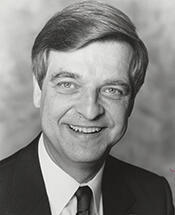
Here you will find contact information for Representative Paul B. Henry, including email address, phone number, and mailing address.
| Name | Paul B. Henry |
| Position | Representative |
| State | Michigan |
| District | 3 |
| Party | Republican |
| Status | Former Representative |
| Term Start | January 3, 1985 |
| Term End | January 3, 1995 |
| Terms Served | 5 |
| Born | July 9, 1942 |
| Gender | Male |
| Bioguide ID | H000514 |
About Representative Paul B. Henry
Paul Brentwood Henry (July 9, 1942 – July 31, 1993) was an American professor of political science and Republican politician from Michigan who served as a Representative in the United States Congress from 1985 to 1993. Elected to five consecutive terms, he represented a Grand Rapids–based district in the U.S. House of Representatives for 8½ years, from January 3, 1985, until his death from brain cancer in Grand Rapids, Michigan, in 1993. During his five terms in office, Henry contributed to the legislative process as a member of several key House committees and represented the interests of his Michigan constituents during a significant period in American political history.
Henry was born in Chicago, Illinois, on July 9, 1942. He grew up in a family deeply engaged in religious and intellectual life. His father, Carl F. H. Henry, was a noted evangelical theologian, one of the founders of Fuller Theological Seminary, and the founding editor of the magazine Christianity Today. His mother, Helga Bender Henry, an author, was born in Cameroon, West Africa, the daughter of German-born American missionaries. Henry spent part of his youth in California and graduated from Pasadena High School in Pasadena, California, in 1959, an upbringing that combined exposure to both academic and missionary traditions and helped shape his later interest in the intersection of faith and public life.
Henry pursued higher education at Wheaton College in Wheaton, Illinois, where he received a Bachelor of Arts degree in 1963. Immediately after his undergraduate studies, he joined the Peace Corps and served as a volunteer in Liberia and Ethiopia from 1963 to 1965, gaining firsthand experience in international development and public service. Upon returning to the United States, he enrolled in graduate school at Duke University in Durham, North Carolina. While at Duke, he earned a Master of Arts degree in 1968 and completed his Ph.D. in political science in 1970, developing the academic foundation that would underpin both his teaching career and his later work as a legislator.
While still a graduate student at Duke, Henry began his involvement in national politics. From 1965 to 1970 he served in two separate stints as a staff member for Congressman John B. Anderson, Republican of Illinois. During 1968 and 1969, when Anderson was the third-ranking Republican in the House of Representatives, Henry’s responsibilities included promoting effective communication within the House Republican caucus. After receiving his doctorate, Henry joined the faculty of Calvin College in Grand Rapids, Michigan, where he served as a professor of political science from 1970 to 1978. His academic work at Calvin focused on American politics and the role of Christian faith in public life, and he became a respected figure in both the college community and the broader Grand Rapids area.
Henry’s formal political career in Michigan began in the mid-1970s. In 1974, in the aftermath of the Watergate scandal, Democrat Richard Vander Veen won the Grand Rapids–centered congressional seat long held by Gerald R. Ford, who had left the House to become Vice President and then President of the United States. Concerned about the Republican Party’s direction in the region, local leaders turned to Henry, then a Calvin College professor, to help rebuild the party organization. He was chosen to provide new direction as chairman of the Kent County Republican Party. In 1975, Michigan Governor William Milliken appointed Henry to the Michigan State Board of Education, on which he served from 1975 to 1978. Building on this statewide experience, Henry ran for an open seat in the Michigan House of Representatives in 1978 and was elected to represent the 91st District, serving from 1979 to 1982. He then moved to the Michigan State Senate, where he represented the 32nd District for one term, further establishing his reputation as a thoughtful, policy-oriented legislator.
In 1984, Henry was elected to the U.S. House of Representatives as a Republican from Michigan’s 5th Congressional District, a Grand Rapids–based district that had historically been a Republican stronghold. The seat had been held for many years by Gerald Ford and had briefly fallen into Democratic hands after Ford’s elevation to the vice presidency and presidency, when Richard Vander Veen won the seat in the mid-1970s. Republican Harold S. Sawyer had subsequently defeated Vander Veen in 1976 but faced unusually close contests in what had long been considered a safe Republican district. When Sawyer chose not to seek re-election in 1984, Henry ran for the open seat and won decisively with 62 percent of the vote, signaling the district’s return to its traditional partisan alignment. He was re-elected three more times without serious difficulty. Following redistricting after the 1990 United States census, his district was renumbered as Michigan’s 3rd Congressional District, but he continued to represent the Grand Rapids area.
During his tenure in Congress, Henry served on the Committee on Education and Labor, the Committee on Science, Space and Technology, and the Select Committee on Aging. In these roles, he participated actively in the legislative process and contributed to debates over education policy, scientific research and technological development, and issues affecting older Americans. He was particularly known for his stance on federal arts funding: he opposed federal funding of artwork he considered offensive, reflecting his conservative and religious convictions, yet he declined to join other Republicans who sought the complete elimination of federal support for the arts, positioning himself as a critic of certain uses of public funds rather than an opponent of public arts funding in principle. Throughout his five terms, he was recognized as a serious, principled legislator who brought his academic background and moral commitments to bear on public policy questions.
In October 1992, two weeks before the general election, Henry was diagnosed with a brain tumor. He underwent surgery a few days before voters returned him to office for a fifth term in Congress. After the operation, he experienced a brief period of improved health and was able to travel to Washington to attend the swearing-in of the 103rd Congress on January 3, 1993. His condition soon worsened, however, and he gradually withdrew from active participation in congressional business as his illness progressed. Paul B. Henry died in Grand Rapids on July 31, 1993, at the age of 51, after living with brain cancer for approximately nine months. He was interred at Woodlawn Cemetery in Grand Rapids. His death made him one of the members of the United States Congress who died in office between 1950 and 1999. He was succeeded in Congress by Vern Ehlers, a fellow Calvin College faculty member who had earlier succeeded Henry in the Michigan State Senate, continuing the close institutional and political ties between Calvin College and the Grand Rapids congressional seat.
In the years following his death, Henry’s legacy in Michigan and in Christian political thought has been commemorated in multiple ways. Grand Valley State University in Grand Rapids named Henry Hall in his honor; the building houses the Biology Department, three lecture halls, and several computer laboratories. The Paul B. Henry Congressional Internship, supported by the Paul B. Henry Foundation, enables a Grand Valley State University student to work in the Washington, D.C., office of a member of the Michigan congressional delegation, reflecting Henry’s commitment to public service and political education. On the south side of Grand Rapids, state highway M-6, connecting Interstate 96 and Interstate 196, was designated the Paul B. Henry Freeway; construction began in 1997 and was completed in 2004, four years ahead of schedule. Calvin College established the Paul B. Henry Institute for the Study of Christianity and Politics in 1997 to continue the work of integrating Christian faith and political life that Henry had advanced as both professor and legislator. In addition, a multi-use trail running from Kentwood through Caledonia, Middleville, and Hastings to Vermontville was named the Paul Henry–Thornapple Rail Trail. His speeches and writings were later collected in the volume “Serving the Claims of Justice: The Thoughts of Paul B. Henry,” published in 2001, and his public career remains accessible through recorded appearances on C-SPAN and other archival sources documenting his contributions to American political life.