Representative Paul John Kvale
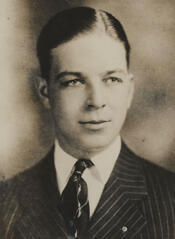
Here you will find contact information for Representative Paul John Kvale, including email address, phone number, and mailing address.
| Name | Paul John Kvale |
| Position | Representative |
| State | Minnesota |
| District | 7 |
| Party | Farmer-Labor |
| Status | Former Representative |
| Term Start | April 15, 1929 |
| Term End | January 3, 1939 |
| Terms Served | 5 |
| Born | March 27, 1896 |
| Gender | Male |
| Bioguide ID | K000350 |
About Representative Paul John Kvale
Paul John Kvale (March 27, 1896 – June 14, 1960) was a U.S. Representative from Minnesota and a member of the Farmer-Labor Party who served five terms in the United States Congress from 1929 to 1939. He was born in Orfordville, Rock County, Wisconsin, the son of Ole J. Kvale, who would himself later serve in Congress. Kvale attended the public schools in Orfordville and pursued further studies at the University of Illinois. In 1917 he moved with his parents to Benson, Swift County, Minnesota, a relocation that would anchor his later professional and political life in that state.
Kvale completed his undergraduate education at Luther College in Decorah, Iowa, graduating in 1917. Shortly thereafter, during the First World War, he entered military service in the United States Army. From September 7, 1917, to August 4, 1919, he served as a sergeant in a machine gun corps, participating in the American war effort in Europe. Following his discharge, Kvale continued his education at the University of Minnesota in Minneapolis, where he studied during 1919 and 1920, further broadening his academic background before turning to journalism and public service.
After leaving the University of Minnesota, Kvale embarked on a career in the newspaper field. Returning to Benson, he became editor of the Swift County News in 1920 and 1921, gaining experience in local affairs and public opinion. In 1921 he moved back to Minneapolis to join the staff of the Minneapolis Tribune as a staff editor, a position that placed him in a major urban newsroom and deepened his engagement with state and national issues. His work in journalism helped establish his reputation as an informed observer of politics and public policy.
Kvale’s direct involvement in national politics began through his association with his father. From 1922 to 1929 he served as secretary to his father, Ole J. Kvale, who was then a member of the United States House of Representatives from Minnesota. In this capacity, he gained practical experience in legislative procedure, constituent service, and the daily operations of a congressional office. This apprenticeship in Washington, D.C., positioned him to assume greater responsibilities when circumstances changed.
Following the death of his father in 1929, Paul John Kvale was elected as a Farmer-Labor candidate to the Seventy-first Congress to fill the resulting vacancy. He took his seat on October 16, 1929, representing Minnesota in the House of Representatives. Kvale was subsequently re-elected to the Seventy-second, Seventy-third, Seventy-fourth, and Seventy-fifth Congresses, serving continuously until January 3, 1939. His decade in Congress coincided with a significant period in American history, encompassing the onset of the Great Depression and the New Deal era. As a member of the Farmer-Labor Party, he participated in the legislative process and represented the interests of his Minnesota constituents, particularly those concerned with agricultural and labor issues, during a time of economic hardship and political realignment.
Kvale’s attempt to secure another term in the House was not successful; he was an unsuccessful candidate for re-election in 1938 to the Seventy-sixth Congress. His congressional service thus concluded at the start of 1939, after five full terms in office. Although he left elective office, his decade-long tenure reflected the influence of third-party politics in Minnesota and the broader Upper Midwest during the interwar period, and his work contributed to the representation of Farmer-Labor perspectives in national debates.
In later years, Kvale resided in Minnesota, maintaining his ties to the communities that had shaped his early life and political career. He died in Minneapolis, Minnesota, on June 14, 1960. He was interred in the Protestant Cemetery in Swift County, Minnesota, underscoring his enduring connection to the Benson area where his family had settled in 1917. Known for the distinctive pronunciation of his surname, Kvale once explained to The Literary Digest that it was “pronounced qually, rhymes with golly,” a small but enduring detail that has accompanied accounts of his life and service.