Senator Paul S. Trible Jr.
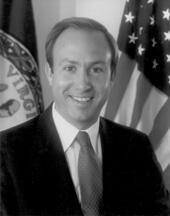
Here you will find contact information for Senator Paul S. Trible Jr., including email address, phone number, and mailing address.
| Name | Paul S. Trible Jr. |
| Position | Senator |
| State | Virginia |
| Party | Republican |
| Status | Former Representative |
| Term Start | January 4, 1977 |
| Term End | January 3, 1989 |
| Terms Served | 6 |
| Born | December 29, 1946 |
| Gender | Male |
| Bioguide ID | T000367 |
About Senator Paul S. Trible Jr.
Paul Seward Trible Jr. (born December 29, 1946) is an American attorney, politician, and academic administrator who served in both houses of the United States Congress and later became a prominent university president. A member of the Republican Party, he represented Virginia in the U.S. House of Representatives for three terms and the U.S. Senate for one, and he was the first Republican Class I Senator from Virginia. Paul Seward Trible served as a Senator from Virginia in the United States Congress from 1977 to 1989, a period marked by significant political and economic change in the United States, during which he contributed to the legislative process over four terms in office when his House and Senate service are considered together.
Trible was born in Virginia on December 29, 1946, and came of age during the post–World War II era, a time of rapid growth and transformation in the Commonwealth. Details of his early life reflect the trajectory of a young man preparing for public service in law and politics, and he developed an early interest in government and civic affairs that would later shape his professional path. Growing up in Virginia, he was exposed to the evolving political landscape of the South during the civil rights era and the realignment of party politics, experiences that informed his later alignment with the Republican Party.
Pursuing higher education with an eye toward a legal and political career, Trible studied at institutions that prepared him for the practice of law and public service. He completed his formal education in law, gaining the professional training that enabled him to enter the legal profession as an attorney. His legal education provided a foundation in constitutional law, statutory interpretation, and public policy, skills that would prove central to his later work as a legislator and as an academic administrator.
Before entering Congress, Trible established himself as an attorney in Virginia, building a professional reputation that helped launch his political career. His work as a lawyer brought him into contact with issues of public concern and the workings of state and local government, and he became active in Republican politics as the party was gaining strength in Virginia. This combination of legal expertise and political engagement positioned him to seek federal office and to represent his constituents on national issues.
Trible was elected to the U.S. House of Representatives as a Republican from Virginia and served three terms, participating in the legislative process during a period of shifting national priorities in the late 1970s and early 1980s. In the House, he represented the interests of his constituents while engaging with broader national debates over economic policy, federal spending, and the role of government. His service in the House formed the first part of what would be four terms in Congress overall, and it established his profile as a rising Republican figure from Virginia.
Building on his House experience, Trible successfully sought election to the United States Senate, where he served as a Senator from Virginia in the United States Congress from 1977 to 1989. As a member of the Senate, Paul Seward Trible participated in the democratic process and represented the interests of constituents during a significant period in American history, encompassing the end of the 1970s, the Reagan administration, and the late Cold War. As the first Republican Class I Senator from Virginia, he held a pioneering role in the state’s partisan realignment, and he contributed to the legislative process on matters of national defense, economic policy, and federal governance consistent with his party’s priorities and the concerns of Virginians.
After concluding his congressional service, Trible transitioned from elective office to academic leadership, bringing his experience in law and government to higher education. In 1996 he became president of Christopher Newport University in Newport News, Virginia, assuming responsibility for guiding the institution’s growth and development. Over the course of his long tenure, from 1996 until his retirement in 2022, he oversaw significant expansion in the university’s academic programs, physical campus, and public profile, helping to transform Christopher Newport into a more comprehensive and competitive public university. His later career as an academic administrator extended his record of public service beyond Congress and into the realm of education and civic leadership in Virginia.